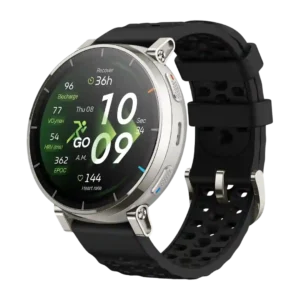
- Worse: heart rate and SpO2 precision The Forerunner 965 tested as more precise than the Suunto Race for heart rate and pulse oximeter comparisons.
- Alternative: multi-day events and solar charging Suunto Race is named as an alternative for buyers needing longer event battery or solar-related priorities.
- Alternative: AMOLED battery life Suunto Race is suggested for shoppers prioritizing much longer AMOLED battery life.
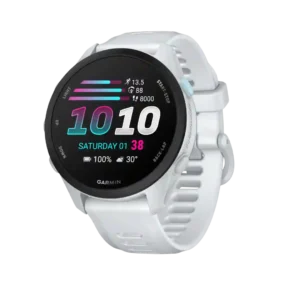
Garmin Forerunner 965 Review
Bottom Line
Choose the Garmin Forerunner 965 for accurate GPS, vivid AMOLED maps, strong battery life, and deep training tools. Skip it if you need LTE, ECG, richer apps, tougher durability, or multi-day ultra battery.
Best for serious runners, triathletes, trail users, and data-driven athletes who want accurate GPS, full maps, long battery life, and deep readiness or recovery guidance in a lighter watch.
Not for casual users who only need basic activity tracking, or buyers who prioritize LTE, ECG, voice assistants, richer apps, wireless charging, sapphire-level durability, or multi-day ultra battery.
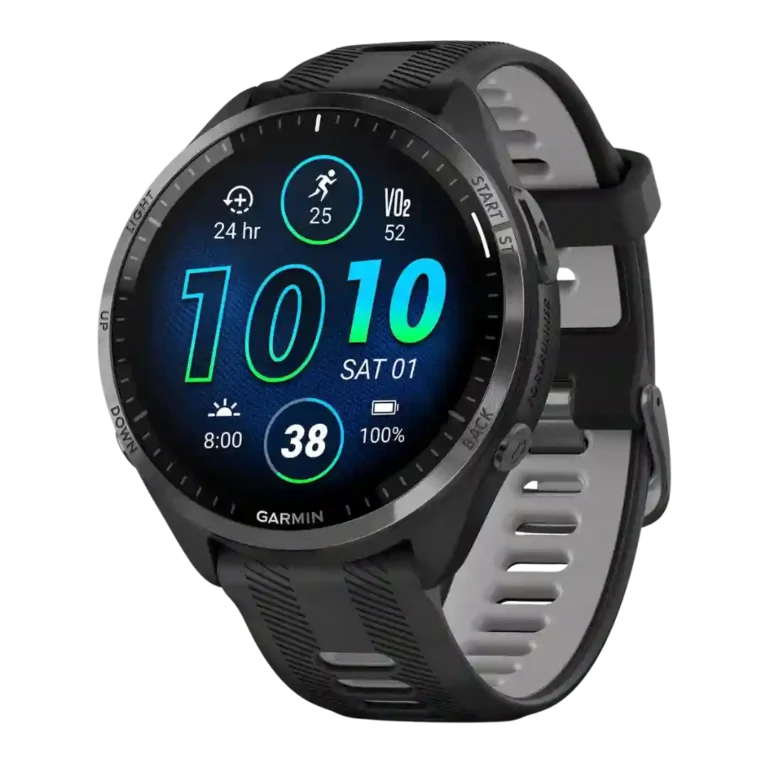
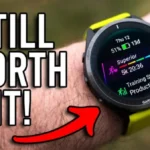
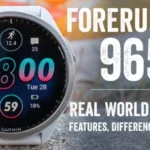
The Garmin Forerunner 965 lands as a premium endurance watch built around superb GPS accuracy, a vivid AMOLED display, detailed mapping, and unusually deep training and recovery metrics. Reviewers repeatedly praise its battery life for an AMOLED watch, comfortable lighter build, button controls, and broad sport tracking. The tradeoff is that it remains more sports computer than full smartwatch: LTE, ECG, voice assistant hardware, wireless charging, and richer app interactions are missing, while Garmin Pay and music features can feel limited. Durability is another caveat, with several reviewers noting scratches or preferring tougher sapphire-equipped alternatives. It makes the most sense for serious runners, triathletes, hikers, and data-driven athletes who value maps and training guidance over phone-like smart features.
Compared in Reviews
Products reviewers directly compared with this model, grouped into quick takeaways.
- Worse: mapping features The Forerunner 965 is distinguished from the Forerunner 265 by its deeper mapping capabilities.
- More expensive: value for most buyers Wareable says many shoppers may save money by choosing the Forerunner 265 instead.
- Alternative: smartwatch features Apple Watch Ultra is positioned as an option for buyers wanting more smartwatch capability.
Feature Scorecards
Pros
-
Mapping and navigation are standout strengths, with full maps, turn-by-turn directions, route following, Next Fork, and AMOLED-enhanced map detail.
-
The AMOLED display is one of the most praised upgrades, with reviewers highlighting crisp resolution, color, legibility, map detail, and a more modern feel.
-
Watch faces benefit from AMOLED color and customization, with reviewers praising the stock faces and Connect IQ options.
-
GPS accuracy is one of the strongest points, with repeated praise for multi-band/SatIQ reliability, precise tracks, quick lock-on, and low distance error.
-
Customization is a clear strength, with extensive control over watch faces, data screens, sport profiles, widgets, and settings from the watch or app.
-
Workout variety is extensive, with running, cycling, swimming, triathlon, gym, yoga, hiking, golf, and many sport profiles or metrics.
-
Fitness tracking is very strong, with reviewers praising distance, pace, activity data, and sensor consistency across workouts.
-
Water resistance is strong for workouts, swimming, showering, and wet use, with reviews noting 5ATM or 50-meter protection.
-
The five-button Garmin layout is a major strength, especially during workouts, because nearly every function can be handled without relying on touch.
-
Pairing and syncing are reliable, with quick phone pairing, seamless Strava syncing, and dependable activity uploads.
-
Wellness insights are broad and useful, especially Body Battery, readiness, sleep, stress, HRV, and daily health context.
-
Style and design receive strong praise for the slim, modern AMOLED look, titanium accents, and a more premium everyday appearance.
-
Health tracking is data-rich and generally reliable, combining heart rate, HRV, blood oxygen, stress, sleep, Body Battery, and related metrics.
-
Reviewers consistently praise the AMOLED screen as bright enough for quick glances, direct sunlight, and varied lighting conditions.
-
Reliability is strong across testing, with reviewers describing stable SatIQ/GPS behavior and dependable performance over heavy use.
-
The AMOLED-era interface is clearer, smoother, and more colorful, while still retaining Garmin’s dense data-first structure.
-
Step counting is supported and measured well in one lab-style review, while other reviewers appreciate live step visibility and basic activity tracking.
-
Outdoor visibility is strong for an AMOLED watch, with reviewers reporting good readability in sunlight and bright outdoor conditions.
-
Coaching tools are a major strength, including suggested workouts, training plans, interval tools, Garmin Coach, race guidance, and structured workout support.
-
Recovery insights are a core strength, especially Training Readiness, HRV Status, Body Battery, Acute Load, Chronic Load, and load-ratio guidance.
-
Software smoothness is generally good, with smoother UI and updates praised, though Garmin’s broader smart-app polish remains imperfect.
-
Heart rate accuracy is broadly strong and often close to straps or medical devices, though several reviewers note lag or limitations during high-intensity intervals.
-
Onboard music storage is a solid smart feature, with Spotify, Deezer, Amazon Music, MP3 or podcast support and enough storage for music plus maps.
-
Materials quality is mixed-positive: reviewers like the titanium bezel, silicone strap, and Gorilla Glass, but some still prefer sapphire for durability.
-
Battery life is widely praised for an AMOLED sports watch, usually landing around a week with always-on use and much longer in gesture or smartwatch modes, but ultra and multi-day users see limits.
-
Comfort is generally strong thanks to the light, slim design, though bulk can still be noticeable for smaller wrists or sleep tracking.
-
Menu navigation is generally approachable for Garmin users, with button and touchscreen options, though some newcomers may find the system dense.
-
Build quality is framed as performance-focused rather than rugged, with the watch feeling purpose-built for running and training.
-
Fit is positive for clothing and activity use, with one review noting the slim profile avoids issues with gloves or jackets.
-
The Forerunner 965 supports Pulse Ox or blood oxygen readings, and reviewers treat it as part of a broad health-sensor suite rather than a headline differentiator.
-
Bluetooth and ANT+ support are useful for headphones, sensors, accessories, and heart-rate broadcasting, with reviewers repeatedly noting broad connectivity.
-
Reviewers generally like the silicone straps and removable bands, with praise for comfort and style, though one notes the silicone band needs drying after workouts.
-
Charging speed is generally good, with several reviews describing roughly one hour to major recharge levels or fast percentage gains.
-
Safety features include Find My Phone/Watch, wrong-direction or course alerts, fall or security features, and location sharing through LiveTrack.
-
Third-party support is useful through Connect IQ, Strava, Komoot, and integrations, but the app ecosystem lacks the polish and breadth of larger smartwatch platforms.
-
Touchscreen support is useful for maps and daily navigation, though many reviewers prefer disabling it during workouts and using buttons instead.
-
Stress tracking is part of Garmin’s broader readiness and wellness stack, useful for recovery context but not always used heavily by reviewers.
-
The watch works across iPhone, Android, and Apple Health workflows, although some functions are more capable on Android.
-
Smartwatch features are useful but secondary, with notifications, music, Garmin Pay, weather, and calls in some contexts but fewer smart extras than Apple or Wear OS.
-
Wi-Fi is useful for map downloads, updates, and faster transfers, although it is not a major review focus.
-
Music support is useful for controls and offline playback, but reviewers note the experience can be basic or occasionally glitchy.
-
Value depends on the buyer: serious athletes get premium mapping and training tools, but casual users or 955 owners may not justify the price.
-
Garmin Connect receives mixed but mostly positive feedback: reviewers praise data depth and access, while some find route creation or organization clunky.
-
Garmin offers Connect IQ apps and widgets, but reviewers describe the app store as useful yet less polished and less broad than major smartwatch ecosystems.
-
Garmin Pay is present and useful where supported, but reviewers note banking support can be weak depending on region.
-
Notifications are readable and customizable, but interaction is limited, especially on iOS and compared with fuller smartwatches.
-
The Garmin operating system is sports-first: smooth and functional on the watch, but still basic compared with Apple or Wear OS smartwatches.
-
Sleep tracking is mixed: some reviewers find it excellent or improved, while others say phases or scores can feel off.
Cons
-
Charging is mixed because USB-C on the cable helps, but reviewers still criticize Garmin’s proprietary four-pin connection, weak cord attachment, and lack of wireless charging.
-
Durability is the most repeated physical caveat: multiple reviewers report scratches or worry about Gorilla Glass compared with more rugged sapphire models.
-
Calorie-related usefulness is limited: one reviewer uses calorie alerts for fueling, while another says Garmin is weak for diet and calorie tracking.
-
Call handling is mixed: some reviews mention answering or taking calls, while others criticize the lack of speaker and microphone features found on more smartwatch-focused models.
-
Size options are limited because the Forerunner 965 comes in one large-ish size, which can be a drawback for smaller wrists.
-
Exercise auto-detection is a weakness because one review says it does not work well enough for training, so users need to start workouts manually.
-
Voice assistant quality is poor because the watch lacks the speaker, microphone, and voice-assistant features found on some alternatives.
-
The Forerunner 965 lacks ECG hardware, a repeated limitation compared with Garmin’s Venu line and newer or more smartwatch-oriented alternatives.
-
LTE is absent, and reviewers call this out as a smart-feature limitation compared with a few Garmin or smartwatch alternatives.
Compared With Category Average
Compared with other Smart Watch, this product is above average in onboard music storage, mapping and navigation, contactless payments, below average in activity auto-detection, ECG functionality, voice assistant quality.
| Attribute | This product | Category average | Difference |
|---|---|---|---|
| activity auto-detection | 1.8 | 3.8 | -2.0 |
| onboard music storage | 4.4 | 2.8 | +1.5 |
| ECG functionality | 1.0 | 2.3 | -1.3 |
| mapping and navigation | 4.7 | 3.6 | +1.1 |
| voice assistant quality | 1.4 | 2.7 | -1.2 |
| contactless payments | 3.9 | 2.8 | +1.0 |
| durability | 3.2 | 4.2 | -1.0 |
| GPS accuracy | 4.7 | 4.0 | +0.7 |
FAQ
Is the Garmin Forerunner 965 GPS accurate?
Yes. Reviewers repeatedly describe the GPS as highly accurate, stable, or best-in-class, with strong performance from multi-band and SatIQ modes.
How is the battery life in real use?
Reviews generally find it strong for an AMOLED watch, often around six to eight days with always-on use and much longer in less demanding modes. The main limitation is very long ultra or multi-day events.
Is the AMOLED display worth it?
Most reviewers say the display is a major upgrade because it is bright, crisp, colorful, and especially helpful for maps, data screens, and quick glances.
Does it have full smartwatch features?
Only partly. It supports notifications, Garmin Pay, music, weather, and some call-related functions, but reviewers note no LTE, no ECG, no voice assistant, and weaker app polish than Apple or Wear OS.
Is it good for mapping and navigation?
Yes. Mapping is one of the strongest reasons to choose it, with detailed maps, route following, turn-by-turn guidance, and AMOLED-enhanced readability.
How reliable is sleep and recovery tracking?
Recovery tools such as Training Readiness, HRV, Acute Load, and Body Battery are widely valued. Sleep tracking is more mixed, with some reviewers praising improvements and others finding stages or scores off.
Consider This Instead
If you want better ECG functionality
Choose Apple Watch Series 11. It scores 4.5 vs 1.0 for ECG functionality, with a 4.2 overall score.
If you want better activity auto-detection
Choose Samsung Galaxy Watch 6. It scores 4.8 vs 1.8 for activity auto-detection, with a 4.3 overall score.
If you want better size options
Choose Garmin Approach S70. It scores 4.7 vs 2.4 for size options, with a 4.3 overall score.
If you want better call handling
Choose Apple Watch Series 10. It scores 4.6 vs 2.7 for call handling, with a 4.2 overall score.
Overall Top Smart Watch Alternatives
Good if you want the most rugged Apple Watch, brighter outdoor screen, better battery, LTE, and top apps. Skip it if you need Garmin-like mapping, recovery analytics, smaller sizing, or...
Pros: display quality, heart rate accuracy
Cons: cross-platform compatibility, recovery insights
Choose the Galaxy Watch 6 for a polished Android smartwatch with a bright screen, strong apps, and broad health tracking. Skip it if battery life, iPhone support, or full non-Samsung...
Pros: outdoor visibility, workout tracking variety
Cons: cross-platform compatibility, battery life
Good if you need a rugged Garmin with deep outdoor, tactical, GPS, training, and battery features. Skip it if you want a cheaper lifestyle watch or do not need the...
Pros: materials quality, durability
Cons: LTE connectivity, value for money
Good if you want premium golf maps, virtual caddie tools, health metrics, music, notifications, and long battery life in one watch. Skip it if you only need basic yardages or...
Pros: pairing reliability, brightness
Cons: software smoothness, user interface