Auto-detection works for common activities, but reliability varies widely; some reviews found it useful, while others called it flaky, overly limited, or prone to false detections.
Multiple reviews explicitly note that the watch does not auto-detect workouts, so activities usually need to be started manually.
The broader app ecosystem is strong thanks to links with Apple Health, Google services, Strava, MyFitnessPal, and other connected platforms.
The Connect IQ ecosystem adds watch faces and widgets, giving the watch a broader customization and app layer than a closed platform.
Band quality is inconsistent: one review likes the stock strap, but others found it itchy, slippery, or awkward to size.
Reviewers describe the silicone band as easy to clean, flexible, and more comfortable than stiffer sport bands.
Battery life is a major selling point. Real-world reports range from roughly two to three weeks up to about a month or more, depending on settings and usage.
Battery life is strong for everyday training, but several reviewers say it trails longer-lasting Garmin alternatives and can be limiting for ultras.
Blood-oxygen support is valuable but not flawless; reviewers describe useful SpO2 coverage and generally in-line readings, though wrist placement and motion can still cause inconclusive results.
Blood oxygen tracking is available as Pulse Ox or blood oxygen measurement, though reviewers focused more on feature presence than deep validation.
Bluetooth connection quality is acceptable but not perfect: pairing can feel fast, yet some review evidence points to phone dependence and sync-related friction.
Bluetooth connectivity appears dependable for phone syncing and audio accessories, with reviewers noting smooth pairing behavior.
Brightness gets only limited direct coverage, but one review says the newer display seems brighter than before.
The AMOLED screen is widely praised for its brightness and vividness, making the watch feel more modern than older MIP models.
Build quality is a strong point, with repeated praise for the premium feel, solid finishing, and well-made case.
The watch feels very light, but some reviewers say the plastic build gives it a cheaper impression than pricier Garmin models.
The single crown/button system is generally well executed, with reviewers praising easy navigation once learned and good tactile feedback.
Physical controls are a strength, with reviewers highlighting clear button layout, useful shortcuts, and easier operation during workouts.
Call handling is minimal. The watch can surface incoming-call alerts, but reviewers consistently note that you cannot meaningfully handle calls from the wrist.
Call handling is limited: some phone-linked accept or reject functions are available, but full on-watch calling is not.
Calorie tracking is present, but the only direct review evidence says the estimates lean pessimistic rather than generous.
Charging convenience is improved but still mixed: several reviewers like the secure cradle or clamp, while others find it fiddly or less elegant than magnetic charging.
Charging is straightforward with USB-C, but there is no wireless charging, no wall plug in the box, and convenience is not class-leading.
Charging speed is consistently respectable in the reviews, with most reporting a full charge in roughly 90 minutes to two hours.
Charging speed is generally good, with reviewers noting roughly hour-long fills or meaningful short top-ups before workouts.
Coaching exists mostly through the app and subscription layer, offering guidance, workouts, or nudges to move more, but some reviewers did not find the extra paid coaching compelling.
Coaching features are a major draw, including Garmin Coach plans, structured workouts, daily suggestions, and audio prompts.
Comfort is usually very good for all-day wear, though it depends on size and personal preference, and a few reviewers found it less comfortable for sleep or certain wrists.
Comfort is a standout, with repeated praise for the low weight, soft band, and easy all-day wear.
Companion app quality is mixed. Some reviewers like the detailed analysis and easy navigation, while others complain about glitches, busy layouts, or weak interpretation of the data.
Companion app impressions are mixed: Garmin Connect is powerful and data-rich, but some reviewers still find it less intuitive than rivals.
Contactless payments are a clear omission, and multiple reviews call out the lack of any pay-from-your-wrist option.
Garmin Pay works well when supported by the user’s bank, though one reviewer cautioned that bank compatibility can make the feature hit or miss.
Cross-platform support is a plus, with review evidence explicitly mentioning Android and iPhone compatibility.
The watch works with both iPhone and Android phones, giving it solid cross-platform support.
Customization is decent around menus, screens, straps, and colors, but not especially deep, and at least one reviewer wanted more control.
Customization is extensive across shortcuts, watch faces, widgets, data screens, and other settings.
Display quality is better than expected for such a small screen, with many reviews calling it sharp or readable, though the limited size still constrains usability.
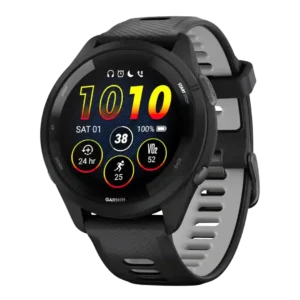
Display quality is one of the Forerunner 265’s clearest strengths thanks to its sharp, colorful, high-contrast AMOLED panel.
Durability is one of the clearer strengths, with reviewers highlighting scratch resistance, sapphire protection, and good cosmetic toughness over time.
Durability is mixed in the reviews: one reviewer worried about scratches and dents, while another reported very little wear after weeks of use.
ECG is a standout feature, repeatedly described as medical-grade, easy to run, and useful for sharing heart-rhythm information with a doctor.
ECG is not supported on this model because the necessary ECG hardware is absent.
Fit can be tricky depending on wrist size and strap setup, with some users finding the larger case or included band less than ideal.
Fit is generally praised as close, light, and easy to wear, without feeling overly bulky on the wrist.
For basic fitness tracking, reviewers generally found the watch dependable for everyday activity, with several saying pace, distance, steps, or overall workout data were reasonably solid.
Overall fitness tracking accuracy is rated highly, with reviewers describing the watch as dependable across many activity types.
GPS is a compromise: the watch often depends on a phone, and route accuracy can vary, though one review still found connected GPS better than many other watches using the same approach.
GPS accuracy is consistently one of the watch’s best-reviewed areas, with multiple reviewers calling it excellent or extremely accurate.
General health tracking reads as broadly useful, with one reviewer saying daytime data looked representative and another saying the core monitoring seemed accurate most of the time.
Broad health tracking accuracy is viewed positively, especially for body metrics, sleep-related monitoring, and recovery-oriented data.
Heart-rate accuracy is mixed: some reviews found readings spot-on or close to reference devices, while others saw elevated daytime numbers or occasional workout errors.
Heart rate accuracy is strong by wrist-based standards, with several reviewers comparing it favorably to chest straps or other trusted devices.
LTE connectivity is not available, so the watch cannot serve as a phone-free cellular device.
Materials quality comes through in the use of sapphire glass, steel, and other premium finishes that make the watch feel upscale.
Materials feel functional rather than premium, with plastic components and Gorilla Glass instead of more upscale case materials.
Menu navigation is functional but mixed overall: some reviewers adjusted quickly, while others found scrolling and backtracking clunky or fiddly.
Menu navigation is flexible thanks to the five-button layout plus touchscreen input, though it still leans toward a sports-watch style UI.
Music control support is absent in the review coverage, which several reviewers flag as a limitation versus full smartwatches.
Music controls are easy to access during workouts and make it simple to skip tracks or adjust volume from the watch.
Onboard or offline music features are not part of the package according to the review evidence.
Onboard music storage is strong, with offline playback support and no need to buy a separate music-specific version.
The operating experience is simple and crown-driven, which some reviewers appreciate, though others find it less intuitive than a standard smartwatch.
Outdoor visibility is mixed: some reviews say the screen is easy to read in all conditions, while another found it harder to see in bright light.
Outdoor visibility is generally good for an AMOLED watch, though a few reviewers still note bright-sun or sunglasses-related caveats.
Pairing is generally easy, with reviewers describing setup as straightforward and, in one case, nearly instant.
Pairing and syncing behavior appears reliable, with reviewers noting quick syncing and easy earbud connections.
Recovery insight is a real strength when temperature and HRV are used well, with reviews pointing to recovery-status feedback, workout heat warnings, and post-workout recovery cues.
Recovery insights are a major strength, especially through Training Readiness and related readiness or recovery metrics.
General reliability is uneven in the review evidence, with mentions of missed notifications, duplicate workouts, and other inconsistent behavior.
Safety-related health features are a genuine strength, with reviewers highlighting ECG-based AFib checks, sleep-apnea or breathing alerts, and temperature warnings for overheating or illness.
Safety features include incident detection, LiveTrack, or alert-based assistance tools that add reassurance for training.
With both small and larger case options available, size choice is a useful part of the product’s appeal.
Two case sizes make it easier to fit different wrists, and several reviewers appreciated the smaller option.
Sleep tracking is one of the most divisive areas, with some reviewers finding results similar to Oura or Ultrahuman and others reporting missed sleep, awake/sleep confusion, or overly generous scores.
Sleep tracking gets mixed marks: sleep and wake timing are often solid, but sleep stage scoring can be inconsistent.
Notifications are intentionally basic: enough for quick triage, but widely criticized for cramped scrolling text, inconsistent delivery, and limited usefulness for anything long.
Smartphone notifications are well supported for alerts, texts, emails, and other phone-linked updates.
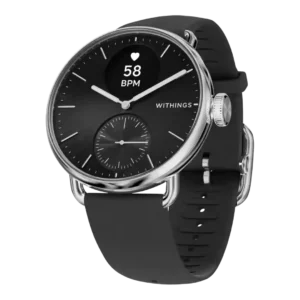
As a smartwatch, the ScanWatch 2 stays intentionally light, offering only basic watch-side tools and notifications instead of the richer feature set found on full smartwatches.
Smartwatch features are useful but limited, with solid basics like notifications, music, and payments but fewer lifestyle extras than true smartwatches.
Software polish is a weak spot in the review evidence, with the app described as decent but not consistently smooth or coherent.
Software smoothness is acceptable, but some reviewers noticed occasional stutter and less polish than Apple or Samsung interfaces.
Step counting is mostly good but not universally consistent, with some reviewers calling it precise and others seeing varying counts or small gaps versus Garmin and Oura.
Stress support is limited and somewhat indirect: one review credits temperature and HRV trends with insight into body stress levels, while another notes the platform lacks dedicated stress features.
Stress tracking is built into the wellness stack and is used meaningfully in readiness and recovery features.
Style is arguably the watch’s biggest advantage, with review after review praising the elegant analog look and understated design.
The design is sporty and generally liked, but it still looks more like a training watch than an all-occasion fashion watch.
Third-party app support on the watch itself is essentially absent in the review coverage.
Third-party support is strong, with integrations and compatibility mentioned for apps and services like Strava, TrainingPeaks, and Spotify.
There is no touchscreen, so responsiveness is a non-factor; all interaction runs through the crown and button input instead.
Touch responsiveness is praised, including in sweaty or rainy conditions, while still remaining optional for workouts.
The interface is deliberately pared back and concise, which helps readability, though it also limits how much can be done on the watch itself.
The interface is mostly intuitive once set up, though first-time Garmin users may face a learning curve during initial configuration.
Value for money is the main downside in the review set, as several reviewers question the premium price given the limited smart features and strong competition.
Value for money is good for serious runners because the feature set is strong, but several reviewers still flag the price as high.
Voice assistant support is effectively absent, with reviewers specifically noting there is no smart assistant or on-watch voice helper.
The watch face earns praise for looking like a real, high-quality analog timepiece rather than a typical gadget-first smartwatch.
Watch face quality is strong thanks to attractive stock faces and additional Connect IQ options.
Water resistance is confidently rated for everyday exposure and swimming, with multiple reviews explicitly calling out 5ATM or pool-safe use.
Water resistance is reassuring for showers, pools, and general wet use, and reviewers reported no issues with routine exposure.
Wellness insight is one of the device’s main appeals, with reviews praising its broad health focus, discreet tracking, and useful wellness readouts more than hardcore training features.
Wellness insights are a clear selling point, especially through Morning Report, Body Battery, and other day-to-day readiness tools.
Wi-Fi is available for syncing and ecosystem functions, though reviewers rarely focused on it as a differentiating strength.
Workout coverage is broad on paper, but the experience stays basic; reviewers mention 30 to almost 50 modes, yet note missing workout types and limited depth for athletes.
Workout tracking variety is broad, with dozens of sport modes and strong support for running, triathlon, gym, and outdoor activities.