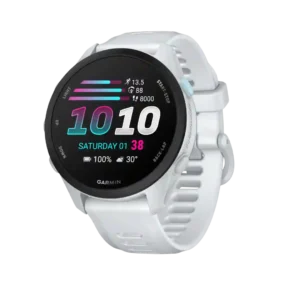
- Cheaper: value and display tradeoff The reviewer says the Forerunner 255 is a better bargain if AMOLED is not important.
- Compared: AMOLED and software upgrade The reviewer frames the Forerunner 265 as an AMOLED-style successor to the Forerunner 255.
- Better: battery life The Forerunner 265 sacrifices battery life compared with the Forerunner 255.
Garmin Forerunner 265 Review
Bottom Line
Choose the Garmin Forerunner 265 for accurate run tracking, a vivid AMOLED screen, recovery guidance, and long everyday battery life. Skip it if you need full maps, LTE/calls, ECG, or ultra-distance GPS endurance.
Best for runners and multisport athletes who want accurate GPS and heart-rate tracking, recovery guidance, suggested workouts, onboard music, and a bright AMOLED display without moving to a higher Garmin tier.
Not for buyers who mainly want phone-replacement smartwatch features, full-color maps, LTE, ECG, voice controls, premium metal materials, or the longest possible GPS battery life for ultra-distance use.
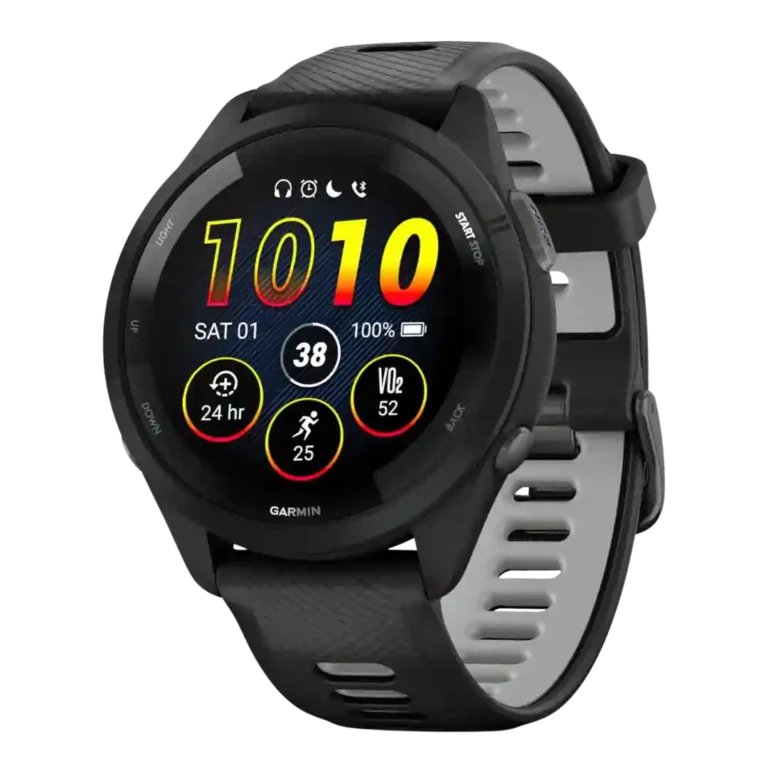
Across the reviews, the Forerunner 265 lands as a runner-first watch with unusually broad appeal. Reviewers repeatedly praise its crisp AMOLED screen, excellent GPS and heart-rate accuracy, strong workout variety, useful Training Readiness and recovery guidance, onboard music, and battery life that is impressive for an AMOLED model. The tradeoff is that the brighter screen and richer interface cost more money and some battery versus older MIP Forerunners, while smartwatch extras remain limited. Calling, LTE, ECG, voice-assistant use, and full mapping are either absent or weak compared with lifestyle watches or higher Garmin models. It is strongest as a training tool, not a phone replacement or serious backcountry navigation watch.
Compared in Reviews
Products reviewers directly compared with this model, grouped into quick takeaways.
- Better: hardware, bezel, and battery The Forerunner 965 is described as a larger, more premium hardware upgrade.
- Better: training load metrics The Forerunner 965 adds Training Load Ratio and Chronic Load that the 265 lacks.
- Better: mapping and routing The Forerunner 965 is cited as a better pick for mapping and routing.
- More expensive: runner-focused smartwatch alternative The reviewer describes the 265 line as a lower-cost alternative to the Apple Watch Ultra for runners.
Feature Scorecards
Pros
-
GPS accuracy is a major consensus strength, with repeated praise for fast locks, multiband accuracy, and highly reliable tracks.
-
Brightness is a major strength; reviewers repeatedly praise the AMOLED screen as bright and easy to read.
-
Heart rate accuracy is one of the strongest areas, with many reviewers comparing it favorably to straps or other reliable sensors.
-
Onboard music storage is a strong feature because offline music is now standard and supports services like Spotify, Amazon Music, Deezer, and podcasts.
-
Display quality is one of the product's strongest attributes, with reviewers repeatedly praising the sharp, colorful AMOLED screen.
-
Fitness tracking accuracy is excellent overall, with reviewers praising activity data, running dynamics, and sports tracking accuracy.
-
Coaching features are a standout, led by suggested workouts, race guidance, Training Readiness, and training feedback that help runners manage effort.
-
Customization is one of the clearest strengths, spanning watch faces, data screens, shortcuts, activity layouts, widgets, and straps.
-
Recovery insights are a major strength, especially Training Readiness, Body Battery, morning reports, sleep, HRV, stress, and training-load context.
-
Charging speed is a clear positive, with multiple reviewers reporting roughly an hour or less for major top-ups or full charges.
-
Water resistance is strong in the reviewed evidence, with shower, pool, submersion, and 5 ATM/50-meter references.
-
Bluetooth support is reliable in the reviewed evidence, covering sensor broadcasting and earbud pairing for phone-free music.
-
Menu navigation is generally strong, especially through activity folders and full button control, although Garmin's depth can be complex.
-
Pairing reliability is positive in the reviewed evidence, with easy phone pairing and quick syncing to connected services.
-
Workout tracking variety is very strong, with reviewers citing dozens of sport profiles, running modes, triathlon, swimming, cycling, yoga, HIIT, and strength options.
-
Touchscreen responsiveness is widely praised and works as an optional control layer alongside buttons.
-
The Garmin ecosystem is a strength for data-heavy users, with deep sports analysis, Garmin Connect, Connect IQ, and broad fitness-data tools.
-
Wellness insights are a strength, especially Body Battery, morning reports, HRV, stress, sleep, and readiness-style guidance.
-
Size options are a clear strength because reviewers highlight the 42mm/265S and 46mm choices for different wrists.
-
Health tracking accuracy is strong overall for heart rate, sleep, body metrics, and wellness data, but tattoos caused problems for one reviewer.
-
Comfort is broadly praised thanks to the lightweight case, soft silicone band, and suitability for workouts and sleep, although not every reviewer found it ideal all day.
-
Watch face quality is strong, with reviewers praising AMOLED watch faces, customization, and Connect IQ options.
-
Music controls work well, with reviewers noting shortcut access and the ability to adjust playback during workouts.
-
Button controls are a core usability strength, especially during workouts, rain, sweat, or glove use, though one reviewer found five buttons confusing at first.
-
Outdoor visibility is mostly strong thanks to the bright AMOLED display, though one reviewer had trouble in bright sun and another noted polarized sunglasses could interfere.
-
Fit is generally positive, especially with two sizes and a close-to-wrist shape, though one reviewer disliked the larger fit on some wrists.
-
Style and design are mostly positive due to the AMOLED screen and cleaner look, but reviewers still see it as sporty rather than dressy.
-
Battery life is strong for an AMOLED watch, often lasting about a week to two weeks in regular use, but GPS-heavy ultra runners may still want more.
-
Blood oxygen tracking is present through Garmin's Pulse Ox or SpO2 readings and is repeatedly listed among the watch's health metrics.
-
Stress tracking is useful and appears in Body Battery, Training Readiness, breathing guidance, and daily wellness context.
-
The user interface is mostly intuitive and data-rich, but setup and Garmin's many options can feel complicated at first.
-
Step counting is present and supported as part of the daily tracking suite, though reviewers provide less direct accuracy testing than for GPS or heart rate.
-
Operating system experience is positive but based on limited evidence, with the AMOLED-era interface described as revamped to match Garmin's higher-end style.
-
Companion app quality is strong for analysis and syncing, but some reviewers describe Garmin Connect as dense, overwhelming, or not always intuitive.
-
Cross-platform compatibility is good with iPhone and Android pairing, but iOS users lose reply functionality and Apple Music support is absent.
-
Sleep tracking is useful and often aligned with expectations, but reviewers disagree on sleep-stage and sleep-score accuracy.
-
Software smoothness is generally good, though one reviewer noticed occasional stutter and Garmin's complexity remains part of the experience.
-
Calorie tracking appears as part of the workout and activity data screens, but reviewers discuss it as one metric among many rather than a standout feature.
-
Third-party app support is good for fitness integrations and Connect IQ, but it is weaker than lifestyle smartwatch app ecosystems.
-
Safety features are useful but not heavily covered, with evidence for emergency alert texts, coordinates, and LiveTrack-style following.
-
Band feedback is generally positive for comfort and cleanability, though one reviewer noted the default band may be too short for larger wrists.
-
Garmin Pay is available and useful when supported, though one reviewer notes bank compatibility can make the feature useless for some users.
-
Wi-Fi connectivity is present but lightly discussed, mainly as one of the syncing routes or phone-dependent update channels.
-
Charging convenience is mostly good due to USB-C cable updates and long intervals between charges, though there is no plug in the box and no wireless charging.
-
Smartphone notifications are adequate for basic alerts and some Android replies, but they remain limited compared with full smartwatches.
-
Smartwatch features are secondary to fitness: reviewers like the basics, but repeatedly note missing richer phone-replacement features.
Cons
-
Value for money is mixed: many reviewers call the watch a strong training value, while others object to the price, plastic build, and cheaper alternatives.
-
Reliability is mixed: the core watch platform is mature, but reviewers still mention Garmin bugs and sporadic LiveTrack message behavior.
-
Build quality is mixed: the watch uses Gorilla Glass and proven Garmin construction, but several reviewers criticize the plastic casing.
-
Durability feedback is mixed: one long test found the watch still looked new, while others worried about scratches, dents, and the plastic case.
-
Mapping and navigation are the biggest functional tradeoff: basic courses, back-to-start, and navigation aids exist, but full maps are missing and some route guidance disappointed reviewers.
-
Materials quality is a weakness compared with more premium watches because reviewers repeatedly call out plastic construction.
-
Call handling is limited; reviewers repeatedly note that there is no microphone or speaker for true on-watch calls, with only basic accepting, rejecting, or quick replies in some cases.
-
The Forerunner 265 is consistently weak for activity auto-detection because reviewers say runs or walks must be manually started rather than automatically detected.
-
ECG functionality is absent; reviewers explicitly state that the Forerunner 265 lacks the required hardware or ECG app support.
-
LTE connectivity is absent; reviewers explicitly note there is no LTE or cellular-data option.
-
Voice assistant quality is poor because the watch lacks a smart assistant, microphone, and speak-to-text features.
Compared With Category Average
Compared with other Smart Watch, this product is above average in onboard music storage, size options, below average in activity auto-detection, voice assistant quality, materials quality.
| Attribute | This product | Category average | Difference |
|---|---|---|---|
| activity auto-detection | 1.5 | 3.8 | -2.3 |
| onboard music storage | 4.7 | 2.8 | +1.8 |
| voice assistant quality | 1.0 | 2.7 | -1.7 |
| materials quality | 2.5 | 4.1 | -1.6 |
| call handling | 1.7 | 3.1 | -1.4 |
| durability | 2.8 | 4.2 | -1.4 |
| ECG functionality | 1.0 | 2.3 | -1.3 |
| size options | 4.4 | 3.1 | +1.2 |
FAQ
Is the Garmin Forerunner 265 accurate for running?
Yes. Reviewers repeatedly praised its GPS and heart-rate accuracy, including fast GPS locks, reliable multiband tracks, and heart-rate readings that often matched straps or other reference devices.
How good is the AMOLED display?
The display is one of the most praised upgrades. Reviewers describe it as bright, crisp, colorful, and easy to read, though one reviewer noted bright sun and another mentioned polarized sunglasses as caveats.
Does the Forerunner 265 have maps?
It can follow courses and offers basic navigation or back-to-start functions, but it does not have full built-in maps. Several reviewers point to higher Garmin models for more complete mapping and routing.
How long does the battery last?
Reviews generally found battery life strong for an AMOLED watch, often around a week to two weeks depending on settings. GPS-heavy use, music, and always-on display reduce that endurance.
Can it replace a smartwatch for calls and voice features?
Not really. Reviews consistently note missing LTE, ECG, microphone, speaker, smart assistant, and full call handling, though basic phone notifications and some Android quick replies are supported.
Who gets the most value from it?
Runners and data-focused athletes get the most value because the watch combines accurate GPS, heart-rate tracking, workout variety, recovery insights, suggested workouts, and onboard music in a lightweight design.
Consider This Instead
If you want better activity auto-detection
Choose Samsung Galaxy Watch 6. It scores 4.8 vs 1.5 for activity auto-detection, with a 4.3 overall score.
If you want better call handling
Choose Apple Watch Ultra 3. It scores 4.6 vs 1.7 for call handling, with a 4.2 overall score.
If you want better mapping and navigation
Choose Garmin Epix Pro (Gen 2). It scores 4.8 vs 2.7 for mapping and navigation, with a 4.1 overall score.
If you want better materials quality
Choose Huawei Watch Fit 4 Pro. It scores 4.8 vs 2.5 for materials quality, with a 4.0 overall score.
Overall Top Smart Watch Alternatives
Good if you want the most rugged Apple Watch, brighter outdoor screen, better battery, LTE, and top apps. Skip it if you need Garmin-like mapping, recovery analytics, smaller sizing, or...
Pros: display quality, heart rate accuracy
Cons: cross-platform compatibility, recovery insights
Choose the Galaxy Watch 6 for a polished Android smartwatch with a bright screen, strong apps, and broad health tracking. Skip it if battery life, iPhone support, or full non-Samsung...
Pros: outdoor visibility, workout tracking variety
Cons: cross-platform compatibility, battery life
Good if you need a rugged Garmin with deep outdoor, tactical, GPS, training, and battery features. Skip it if you want a cheaper lifestyle watch or do not need the...
Pros: materials quality, durability
Cons: LTE connectivity, value for money
Good if you want premium golf maps, virtual caddie tools, health metrics, music, notifications, and long battery life in one watch. Skip it if you only need basic yardages or...
Pros: pairing reliability, brightness
Cons: software smoothness, user interface