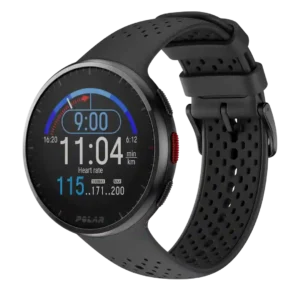
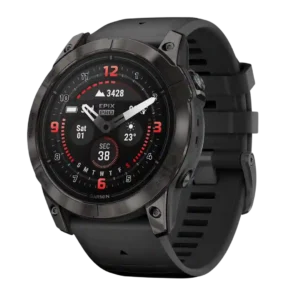
Polar Flow is repeatedly described as a deep and capable ecosystem, with both phone and web tools supporting detailed workout analysis.
Reviews mention a relatively large software marketplace and Connect IQ access for apps, widgets, and personalization.
Reviewers praise the strap for airflow and running comfort, highlighting perforation, stretch, and race-friendly wear.
Band impressions are mixed: the included silicone strap is described as high quality, but one reviewer said the white band gets dirty easily.
Battery life usually lands around five to seven days with roughly 35 hours of GPS, useful but commonly described as average rather than class-leading.
Battery life is a clear strength, with reviewers reporting long real-world endurance from multi-day always-on use to weeks between charges depending on settings and size.
Reviews explicitly note that the watch lacks built-in blood oxygen or oxygen saturation tracking.
The watch includes wrist-based pulse-ox tracking for blood oxygen saturation, with reviews noting altitude and wellness uses.
Bluetooth setup is straightforward and the watch supports Bluetooth pairing for phones and compatible sensors.
Bluetooth support is well covered, including sensor pairing and accessory connectivity alongside Garmin’s broader smartwatch radios.
The screen is generally described as bright enough for outdoor use, though it is still not a vivid AMOLED-style display.
Screen brightness is consistently praised, with reviewers calling it easy to see indoors, outdoors, and even on sunny days.
The Pacer Pro is broadly seen as well built for a lightweight sports watch, with a durable and practical construction.
Build quality is described as rugged and tank-like, with premium-feeling construction for a high-end sports watch.
Physical controls are a strength, with reviewers liking the button-based layout for training and navigation.
The physical controls are a strong point, with dedicated buttons, useful shortcuts, and a more satisfying click than some newer Garmin alternatives.
Phone-call handling is limited to one-way call notifications rather than full calling features.
Phone integration is limited for calls on some setups, with one review noting you cannot respond to texts or calls in that configuration.
Calorie and fueling data are seen as useful because Polar breaks effort down into energy-source or workout-fueling insights, not just a raw calorie total.
Garmin Connect gives clear daily calorie totals, including base and active calories, making calorie data easy to review.
Charging works, but the new connector is a weak point, with reviewers describing it as less secure or a step back from older Polar chargers.
Charging is less convenient than open USB-C freedom because the watch still relies on Garmin’s proprietary charger.
Charging speed is mixed in the reviews, with some praise for fast top-ups and others calling full charging slow.
Charging speed is improved and widely praised, with reviews citing fast top-ups and roughly an hour to reach full charge.
FitSpark, guided workouts, and training guidance are repeatedly praised as practical coaching tools for runners and general fitness users.
Training guidance is a strong area, with suggested workouts, customizable plans, race support, and coaching-oriented tools called out positively.
Comfort is a consistent strength, with the watch frequently described as light, wearable, and easy to keep on day and night.
Comfort is better than the size suggests for at least some users, with one reviewer saying the watch is comfortable enough to mostly disappear on wrist.
Polar Flow offers rich detail and clear metric explanations, though some reviewers still find the companion app less intuitive than rival apps.
Garmin Connect is useful and feature-rich, but reviews also say some finer watch settings are still awkward to manage from the phone side.
Reviews explicitly say payment features are not included.
Garmin Pay is treated as genuinely useful for runs and outdoor use, with reviewers saying it works in normal tap-to-pay situations.
The watch is presented as working with both Android and iOS through Polar Flow.
The watch works with both iOS and Android, but reviews note feature differences and a generally better experience on Android.
Customization is solid, especially for sport profiles, exercise screens, and default watch-face choices.
Customization is extensive, with adjustable settings, customizable data pages, widgets, bands, and downloadable extras.
The display is readable and improved over older Polar models, but reviewers still note that it can look dull or unexciting next to stronger screens.
The AMOLED display is one of the product’s standout strengths, repeatedly described as beautiful, vivid, and high resolution.
Durability is considered good for a lightweight sports watch, with reviewers noting protective materials or ruggedness claims.
Durability is strong overall, with reports of the watch holding up well in long-term use and the sapphire crystal resisting visible damage.
Reviews explicitly note that ECG hardware is not included.
ECG support is part of the Pro story, with reviews noting the feature arrived via firmware on supported models.
Fit is generally good on a wide range of wrists, though at least one reviewer still found it less ideal than other Polar models.
Fit varies by wrist size, but the expanded case range helps; some reviewers found good fit on smaller wrists while others still found larger versions bulky.
Fitness-test usefulness is mixed: reviewers like the performance-testing tools, but accuracy and interpretation are not universally convincing.
Overall fitness tracking accuracy is a major selling point, especially for GPS-based workouts and consistent distance tracking.
GPS performance is generally good to very good for the price, but several reviews still mention wobble, noise, or results that are not best in class.
GPS performance is repeatedly described as excellent, with reviews highlighting reliable positioning, accurate routes, and class-leading results.
General health tracking is described as useful and often reliable, but not every reviewer was impressed by the scientific accuracy of all wellness metrics.
Health tracking is generally viewed positively, with reviewers trusting the data more than before even if not every metric is treated as perfect.
Heart-rate tracking is usually rated good for steady efforts, but repeated reviews warn that intensity spikes or tougher conditions can reduce accuracy.
Heart-rate accuracy is broadly praised, especially against chest straps, though some reviews still note occasional limits in harder efforts.
Materials feel appropriate for the price, with the aluminum bezel helping the Pro look and feel more premium than simpler models.
Material choices look functional and durable, but one review notes the polymer-heavy build is more tool-like than luxurious.
Menu navigation is commonly described as easy to learn and straightforward once the button layout is familiar.
Menu navigation can be demanding, with one reviewer saying deeper customization still involves too much fiddling.
Phone-based music controls work well and are easy to access during workouts, but they rely on a connected phone.
Music controls are available and useful, with support for controlling apps like Spotify and integrated music control features.
Reviews repeatedly state that the watch does not offer onboard music storage.
Onboard storage is generous enough for music, with reviews pointing to 32GB capacity and local audio support.
The overall operating experience is seen as faster and more responsive than earlier mid-range Polar watches.
The Garmin software experience is described as robust and feature-rich, though it still expects users to invest time learning it.
Outdoor visibility is a strong point, with the screen repeatedly described as easy to read in sun and bright conditions.
Outdoor visibility is excellent, with reviewers calling the screen easy to read in strong sun and varied light.
Pairing and syncing are generally dependable, with fast GPS lock and straightforward phone setup mentioned positively.
Nightly Recharge and related recovery tools are among the most praised parts of the watch, giving usable readiness feedback and training context.
Recovery tools such as Recovery Time, Acute Load, and related guidance are repeatedly described as useful for planning training.
In day-to-day use the watch is generally portrayed as dependable, with few major usability issues once set up.
Long-term reliability is a clear positive, with reviewers describing the watch as dependable in day-to-day use.
Back to Start and basic route guidance add useful safety-oriented navigation, though the implementation is simpler than full mapping or advanced trackback tools.
Safety-oriented tools get positive mentions, including flashlight visibility, strobe options, and location-sharing style features such as LiveTrack.
Size flexibility is modest: reviewers mention multiple strap lengths or fit ranges, but not multiple watch-case sizes.
The three-size lineup is one of the headline upgrades, with multiple reviews praising the better fit options for smaller and larger wrists.
Sleep tracking gets both praise and pushback: some reviews compare it favorably with other wearables, while stricter testing judged it only average.
Sleep tracking is seen as improved but not perfect, with some reviewers praising better results while others still question exact precision.
Notifications work and are useful for texts and alerts, but they are one-way and not especially advanced.
Phone notifications are handled well, with reviews highlighting readable alerts and even good emoji support.
Smartwatch extras are present but limited, with weather, notifications, and music control available while richer smartwatch capabilities are absent.
Smartwatch basics are solid rather than dominant, covering notifications, music, payments, weather, and other everyday tools.
Software performance is a clear improvement, with reviewers often calling the watch faster, smoother, and less laggy than older Polar models.
General performance is good, but the watch is not universally seen as ultra-smooth; some reviewers praise stability while others note less polished animation or feel.
Step counting looks acceptable in casual comparisons, but more controlled testing found it only average rather than standout.
Stress-related support is limited: there are breathing or recovery tools, but dedicated stress tracking is absent.
Stress tracking is part of the broader recovery picture and is used in Garmin’s readiness and Body Battery style insights.
Design opinion is mixed: the watch is light and sporty, but several reviewers call the look plain or criticize the large bezel.
Design is widely praised for balancing rugged outdoor character with an attractive everyday look.
Third-party support is a plus, with recurring mentions of Strava, TrainingPeaks, Komoot, and phone-audio apps.
Third-party support exists through Connect IQ and related downloads, giving users access to extra apps and add-ons.
The Pacer Pro uses buttons instead of a touchscreen, so touch responsiveness is not part of the experience.
Touch response is strong, with reviewers saying the screen works well even in wet conditions and avoids over-sensitivity.
The interface is generally praised for being simple, accessible, and easy to understand once the button scheme is learned.
The interface is powerful but mixed in usability: some reviewers find it intuitive enough, while others still call it confusing or busy.
Value is a recurring strength, with reviewers repeatedly saying the Pacer Pro packs high-end Polar features into a more affordable price point.
Value is mixed: reviewers respect the hardware and long-term usefulness, but many still call the price high and note cheaper Garmin alternatives.
Voice-assistant support is explicitly absent.
Watch-face options are functional rather than flashy, offering basic customization without a premium visual experience.
Water resistance is consistently described as solid for normal swimming and everyday wet use.
Water resistance is a strength, with repeated mentions of 100-meter or 10 ATM capability for swimming and even diving scenarios.
Wellness insight features such as Nightly Recharge and daily wellness tracking are considered useful and fairly comprehensive for training-focused users.
Wellness features such as HRV, Body Battery, Training Readiness, and similar guidance are frequently highlighted as useful.
Wi-Fi support is present for tasks like syncing and map downloads, adding convenience beyond Bluetooth-only workflows.
Workout coverage is a major strength, with multisport support and a broad range of sport profiles repeatedly highlighted.
Workout and sport coverage is broad, with reviewers repeatedly pointing to a very large activity list and many sport profiles.