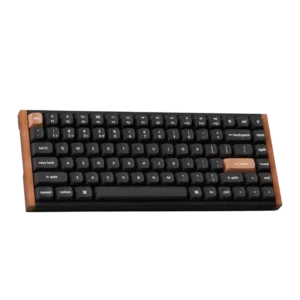
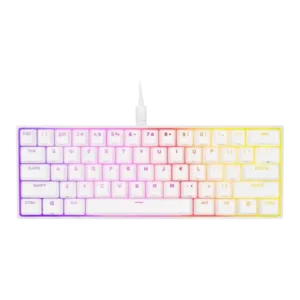
Sound character is a strong point, with recurring descriptions like muted, premium, thocky, and substantial.
Sound character gets mixed comments, ranging from pleasant clack to a less intrusive tone, but it is not a standout strength.
Adjustable Hall effect actuation is a recurring strength, with reviewers describing the keys as consistent and precisely tunable.
One reviewer specifically said the board did not trigger accidental double-presses during play, suggesting stable actuation once acclimated.
Several reviews explicitly mention analog-style behavior, including per-key analog control, variable inputs, and gamepad-like simulation.
Backlight brightness is mixed. Some reviewers call it bright and attractive, while others find it dim or less useful on non-shine-through caps.
Multiple reviewers praised bright, vivid lighting and strong color output, though one noted the edge spill is not perfectly even.
Battery life is a consistent strength, with scored reviews ranging from several days to multiple weeks depending on lighting and usage.
Build quality is consistently strong, with reviewers describing the board as solid, sturdy, and premium-feeling.
Construction is generally seen as solid and sturdy despite the plastic-heavy chassis, with some reviewers wanting richer materials.
The included cable earns mixed-to-positive feedback: reviewers appreciate the braided or angled design, but several wish it were longer.
The detachable braided USB-C cable is convenient for travel and swapping, but one reviewer disliked how easily it kinks.
Compatibility is a strong point, with repeated support for Windows and Mac and positive notes about multi-device use.
Reviews mention support for Windows and macOS, with Xbox One connectivity noted but without iCue support there.
Connectivity is broadly praised, with wired, Bluetooth, and 2.4GHz modes repeatedly confirmed.
The K65 RGB Mini uses a detachable USB-C to USB-A wired connection; reviewers liked the removable cable but did not mention wireless modes.
Customization is one of the board’s biggest advantages, especially per-key actuation control and broader remapping or tuning options.
Reviews consistently highlight extensive lighting, remapping, layer, and onboard customization, with hardware-level controls being a recurring strength.
Reviewers explicitly call out the compact layout for saving desktop space.
The 60% layout repeatedly earns praise for freeing up desk and mouse space and fitting easily into tight setups.
The scored evidence suggests good durability, with durable keycap construction and at least one reviewer noting the board survived an accidental drop with only minor cosmetic damage.
Reviewers repeatedly cite the double-shot PBT keycaps and durable components as positives, even though the chassis is plastic.
Switch swapping appears possible with included tools or basic effort, but it is framed more as manageable than effortless.
Switch replacement is limited because reviewers explicitly note there is no hot-swap support.
Ergonomics are mixed. Some reviewers like the typing angle or stable stance, while others report wrist-rest needs or wrist soreness.
Ergonomics are mixed-to-poor because the fixed angle, lack of feet, awkward shortcut reaches, and sharp edges can hurt comfort.
Beyond raw speed, the scored reviews repeatedly highlight features like Snap Click, last key prioritization, multiple actuation, and dynamic keystrokes.
Gaming extras include NKRO, Windows lock, mouse controls, 4kHz keyscan, and onboard shortcuts, giving the small board a feature-rich gaming toolset.
Frame rigidity is a clear strength, with reviewers calling out no deck flex, strong stability, and a rigid feel.
Despite the plastic construction, reviewers generally found the chassis sturdy with little or no flex.
In actual use, reviewers report strong gaming performance, from FPS play to quicker weapon selection and movement.
Reviewers describe the board as precise, responsive, and especially suited to gaming, particularly when extra desk room helps mouse movement.
The K2 HE supports hot-swapping within its magnetic-switch ecosystem, according to multiple scored reviews.
Reviews explicitly call out the lack of hot-swap support as a downside.
The scored evidence points to solid keycap quality, particularly doubleshot PBT construction and quality finishing.
The double-shot PBT keycaps are widely praised for texture, durability, and overall feel.
Reviewers repeatedly say inputs register very quickly, with little force needed to trigger a key.
Key response is generally described as quick and satisfying, with several reviewers calling the board responsive in-game.
Key spacing is mixed, with several reviewers needing time to adjust to the smaller, more compressed layout.
Even with the compact form factor, reviewers say the layout does not feel especially cramped and that key spacing feels right.
Key stability scores well, with repeated praise for low wobble and stable double-rail switch behavior.
Gaming latency is described positively in the scored evidence, with one reviewer explicitly reporting no noticeable lag in play.
The 8,000Hz mode is fast on paper, but several reviewers say the real-world benefit is hard or impossible to notice.
The scored evidence notes layout variation beyond the base board, including an ISO option tied to layout changes.
Software-level layout flexibility is a plus, with reviewers noting active layout changes and support beyond the default QWERTY setup.
Legend visibility is mixed. Reviewers like the clear font, but several note the Special Edition legends are not shine-through.
Legend clarity is mixed: some reviewers say the legends shine through well or help identify functions, while others find them cluttered or less clear.
Macro support is present and clearly documented in the scored reviews, including both standard macros and depth-based actions.
Reviews consistently mention macro recording and remapping both in software and via onboard controls.
Materials are well regarded, especially the wood, aluminum, and specialty frame elements highlighted in the scored reviews.
Material impressions are mixed: strong PBT keycaps and solid construction help, but the plastic case keeps the board from feeling truly premium to everyone.
Media control support is serviceable rather than exceptional, usually handled through the function row instead of dedicated controls.
Reviewers like that media controls are present on the 60% layout, though they rely on secondary functions.
Noise level lands in a comfortable middle ground: quieter than many mechanical boards, but not silent.
Noise is a recurring weakness, with multiple reviews describing the board as loud, pingy, scratchy, or hollow.
The keyboard retains settings internally in the scored evidence, including mappings or profiles that persist across devices.
The onboard memory is repeatedly praised for storing profiles, lighting, macros, and assignments directly on the board.
Per-key RGB control is a consistent strength, with reviewers highlighting customizable per-key effects and hardware-saved lighting.
The K2 HE is repeatedly described as a 1,000Hz board over wired or 2.4GHz, with Bluetooth framed as the slower mode.
Reviewers acknowledge the headline 8,000Hz polling feature, but many question how useful it is beyond the spec sheet.
Portability is limited. The compact format helps, but reviewers still describe the board as fairly heavy or not especially travel-friendly.
Compact size and the detachable cable make this keyboard easy to pack and travel with.
Profile handling is a strength, with stored profiles and easy switching called out in multiple reviews.
Reviews repeatedly mention onboard profile storage and easy profile switching, often citing around 50 profiles.
Rapid Trigger is one of the standout features in the scored reviews and is described as working very well for fast inputs.
Reliability is generally solid in the scored evidence, with reviewers noting stable everyday use and no major issues, though some wireless behavior elsewhere is less perfect.
One reviewer reported a defective initial sample before receiving functioning replacements, creating a small reliability question mark.
RGB settings appear flexible in the scored reviews, with support for static colors, color shifts, and other preset effects.
Lighting customization is deep, with layered effects, per-key edits, and broad RGB control through iCue or onboard shortcuts.
RGB presentation is generally liked, with reviewers praising the color and backlight effect, though it is not equally practical on every version.
RGB presentation is widely praised for looking beautiful, bright, and clean, although some reviewers note minor dead zones or cosmetic limits.
The K2 HE’s 75% footprint is repeatedly framed as compact yet still practical for everyday use.
The 60% form factor is a clear strength for gamers and minimalists, though it remains a niche layout with tradeoffs for non-gaming use.
Software is a major plus overall, with reviewers praising the browser-based Launcher as easy, refreshing, and highly usable.
iCue is generally viewed as capable and improved, especially for remapping, lighting, and onboard control, though some reviewers mention complexity or rough edges.
Multiple reviews explicitly credit foam, silicone, and other dampening layers for the keyboard’s controlled sound.
Lack of internal dampening shows up in repeated complaints about ping, hollow tones, and reverberation.
Stabilizers are generally viewed positively for reducing wobble, though one scored review still sees room for improvement.
Stabilizers are generally seen as improved versus older Corsair boards, though still not exceptional.
Across the scored reviews, the magnetic switches are described as buttery smooth and among the smoothest reviewers have used.
Switch feel is mixed: some reviewers like the smooth, responsive linear action, while others complain about scratchiness or reduced smoothness.
Switch choice is limited. Multiple reviewers note the board only supports Keychron or Gateron double-rail magnetic switches, with a small linear-only selection.
Reviews mention multiple Cherry MX options, with variants such as Red, Silent, and Speed available depending on region or SKU.
Typing comfort is strong overall, though not universal; several reviewers say it stays comfortable over long sessions, while one flags the case height.
Typing comfort is mixed; some reviewers found the board comfortable, while others disliked it for office work or daily productivity because of the compact layout.
Typing feel is a major strength, with reviewers calling it satisfying, enjoyable, and even cloud-like.
Several reviewers liked the key feel once acclimated, praising the switch-and-keycap combination even if the board is not universally ideal for typing.
Value is viewed positively overall. Some reviewers note the price is not low, but most still judge the feature set and finish to be worth it.
Value is divisive: some reviewers thought the pricing was competitive for a major-brand 60% board, while others felt rivals delivered more for the money.
Volume control is available, but mostly through remapping or Fn-based shortcuts rather than a dedicated knob.
Volume control shortcuts are available and considered handy once learned.
Wireless performance is good overall but not flawless. Some reviewers report seamless behavior or fast wake, while others mention slower Bluetooth or wake quirks.
One reviewer specifically noted there is no wrist rest included.