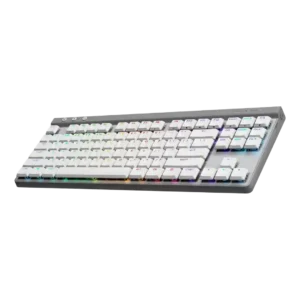

Reviews describe a pleasant overall sound with foam reducing ping and rattle, though one review still heard some plasticky rattle.
Reviewers praise the GX87’s stock sound as a standout, describing it as refined, lively, and unusually satisfying for a prebuilt board.
One review found the switch feel reasonably consistent across all keys.
One review specifically says the switches deliver a consistent key press.
Backlighting is visible and generally attractive, but brightness is not class-leading and some reviews found it dimmer than top rivals.
Battery life is good rather than class-leading, with several tests clustering around the mid-30s to mid-40s hours with lighting and longer runtimes possible with power-saving settings.
Battery life is a clear strength, with multiple reviews calling out the large 8,000mAh capacity and very long runtime.
Despite the plastic chassis, reviews consistently describe the board as solid, sturdily built, and better made than the price might suggest.
Multiple reviewers describe the GX87 as very well built, with strong assembly, solid casework, and no obvious quality-control issues.
The included USB-C cable is described as rubberized, flexible, and perfectly serviceable for charging or wired use.
One video calls the included cable cheap and unimpressive.
Compatibility evidence includes macOS support, pairing with compatible Logitech Lightspeed devices, multi-device use, and support for aftermarket low-profile keycaps.
Key mappings are described as persisting across multiple devices, which supports multi-device use.
Tri-mode connectivity is a recurring strength, with 2.4GHz Lightspeed, Bluetooth, and wired USB-C all repeatedly confirmed.
The board offers Bluetooth and 2.4GHz wireless modes, but one review also reports minor connectivity issues.
Customization is a major strength, with G Hub and KEYCONTROL providing deep remapping, layering, and setup flexibility beyond basic lighting tweaks.
Reviewers consistently say the GX87 is easy to customize, thanks to straightforward disassembly and mod-friendly design, with one video also mentioning swappable top colors.
The TKL layout is explicitly praised for freeing up desk space.
The TKL layout is described as saving desk space versus full-size boards while keeping a familiar key set.
PBT caps and, in one review, a replaceable battery help the G515 make a stronger long-term durability case than many wireless boards.
One review explicitly says the GX87 feels built to last.
Switch replacement is limited because the switches are explicitly described as not hot-swappable.
Switch replacement is described as very easy because switches can be removed and replaced without soldering.
Low-profile height and adjustable tilt contribute to a comfortable, easy-to-reach typing posture.
The fixed typing angle is presented as standard enough that it should not bother most users.
Game Mode and Logitech-specific extras are present, but some reviews still felt the board lacked more advanced gaming hardware features.
A dedicated ultra low latency mode is explicitly mentioned in the software.
Despite its slim plastic build, the frame is described as hard to bend with very little flex.
The chassis is praised for having no flex or rattles, though one video notes the quick-release design may feel less rigid than a screwed-in case.
Gaming performance is generally strong and responsive, though the board is not positioned as the most hardcore esports feature set.
Reviewers say the GX87 handles gaming well, especially for hybrid work-and-play use, even if it is not framed as a specialist Hall Effect board.
Multiple reviews explicitly note that the switches are not hot-swappable.
Hot-swap support is clearly confirmed across reviews, making switch swaps part of the board’s appeal.
Double-shot PBT keycaps are a repeated highlight for texture, grip, and durability, though some reviewers still criticized flatness, looseness, or smoothness.
One review specifically praises the included PBT keycaps as high quality.
Short-travel switches and responsive action make inputs feel quick across both work and gaming.
One review says the switches feel fairly responsive in play.
Key spacing is described as familiar and close to a standard ANSI layout, which eases adaptation.
Key stability is mostly positive, with some reviews praising minimal wobble and others noting more movement than ideal.
2.4GHz Lightspeed is repeatedly described as low-latency or lag-free, while Bluetooth carries the usual latency penalty.
Latency is framed positively for normal gaming use, with reviewers noting reduced latency concerns and immediate-feeling keypresses.
The board sticks to a familiar TKL layout rather than offering alternate size variants, and reviewers found that layout practical and easy to learn.
Shine-through legends are generally easy to read, but a few reviews noted uneven illumination or incomplete legend coverage on some keys.
Macro and layer functionality is deep, with several reviews highlighting the ability to assign up to 15 functions per key.
Macro support is explicitly mentioned as part of the board’s deeper customization toolkit.
Materials quality lands above expectations for the price, with sturdy plastics and a generally premium-feeling finish.
The materials are consistently praised, especially the aluminum chassis and PBT keycaps, with one reviewer also highlighting the smooth finish.
Media functions exist, but mostly as secondary Fn commands rather than dedicated hardware controls.
The board is repeatedly described as quiet or audibly muted for a mechanical keyboard.
The sound profile is described as muted rather than sharply loud, keeping the board’s thock controlled.
Onboard or built-in memory is confirmed for storing settings, profiles, or lighting when moving between systems.
Customizations are explicitly described as being stored on the keyboard itself.
One review explicitly notes the absence of a USB passthrough port.
Per-key RGB control is directly supported through Logitech software.
One review explicitly confirms a 1,000 Hz wireless polling rate.
The keyboard is repeatedly described as running at 1,000Hz, with one video also discussing a low-latency mode.
The slim TKL shape, dongle storage, and travel-friendly framing make the keyboard easy to carry and use in tighter spaces.
Its heavy all-metal build makes it less convenient to carry around or reposition frequently.
Reviews describe multiple profiles, presets, community profile sharing, or per-program configs, giving the board solid profile-management flexibility.
A review explicitly flags the absence of rapid-trigger-style features.
Connection stability and day-to-day reliability are called out as strong.
One review reports rare duplicate key registrations and a fringe long-hold input issue, so reliability is good but not flawless.
G Hub allows custom RGB effects and animations rather than limiting users to presets alone.
Lighting customization exists and can be adjusted, but the experience is not unanimously polished, with one review calling it clunky.
RGB looks clean and appealing overall, but several reviews note uneven legends or less-than-ideal consistency across the lighting.
The 22mm-tall low-profile TKL form factor is one of the keyboard’s clearest strengths.
The GX87 is explicitly described as an 80% TKL, giving it a compact-but-not-tiny footprint.
G Hub is broadly seen as capable and feature-rich, with strong programming tools, though some reviews imply a learning curve.
Software support is generally seen as good for the category, with QMK/VIA support and dedicated software, though one reviewer still found VIA basic.
Foam and layered dampening are repeatedly cited as meaningful contributors to the quieter sound.
Internal foam and damping layers are specifically credited with reducing ping and cleaning up the typing sound.
Direct stabilizer evidence is positive, with one review saying they do their job well and keep wobble low on larger keys.
Stabilizers are mixed but acceptable overall: one review says they are nearly silent, while another wanted a bit more lube.
Switch feel is generally praised as tactile, smooth, and satisfying for a low-profile board.
The stock linear switches are described as satisfying, bouncy, crisp, and snappy in everyday use.
Buyers get tactile or linear switch choices, but the scored reviews do not support a third clicky option.
Switch choice at purchase is limited, with one review explicitly noting only two similar linear options and no tactile choice.
Typing comfort is consistently strong once users adjust to the low-profile form factor.
Typing comfort is positively described, with reviewers calling out a soft, bouncy, comfort-focused feel.
Typing feel is a standout, with reviewers describing it as fast, satisfying, and productive.
Typing feel is strongly positive, with reviewers describing the GX87 as joyful, smooth, and satisfying to type on.
Value is viewed as good but not unbeatable, with a lower price than pricier Logitech low-profile models offset by a few compromises.
Reviews repeatedly frame the GX87 as unusually strong value, pairing premium-feeling features with a budget-friendly price.
Volume adjustment exists through secondary keys, but the missing dial or dedicated controls is a recurring complaint.
Lightspeed wireless performance is one of the product’s most consistent strengths, with repeated praise for stability and wired-like behavior.
Wireless behavior is praised for reconnecting quickly after idle and feeling responsive in use.
There is no included wrist rest, and several reviews mention that absence as a drawback even if the low profile reduces the need.