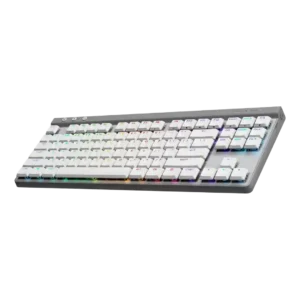
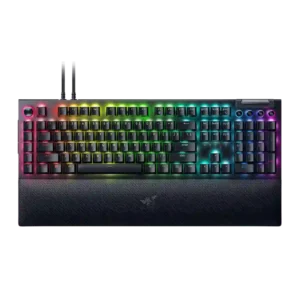
Reviews describe a pleasant overall sound with foam reducing ping and rattle, though one review still heard some plasticky rattle.
Acoustics are solid but switch-dependent. Yellow builds are described as pleasing and controlled, while Green builds can sound louder and more plasticky.
One review found the switch feel reasonably consistent across all keys.
For the tested Yellow switches, reviewers describe consistent fast reset behavior that keeps repeated presses from dropping inputs.
Backlighting is visible and generally attractive, but brightness is not class-leading and some reviews found it dimmer than top rivals.
Brightness is strong and flexible enough to stand out in normal use, with reviewers specifically praising how bright and focused the lighting looks.
Battery life is good rather than class-leading, with several tests clustering around the mid-30s to mid-40s hours with lighting and longer runtimes possible with power-saving settings.
Despite the plastic chassis, reviews consistently describe the board as solid, sturdily built, and better made than the price might suggest.
Build quality is widely praised. Reviewers consistently describe the board as premium, sturdy, and well assembled despite some plastic in the chassis.
The included USB-C cable is described as rubberized, flexible, and perfectly serviceable for charging or wired use.
Cable quality is good, with braided detachable cables repeatedly noted, though the dual-cable setup adds clutter if passthrough is enabled.
Compatibility evidence includes macOS support, pairing with compatible Logitech Lightspeed devices, multi-device use, and support for aftermarket low-profile keycaps.
Compatibility is limited by platform support; one review specifically calls out weak Mac support and points users toward Windows for the full experience.
Tri-mode connectivity is a recurring strength, with 2.4GHz Lightspeed, Bluetooth, and wired USB-C all repeatedly confirmed.
Connectivity is functional but not especially flexible: the board is wired, supports passthrough, and benefits from that for low latency, but several reviews note the loss of wireless.
Customization is a major strength, with G Hub and KEYCONTROL providing deep remapping, layering, and setup flexibility beyond basic lighting tweaks.
Overall customization is exceptional, especially around key remapping, dial modes, lighting, and workflow tuning.
The TKL layout is explicitly praised for freeing up desk space.
Desk-space efficiency is poor. Reviewers repeatedly note that the macro column and large wrist rest make the board hard to justify on tighter setups.
PBT caps and, in one review, a replaceable battery help the G515 make a stronger long-term durability case than many wireless boards.
Durability evidence centers on the rated 100 million keystroke lifespan and the generally robust construction.
Switch replacement is limited because the switches are explicitly described as not hot-swappable.
Switch replacement is not especially easy because the board is not hot-swappable, so changing switches is more restrictive than on enthusiast-oriented alternatives.
Low-profile height and adjustable tilt contribute to a comfortable, easy-to-reach typing posture.
Ergonomics are good in some respects thanks to the wrist rest and comfortable key shapes, but the added side and left macro controls can interfere with hand placement until you adapt.
Game Mode and Logitech-specific extras are present, but some reviews still felt the board lacked more advanced gaming hardware features.
Extra gaming features are plentiful, including macro keys, command-dial functions, polling-rate options, and other gaming-focused controls.
Despite its slim plastic build, the frame is described as hard to bend with very little flex.
Frame rigidity is excellent, with the board repeatedly described as heavy, planted, and difficult to shift once it is on the desk.
Gaming performance is generally strong and responsive, though the board is not positioned as the most hardcore esports feature set.
Gaming performance is consistently strong, with reviewers praising smooth inputs, macro advantages, and dependable action across shooters, MMOs, and general gaming.
Multiple reviews explicitly note that the switches are not hot-swappable.
Hot-swappable switches are a clear weakness. Multiple reviewers explicitly note that the full-size V4 Pro does not support hot-swap.
Double-shot PBT keycaps are a repeated highlight for texture, grip, and durability, though some reviewers still criticized flatness, looseness, or smoothness.
Keycap quality is decent rather than class-leading: reviewers like the shine-through look and texture, but several note the premium price makes the ABS choice harder to forgive.
Short-travel switches and responsive action make inputs feel quick across both work and gaming.
Where responsiveness is discussed directly, presses are described as immediate and dependable, with fast recovery under repeated inputs.
Key spacing is described as familiar and close to a standard ANSI layout, which eases adaptation.
Key spacing is generally favorable, with reviewers noting enough separation and room to reduce accidental presses once they adjust to the macro-heavy layout.
Key stability is mostly positive, with some reviews praising minimal wobble and others noting more movement than ideal.
Stability is strong where reviewers examined wobble directly, with switches and keycaps described as very tight and controlled.
2.4GHz Lightspeed is repeatedly described as low-latency or lag-free, while Bluetooth carries the usual latency penalty.
Latency is a clear strength in the full-size model, with reviewers repeatedly describing inputs as instantaneous, lag-free, and especially strong for wired competitive play.
The board sticks to a familiar TKL layout rather than offering alternate size variants, and reviewers found that layout practical and easy to learn.
Shine-through legends are generally easy to read, but a few reviews noted uneven illumination or incomplete legend coverage on some keys.
Legend visibility is mixed. Main legends are praised for shine-through readability, but several reviewers say the media-button legends are too dark or hard to see.
Macro and layer functionality is deep, with several reviews highlighting the ability to assign up to 15 functions per key.
Macro customization is a major strength. Across many reviews, the board’s macro keys and remapping options are described as flexible, powerful, and useful for both games and productivity.
Materials quality lands above expectations for the price, with sturdy plastics and a generally premium-feeling finish.
Material quality is strong overall thanks to the aluminum top case and premium-feeling finishes, though the plastic lower shell keeps it from feeling fully top-tier throughout.
Media functions exist, but mostly as secondary Fn commands rather than dedicated hardware controls.
Media controls are widely praised for convenience and feel, making everyday playback adjustments easier.
The board is repeatedly described as quiet or audibly muted for a mechanical keyboard.
Noise level depends heavily on switch choice, but the Green version is explicitly described as very loud.
Onboard or built-in memory is confirmed for storing settings, profiles, or lighting when moving between systems.
Onboard memory exists and stores profiles, but some custom behavior still depends on Synapse, so the onboard implementation is useful without being fully self-sufficient.
One review explicitly notes the absence of a USB passthrough port.
USB passthrough is useful for low-power accessories and convenient desk routing, but reviewers note bandwidth or power limitations and the need for a second cable.
Per-key RGB control is directly supported through Logitech software.
Per-key lighting control is supported and called out directly, alongside underglow zones for a more elaborate lighting setup.
One review explicitly confirms a 1,000 Hz wireless polling rate.
The board’s adjustable polling rate and 8,000Hz ceiling are repeatedly highlighted as premium gaming features, even if some reviewers note many players may not fully notice the difference.
The slim TKL shape, dongle storage, and travel-friendly framing make the keyboard easy to carry and use in tighter spaces.
Portability is poor. The full-size body, added macro column, and overall heft make this a desk board rather than a travel-friendly one.
Reviews describe multiple profiles, presets, community profile sharing, or per-program configs, giving the board solid profile-management flexibility.
Profile management is solid, with multiple reviews confirming onboard profiles and quick switching for different tasks.
A review explicitly flags the absence of rapid-trigger-style features.
Connection stability and day-to-day reliability are called out as strong.
Reliability is mixed. Reviews mention lighting glitches, occasional wrist-rest connection issues, accidental side-button presses, and some software inconsistency.
G Hub allows custom RGB effects and animations rather than limiting users to presets alone.
RGB customization is robust through Synapse and Chroma, including synchronized effects and game-aware lighting options.
RGB looks clean and appealing overall, but several reviews note uneven legends or less-than-ideal consistency across the lighting.
RGB lighting quality is one of the board’s standout features, with reviewers repeatedly praising the brightness, underglow, wrist-rest lighting, and overall presentation.
The 22mm-tall low-profile TKL form factor is one of the keyboard’s clearest strengths.
The full-size form factor gives buyers every control they could want, but several reviewers stress that it is undeniably big and best suited to larger desks.
G Hub is broadly seen as capable and feature-rich, with strong programming tools, though some reviews imply a learning curve.
Software quality is mixed. Synapse is often called easy enough to use, but many reviews criticize its background dependency, resource use, or occasional inconsistency.
Foam and layered dampening are repeatedly cited as meaningful contributors to the quieter sound.
Sound dampening is a genuine plus, with multiple reviewers noticing that the internal foam cuts down ping, reverb, and harsher case noise.
Direct stabilizer evidence is positive, with one review saying they do their job well and keep wobble low on larger keys.
Stabilizers are better than expected for a mainstream gaming board, with reviewers noting improved stability, low rattle, and effective factory lubrication.
Switch feel is generally praised as tactile, smooth, and satisfying for a low-profile board.
Across multiple switch variants, reviewers describe the switch feel as smooth, fast, and satisfying, with Yellow switches especially easy to game on and Green switches still enjoyable for clicky fans.
Buyers get tactile or linear switch choices, but the scored reviews do not support a third clicky option.
Reviews confirm two stock switch choices, Green clicky and Yellow linear, which gives buyers a basic choice but not a broad menu of switch options.
Typing comfort is consistently strong once users adjust to the low-profile form factor.
Typing comfort is generally good for long sessions, though not every switch variant feels equally cushioned for extended writing.
Typing feel is a standout, with reviewers describing it as fast, satisfying, and productive.
Typing feel is generally praised for being fast and satisfying, though it depends somewhat on switch choice and the board’s larger layout.
Value is viewed as good but not unbeatable, with a lower price than pricier Logitech low-profile models offset by a few compromises.
Value depends on whether you will use the extra features. Many reviewers think the feature set helps justify the price, but several still call the board expensive.
Volume adjustment exists through secondary keys, but the missing dial or dedicated controls is a recurring complaint.
Volume control is a strong point, with the roller or dial repeatedly described as smooth, satisfying, and easy to use.
Lightspeed wireless performance is one of the product’s most consistent strengths, with repeated praise for stability and wired-like behavior.
There is no included wrist rest, and several reviews mention that absence as a drawback even if the low profile reduces the need.
Wrist rest quality is one of the most praised parts of the package, with reviewers repeatedly calling it soft, comfortable, and premium, even if a few mention connection or height quirks.