Reviews consistently praise the board for deeper, fuller sound than many analog competitors.
Sound character is a strong point, with recurring descriptions like muted, premium, thocky, and substantial.
One review framed the inductive design as offering more consistent response over long periods.
Adjustable Hall effect actuation is a recurring strength, with reviewers describing the keys as consistent and precisely tunable.
Reviews confirm support for adjustable actuation, rapid trigger, and multi-point style analog inputs.
Several reviews explicitly mention analog-style behavior, including per-key analog control, variable inputs, and gamepad-like simulation.
Backlight brightness is usable, but not a standout strength across reviews.
Backlight brightness is mixed. Some reviewers call it bright and attractive, while others find it dim or less useful on non-shine-through caps.
Multiple reviews landed around 11 to 12 hours with RGB on, so battery life is workable but unimpressive.
Battery life is a consistent strength, with scored reviews ranging from several days to multiple weeks depending on lighting and usage.
Reviewers repeatedly describe the keyboard as solid, sturdy, and well-constructed despite the plastic shell.
Build quality is consistently strong, with reviewers describing the board as solid, sturdy, and premium-feeling.
The included USB-C cable is presented as a nice braided, color-matched in-box extra.
The included cable earns mixed-to-positive feedback: reviewers appreciate the braided or angled design, but several wish it were longer.
Browser-based setup is limited by compatibility constraints, with one review specifically noting Chromium over Firefox.
Compatibility is a strong point, with repeated support for Windows and Mac and positive notes about multi-device use.
Tri-mode connectivity is a clear strength, with wired, Bluetooth, and 2.4 GHz support called out repeatedly.
Connectivity is broadly praised, with wired, Bluetooth, and 2.4GHz modes repeatedly confirmed.
There is substantial remapping and actuation customization, but the software experience can make that flexibility harder to use well.
Customization is one of the board’s biggest advantages, especially per-key actuation control and broader remapping or tuning options.
The compact models help mouse room, but the full-size layout leaves less space for wider sweeps.
Reviewers explicitly call out the compact layout for saving desktop space.
Keycap wear resistance helps durability, but proprietary parts and fit concerns weaken long-term confidence.
The scored evidence suggests good durability, with durable keycap construction and at least one reviewer noting the board survived an accidental drop with only minor cosmetic damage.
Hot-swap support helps, but proprietary switches and the lack of spare parts make replacement less convenient than it should be.
Switch swapping appears possible with included tools or basic effort, but it is framed more as manageable than effortless.
Comfort is decent overall, but the tall profile and missing wrist rest hurt ergonomics for some users.
Ergonomics are mixed. Some reviewers like the typing angle or stable stance, while others report wrist-rest needs or wrist soreness.
Rapid trigger, multi-point inputs, and adjustable actuation are real gaming extras, even if the feature depth trails top HE boards.
Beyond raw speed, the scored reviews repeatedly highlight features like Snap Click, last key prioritization, multiple actuation, and dynamic keystrokes.
One review found little meaningful twist or bend, pointing to a rigid frame.
Frame rigidity is a clear strength, with reviewers calling out no deck flex, strong stability, and a rigid feel.
Gaming performance is generally fast and enjoyable, though not everyone saw it as a best-in-class esports board.
In actual use, reviewers report strong gaming performance, from FPS play to quicker weapon selection and movement.
The switches are hot-swappable, but the ecosystem is currently proprietary to Ducky’s inductive parts.
The K2 HE supports hot-swapping within its magnetic-switch ecosystem, according to multiple scored reviews.
High-purity or thick PBT caps are one of the keyboard’s most consistently praised strengths.
The scored evidence points to solid keycap quality, particularly doubleshot PBT construction and quality finishing.
Tap response and in-game responsiveness are consistently described as fast.
Reviewers repeatedly say inputs register very quickly, with little force needed to trigger a key.
Key spacing is manageable once adjusted to, but the full-size layout can feel wider if you come from smaller boards.
Key spacing is mixed, with several reviewers needing time to adjust to the smaller, more compressed layout.
Large keys and the switches themselves are praised for low wobble and stable feel.
Key stability scores well, with repeated praise for low wobble and stable double-rail switch behavior.
Wireless latency is strong enough to feel close to wired in normal use, though this is still a 1,000 Hz board.
Gaming latency is described positively in the scored evidence, with one reviewer explicitly reporting no noticeable lag in play.
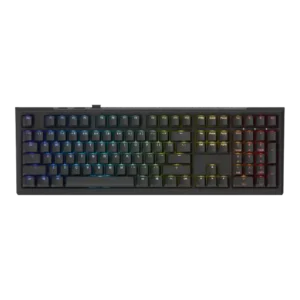
The lineup offers both full-size and 60% options, along with layout variety.
The scored evidence notes layout variation beyond the base board, including an ISO option tied to layout changes.
Standard legends are sharp and evenly lit, but some alternate caps are harder to read in low light.
Legend visibility is mixed. Reviewers like the clear font, but several note the Special Edition legends are not shine-through.
The web configurator supports macros, though that capability sits inside a broader software experience that still needs polish.
Macro support is present and clearly documented in the scored reviews, including both standard macros and depth-based actions.
The material mix is not flashy, but the plastic case, PBT caps, and internal stack still come across as well chosen and solid.
Materials are well regarded, especially the wood, aluminum, and specialty frame elements highlighted in the scored reviews.
You do get top-right media controls, but several reviews note that the board lacks richer dedicated playback extras.
Media control support is serviceable rather than exceptional, usually handled through the function row instead of dedicated controls.
Typing noise is generally kept low and muted, though one review noted light coil whine with RGB enabled.
Noise level lands in a comfortable middle ground: quieter than many mechanical boards, but not silent.
Settings and profile data are described as saving on the keyboard itself rather than living only in software.
The keyboard retains settings internally in the scored evidence, including mappings or profiles that persist across devices.
Per-key RGB support exists, but at least one review found per-key editing limited in practice.
The 1,000 Hz polling rate is fine for most users, but it is not an aggressive headline spec versus faster rivals.
The K2 HE is repeatedly described as a 1,000Hz board over wired or 2.4GHz, with Bluetooth framed as the slower mode.
The full-size board is heavy enough that portability is not a strong point.
Portability is limited. The compact format helps, but reviewers still describe the board as fairly heavy or not especially travel-friendly.
Review timing matters here: early coverage criticized missing profiles, while later coverage reported dual-profile support.
Profile handling is a strength, with stored profiles and easy switching called out in multiple reviews.
Rapid trigger is supported, but the adjustment granularity is lighter than what some competing analog boards offer.
Rapid Trigger is one of the standout features in the scored reviews and is described as working very well for fast inputs.
Later coverage mentioned bug fixes and improved system stability, suggesting the platform is getting steadier over time.
Reliability is generally solid in the scored evidence, with reviewers noting stable everyday use and no major issues, though some wireless behavior elsewhere is less perfect.
RGB modes and settings are available through the web configurator.
RGB settings appear flexible in the scored reviews, with support for static colors, color shifts, and other preset effects.
Lighting looks smooth and fairly uniform, but brightness is not class-leading.
RGB presentation is generally liked, with reviewers praising the color and backlight effect, though it is not equally practical on every version.
The product family spans compact and full-size versions, so buyers can choose between desk space and a full layout.
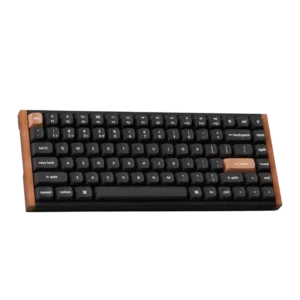
The K2 HE’s 75% footprint is repeatedly framed as compact yet still practical for everyday use.
The web configurator is the keyboard’s clearest weakness, with repeated complaints about bugs, confusion, limits, or unfinished behavior.
Software is a major plus overall, with reviewers praising the browser-based Launcher as easy, refreshing, and highly usable.
The dense internal foam and layered dampening clearly help suppress rattle and shape the sound.
Multiple reviews explicitly credit foam, silicone, and other dampening layers for the keyboard’s controlled sound.
Stabilizers are a strength, with reviewers calling out low rattle and solid larger keys.
Stabilizers are generally viewed positively for reducing wobble, though one scored review still sees room for improvement.
The inductive switches are widely praised as smooth and pleasant to use.
Across the scored reviews, the magnetic switches are described as buttery smooth and among the smoothest reviewers have used.
Switch choice is currently narrow because the board depends on Ducky’s proprietary inductive switch ecosystem.
Switch choice is limited. Multiple reviewers note the board only supports Keychron or Gateron double-rail magnetic switches, with a small linear-only selection.
Long sessions are generally comfortable, though the larger chassis and lack of a wrist rest can still wear on some users.
Typing comfort is strong overall, though not universal; several reviewers say it stays comfortable over long sessions, while one flags the case height.
Typing feel is one of the clearest reasons reviewers kept reaching for this keyboard.
Typing feel is a major strength, with reviewers calling it satisfying, enjoyable, and even cloud-like.
Some reviews see the price as attractive for a wireless analog board, but the software caveats still affect the overall value story.
Value is viewed positively overall. Some reviewers note the price is not low, but most still judge the feature set and finish to be worth it.
Dedicated volume control is included rather than buried in generic function shortcuts.
Volume control is available, but mostly through remapping or Fn-based shortcuts rather than a dedicated knob.
Wireless mode is generally stable and responsive enough for everyday gaming use.
Wireless performance is good overall but not flawless. Some reviewers report seamless behavior or fast wake, while others mention slower Bluetooth or wake quirks.
No wrist rest is included, so this area is a straightforward weakness.