Reviews consistently praise the board for deeper, fuller sound than many analog competitors.
Acoustics are solid but switch-dependent. Yellow builds are described as pleasing and controlled, while Green builds can sound louder and more plasticky.
One review framed the inductive design as offering more consistent response over long periods.
For the tested Yellow switches, reviewers describe consistent fast reset behavior that keeps repeated presses from dropping inputs.
Reviews confirm support for adjustable actuation, rapid trigger, and multi-point style analog inputs.
Backlight brightness is usable, but not a standout strength across reviews.
Brightness is strong and flexible enough to stand out in normal use, with reviewers specifically praising how bright and focused the lighting looks.
Multiple reviews landed around 11 to 12 hours with RGB on, so battery life is workable but unimpressive.
Reviewers repeatedly describe the keyboard as solid, sturdy, and well-constructed despite the plastic shell.
Build quality is widely praised. Reviewers consistently describe the board as premium, sturdy, and well assembled despite some plastic in the chassis.
The included USB-C cable is presented as a nice braided, color-matched in-box extra.
Cable quality is good, with braided detachable cables repeatedly noted, though the dual-cable setup adds clutter if passthrough is enabled.
Browser-based setup is limited by compatibility constraints, with one review specifically noting Chromium over Firefox.
Compatibility is limited by platform support; one review specifically calls out weak Mac support and points users toward Windows for the full experience.
Tri-mode connectivity is a clear strength, with wired, Bluetooth, and 2.4 GHz support called out repeatedly.
Connectivity is functional but not especially flexible: the board is wired, supports passthrough, and benefits from that for low latency, but several reviews note the loss of wireless.
There is substantial remapping and actuation customization, but the software experience can make that flexibility harder to use well.
Overall customization is exceptional, especially around key remapping, dial modes, lighting, and workflow tuning.
The compact models help mouse room, but the full-size layout leaves less space for wider sweeps.
Desk-space efficiency is poor. Reviewers repeatedly note that the macro column and large wrist rest make the board hard to justify on tighter setups.
Keycap wear resistance helps durability, but proprietary parts and fit concerns weaken long-term confidence.
Durability evidence centers on the rated 100 million keystroke lifespan and the generally robust construction.
Hot-swap support helps, but proprietary switches and the lack of spare parts make replacement less convenient than it should be.
Switch replacement is not especially easy because the board is not hot-swappable, so changing switches is more restrictive than on enthusiast-oriented alternatives.
Comfort is decent overall, but the tall profile and missing wrist rest hurt ergonomics for some users.
Ergonomics are good in some respects thanks to the wrist rest and comfortable key shapes, but the added side and left macro controls can interfere with hand placement until you adapt.
Rapid trigger, multi-point inputs, and adjustable actuation are real gaming extras, even if the feature depth trails top HE boards.
Extra gaming features are plentiful, including macro keys, command-dial functions, polling-rate options, and other gaming-focused controls.
One review found little meaningful twist or bend, pointing to a rigid frame.
Frame rigidity is excellent, with the board repeatedly described as heavy, planted, and difficult to shift once it is on the desk.
Gaming performance is generally fast and enjoyable, though not everyone saw it as a best-in-class esports board.
Gaming performance is consistently strong, with reviewers praising smooth inputs, macro advantages, and dependable action across shooters, MMOs, and general gaming.
The switches are hot-swappable, but the ecosystem is currently proprietary to Ducky’s inductive parts.
Hot-swappable switches are a clear weakness. Multiple reviewers explicitly note that the full-size V4 Pro does not support hot-swap.
High-purity or thick PBT caps are one of the keyboard’s most consistently praised strengths.
Keycap quality is decent rather than class-leading: reviewers like the shine-through look and texture, but several note the premium price makes the ABS choice harder to forgive.
Tap response and in-game responsiveness are consistently described as fast.
Where responsiveness is discussed directly, presses are described as immediate and dependable, with fast recovery under repeated inputs.
Key spacing is manageable once adjusted to, but the full-size layout can feel wider if you come from smaller boards.
Key spacing is generally favorable, with reviewers noting enough separation and room to reduce accidental presses once they adjust to the macro-heavy layout.
Large keys and the switches themselves are praised for low wobble and stable feel.
Stability is strong where reviewers examined wobble directly, with switches and keycaps described as very tight and controlled.
Wireless latency is strong enough to feel close to wired in normal use, though this is still a 1,000 Hz board.
Latency is a clear strength in the full-size model, with reviewers repeatedly describing inputs as instantaneous, lag-free, and especially strong for wired competitive play.
The lineup offers both full-size and 60% options, along with layout variety.
Standard legends are sharp and evenly lit, but some alternate caps are harder to read in low light.
Legend visibility is mixed. Main legends are praised for shine-through readability, but several reviewers say the media-button legends are too dark or hard to see.
The web configurator supports macros, though that capability sits inside a broader software experience that still needs polish.
Macro customization is a major strength. Across many reviews, the board’s macro keys and remapping options are described as flexible, powerful, and useful for both games and productivity.
The material mix is not flashy, but the plastic case, PBT caps, and internal stack still come across as well chosen and solid.
Material quality is strong overall thanks to the aluminum top case and premium-feeling finishes, though the plastic lower shell keeps it from feeling fully top-tier throughout.
You do get top-right media controls, but several reviews note that the board lacks richer dedicated playback extras.
Media controls are widely praised for convenience and feel, making everyday playback adjustments easier.
Typing noise is generally kept low and muted, though one review noted light coil whine with RGB enabled.
Noise level depends heavily on switch choice, but the Green version is explicitly described as very loud.
Settings and profile data are described as saving on the keyboard itself rather than living only in software.
Onboard memory exists and stores profiles, but some custom behavior still depends on Synapse, so the onboard implementation is useful without being fully self-sufficient.
USB passthrough is useful for low-power accessories and convenient desk routing, but reviewers note bandwidth or power limitations and the need for a second cable.
Per-key RGB support exists, but at least one review found per-key editing limited in practice.
Per-key lighting control is supported and called out directly, alongside underglow zones for a more elaborate lighting setup.
The 1,000 Hz polling rate is fine for most users, but it is not an aggressive headline spec versus faster rivals.
The board’s adjustable polling rate and 8,000Hz ceiling are repeatedly highlighted as premium gaming features, even if some reviewers note many players may not fully notice the difference.
The full-size board is heavy enough that portability is not a strong point.
Portability is poor. The full-size body, added macro column, and overall heft make this a desk board rather than a travel-friendly one.
Review timing matters here: early coverage criticized missing profiles, while later coverage reported dual-profile support.
Profile management is solid, with multiple reviews confirming onboard profiles and quick switching for different tasks.
Rapid trigger is supported, but the adjustment granularity is lighter than what some competing analog boards offer.
Later coverage mentioned bug fixes and improved system stability, suggesting the platform is getting steadier over time.
Reliability is mixed. Reviews mention lighting glitches, occasional wrist-rest connection issues, accidental side-button presses, and some software inconsistency.
RGB modes and settings are available through the web configurator.
RGB customization is robust through Synapse and Chroma, including synchronized effects and game-aware lighting options.
Lighting looks smooth and fairly uniform, but brightness is not class-leading.
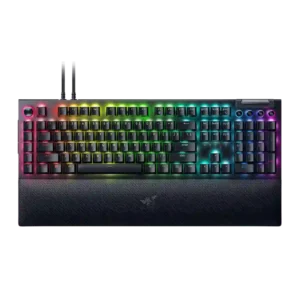
RGB lighting quality is one of the board’s standout features, with reviewers repeatedly praising the brightness, underglow, wrist-rest lighting, and overall presentation.
The product family spans compact and full-size versions, so buyers can choose between desk space and a full layout.
The full-size form factor gives buyers every control they could want, but several reviewers stress that it is undeniably big and best suited to larger desks.
The web configurator is the keyboard’s clearest weakness, with repeated complaints about bugs, confusion, limits, or unfinished behavior.
Software quality is mixed. Synapse is often called easy enough to use, but many reviews criticize its background dependency, resource use, or occasional inconsistency.
The dense internal foam and layered dampening clearly help suppress rattle and shape the sound.
Sound dampening is a genuine plus, with multiple reviewers noticing that the internal foam cuts down ping, reverb, and harsher case noise.
Stabilizers are a strength, with reviewers calling out low rattle and solid larger keys.
Stabilizers are better than expected for a mainstream gaming board, with reviewers noting improved stability, low rattle, and effective factory lubrication.
The inductive switches are widely praised as smooth and pleasant to use.
Across multiple switch variants, reviewers describe the switch feel as smooth, fast, and satisfying, with Yellow switches especially easy to game on and Green switches still enjoyable for clicky fans.
Switch choice is currently narrow because the board depends on Ducky’s proprietary inductive switch ecosystem.
Reviews confirm two stock switch choices, Green clicky and Yellow linear, which gives buyers a basic choice but not a broad menu of switch options.
Long sessions are generally comfortable, though the larger chassis and lack of a wrist rest can still wear on some users.
Typing comfort is generally good for long sessions, though not every switch variant feels equally cushioned for extended writing.
Typing feel is one of the clearest reasons reviewers kept reaching for this keyboard.
Typing feel is generally praised for being fast and satisfying, though it depends somewhat on switch choice and the board’s larger layout.
Some reviews see the price as attractive for a wireless analog board, but the software caveats still affect the overall value story.
Value depends on whether you will use the extra features. Many reviewers think the feature set helps justify the price, but several still call the board expensive.
Dedicated volume control is included rather than buried in generic function shortcuts.
Volume control is a strong point, with the roller or dial repeatedly described as smooth, satisfying, and easy to use.
Wireless mode is generally stable and responsive enough for everyday gaming use.
No wrist rest is included, so this area is a straightforward weakness.
Wrist rest quality is one of the most praised parts of the package, with reviewers repeatedly calling it soft, comfortable, and premium, even if a few mention connection or height quirks.