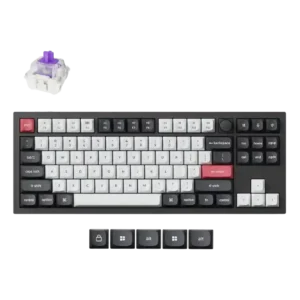
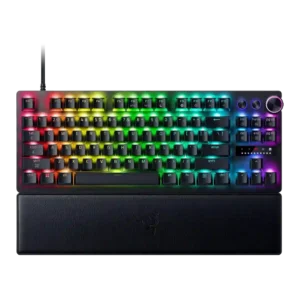
The board's sound profile is a recurring highlight, with reviewers calling it refined, satisfying, soft-muted, or simply excellent out of the box.
Acoustic tuning is serviceable rather than class-leading in the limited direct coverage.
Hall Effect tuning is a clear strength, with reviews highlighting adjustable actuation, very light trigger points, and precise activation and reset behavior.
Reviewers consistently say actuation is accurate and easy to fine-tune, with precise recognition across the adjustable range.
One review explicitly says the board can adjust steering angle in racing use, pointing to analog-style input behavior beyond simple on/off presses.
Analog input support is real and flexible, but usefulness depends heavily on the game; some reviewers loved the controller-like movement while others found support inconsistent.
Backlighting looks bright enough to stand out, but reviews frame it as balanced rather than overwhelming or overly flashy.
Backlight brightness is generally strong, especially on 8K variants, but one review found it dimmer than expected.
Battery evidence is mixed but generally good: one reviewer praises endurance, another cites up to 100 hours, and one warns that wireless RGB use drains it faster.
Build quality is one of the clearest strengths in the review set. Nearly every reviewer highlights the heavy metal construction and sturdy, premium overall feel.
Build quality is widely described as premium and solid, usually anchored by the aluminum top plate, though a few reviews note the plastic lower shell or lighter weight.
Cable quality gets favorable mentions through bundled braided USB-C cabling and included adapters.
The detachable braided USB cable is viewed positively where mentioned.
Cross-platform compatibility is a strong point, with repeated mentions of Mac and Windows modes and smooth switching between systems.
Compatibility is limited where discussed, especially because Synapse setup is unavailable for Mac and some analog features depend on game support.
Connectivity is one of the most consistently praised features, with repeated support for wired, Bluetooth, and 2.4GHz use across multiple setups.
Connectivity is basic wired USB-C only. Reviews frame that as functional but not flexible.
Customization breadth is one of the board's biggest advantages, spanning actuation tuning, remapping, macros, lighting, and broader software-side personalization.
Customization is one of the strongest recurring themes, spanning actuation depth, per-key tuning, profiles, onboard controls, and game-specific behavior.
One review specifically says the Q3 HE uses the same footprint as a Mac Magic Keyboard, indicating strong desk-space efficiency for its feature set.
The smaller variants clearly improve desk space for mouse movement.
Durability evidence is strong. Reviews mention long-lasting materials, wear-resistant PBT caps, and a build that feels made for years of use.
Durability coverage is positive, with reviewers pointing to heavy-use readiness, long switch life, and materials that should hold up well.
Switch replacement appears straightforward in the supported ecosystem, with reviewers describing hot-swap support and simple pull-out, click-in handling.
Direct evidence is limited, but one review notes the switch mechanism can be replaced with another Razer optical switch.
Ergonomics are mixed but still favorable overall: one reviewer reported no cramping or adjustment period, while another wanted more angle flexibility and a palm rest.
Ergonomics are generally positive due to tilt options and smaller variants, though comfort still depends on whether you like the firmer wrist rest.
Extra gaming features are a major selling point, especially Rapid Trigger, Snap Tap or SOCD-style behavior, and multi-action Hall Effect functions.
Features like Snap Tap, dual-step inputs, special onboard shortcuts, and controller-style behavior are repeatedly framed as meaningful competitive extras.
Reviewers repeatedly connect the board's weight and stiffness with better stability on the desk, noting sturdy construction and reduced unwanted movement.
One review found the chassis rigid enough for normal use but not especially resistant to twisting.
Gaming performance is a repeated strength. Reviewers describe the Q3 HE as strong for gaming thanks to responsive switches, Hall Effect features, and dependable wireless or wired behavior.
Gaming performance is the standout theme across reviews, with repeated praise for speed, responsiveness, counter-strafing, and overall competitive advantage.
Hot-swap support is present for compatible switches, and reviewers explicitly note that the switches can be removed or swapped.
Reviews explicitly note that the switches are not hot-swappable, which is a clear downside versus more mod-friendly competitors.
Keycaps get positive marks for material and feel, with reviewers specifically praising the soft-touch double-shot PBT caps and solid OSA set.
Double-shot PBT keycaps are widely praised for texture, grip, durability, and premium feel.
Key response is repeatedly praised as fast and accurate, with reviewers calling the switches highly responsive and easy to trigger in play and daily use.
Supported reviews describe the keyboard as highly responsive in both gaming and repeated inputs.
One reviewer specifically praises the separated layout for reducing accidental presses, suggesting thoughtful spacing around key clusters.
Where discussed, spacing is praised as comfortable and easy to work with.
One reviewer says larger keys still press evenly with no difference across the edges, suggesting generally stable key behavior in use.
One review specifically praised reduced keycap wobble on the updated 8K model.
The only direct latency evidence is positive, with one reviewer saying they did not notice input lag in testing.
Latency is a clear strength, with reviews describing inputs as almost instantaneous and citing very low measured latency on 8K variants.
The layout is generally praised for offering a full TKL arrangement with useful keys and a knob while avoiding a full-size board's extra bulk.
Layout flexibility is good, with reviewers noting full-size, TKL, and Mini variants.
Legend visibility is acceptable rather than exceptional: reviewers mention crisp legends and say the keys remain visible even without shine-through caps.
Legend visibility is strong where discussed, with bright, even shine-through coverage.
Macro and advanced key-action customization are well supported, with reviews mentioning custom macros, layered actions, and depth-based behavior.
Macro support is present and directly mentioned, but detailed evaluation is limited.
Materials quality is consistently praised, especially the aluminum chassis and premium-feeling parts throughout the package.
Where discussed directly, the aluminum top plate was seen as a premium materials choice.
One review explicitly calls out built-in media shortcuts for backward, play or pause, and forward control.
Media controls are generally useful and well featured, though a few reviewers disliked the button layout or feel.
Noise levels are repeatedly described as low for a mechanical board, with several reviewers calling it quiet or subtle enough for shared workspaces.
Noise level is the clearest weakness across reviews; many call the board loud, clacky, or rattly, especially for shared spaces.
One review explicitly mentions onboard memory that stores up to three saved profiles.
Onboard memory is positively covered where discussed, making saved profiles and settings practical without always relying on software.
Pass-through is a clear miss; reviews explicitly call out the lack of USB passthrough or extra ports.
Per-key RGB control is explicitly supported and reviewed positively, though direct discussion is limited.
Polling is consistently described as 1,000Hz. Reviewers found it responsive in practice, but some also point out that rivals now offer higher polling at similar or lower prices.
Polling performance is strong overall because 8K variants are praised heavily, though one TKL review criticized the base model for topping out at 1,000Hz.
Portability is a weak spot. Reviewers acknowledge the smaller layout but repeatedly say the heavy chassis is better suited to staying on a desk than traveling.
Limited direct evidence suggests portability is decent because the board is relatively light for its class.
One review states that the keyboard can save up to three profiles for different games or work setups.
Profile management is a strength, with onboard and quick-switch profiles repeatedly praised.
Rapid Trigger is explicitly called out in several reviews and is treated as one of the board's standout competitive-gaming features.
Rapid Trigger is one of the product line’s signature strengths, repeatedly praised for faster resets, easier counter-strafing, and better competitive responsiveness.
Reliability evidence is limited and slightly mixed: one reviewer reported occasional Bluetooth reconnect issues before a firmware update.
Where discussed, reliability is a positive, tied to longer-lasting optical switches and fewer failure-prone contacts.
RGB customization is well supported through effects and settings, with reviewers mentioning numerous lighting options, Pixel Rain, and easy software-side changes.
Chroma customization is deep, with per-key effects and broad control called out positively.
RGB quality is generally well-liked. Reviews describe the lighting as gorgeous or aesthetically pleasing, though some note it is more tasteful than intensely bright.
RGB quality is consistently praised for bright, even diffusion and strong legend coverage.
Reviewers like the compact TKL or 80% footprint, repeatedly noting that it preserves useful keys while staying smaller than a full-size keyboard.
Form factor coverage is positive, especially for TKL and Mini models that balance features with gaming space.
Software is a major strength. The web-based configurator is repeatedly described as smooth, easy to use, and unusually polished for this category.
Synapse offers very deep control, but reviewers are split on usability; some found it powerful and easy enough, while others called it bloated, finicky, or overwhelming.
Sound dampening appears effective, with reviews citing double-gasket construction, padding, reduced resonance, and very low echo.
Sound damping improved on newer and 8K versions thanks to foam and added dampening, but reviews still do not place the keyboard among the best-sounding boards overall.
Stabilizer feedback is mostly positive. Multiple reviews praise low rattle and solid large-key behavior, though one reviewer still noticed slight spacebar wobble.
Stabilizer quality is mixed: some reviews note good lube or no rattle, while others still hear scratchiness or feel the implementation is only average.
Across multiple reviews, the switches are described as tactile or smooth, with a satisfying pop and bouncy feel rather than a harsh or scratchy response.
Reviewers generally liked the Gen-2 analog optical switches for feeling smooth, light, and fast, though a few noted wobble or a less comfortable bottom-out.
Switch choice is a recurring limitation: reviewers note narrow compatibility or support for only specific magnetic switches, even if the included options generally sound and feel good.
Typing comfort is consistently strong, with multiple reviewers reporting comfortable all-day use, low fatigue, and an easy adjustment period.
Typing comfort is mixed. Some reviewers found it comfortable for long sessions, but others never fully adjusted or disliked the rigid typing feel.
Typing feel is a strong positive overall, with reviewers describing the board as great to type on, unique in character, and pleasing in both sound and feel.
Typing feel trends positive once actuation is tuned, with many reviewers calling it smooth or satisfying, but several still preferred it more for gaming than daily typing.
Value is the biggest tradeoff in the review set. Some reviewers still think the board is worth it, but many also say the price is steep relative to competing options.
Value is mixed. Reviewers respect the feature set and performance, but many still question the premium price unless you specifically want its competitive features.
Volume control is a clear convenience feature, with reviewers highlighting the knob and dedicated audio controls as useful quality-of-life touches.
The dedicated volume control is positively received in the limited direct coverage.
Wireless performance is described positively overall, especially for gaming, with reviewers calling the connection accurate, responsive, and dependable in use.
Wrist rest quality is mixed overall: some reviewers appreciated the support, but many found it firmer and less plush than earlier Razer rests.