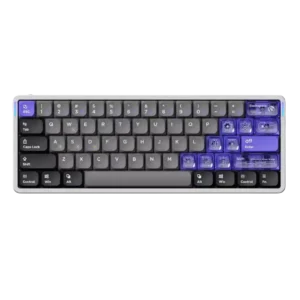
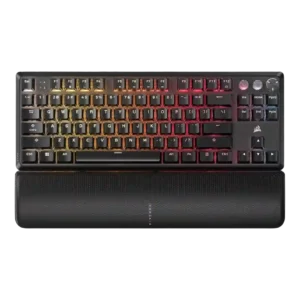
Across reviews, the Air60 HE is repeatedly described as sounding unusually good for a low-profile board, with a deeper and more premium tone than expected.
Acoustics are mixed to negative overall: some reviews found limited ping, but several others called out obvious pinging or a harsher sound profile.
Reviewers describe the low-profile magnetic switches as stable and predictable, with travel and adjustable actuation behavior that feel consistent in use.
One measured review found actuation and peak-force behavior within spec, supporting consistent key triggering on the tested sample.
One review explicitly highlights Hall Effect support for analog control in addition to multi-function key behavior.
The south-facing RGB is described as bright and easy to notice, even without relying on shine-through legends.
Brightness control is available directly on the board, with stepped adjustment for the backlight.
Reviewers generally describe the board as solid and sturdy, with few complaints about the overall chassis construction.
Build quality is a major strength across reviews, with the board repeatedly described as sturdy, premium-feeling, and well put together.
The included USB-C cable is described positively, especially its right-angled design and matching finish.
The detachable USB-C cable is viewed positively, with reviewers appreciating the quality, serviceability, and easier handling versus fixed cables.
Reviews mention support across Windows, Mac, and Linux, with one review also calling out Android and iOS compatibility.
Compatibility coverage is good for Windows, macOS, and Xbox based on the review set, though one review separately warned about PS5 limitations.
Wired USB-C helps keep performance fast, but the lack of wireless is the most common connectivity complaint.
Connectivity is stable and simple through wired USB-C, but reviews clearly frame the board as wired-only rather than wireless-flexible.
The browser-based configurator gives users broad control over remaps, actuation, layers, and gaming behaviors.
Overall customization is one of the board’s clearest strengths, spanning lighting, macros, key behavior, and saved presets.
The compact 60% footprint is repeatedly praised for reclaiming desk space and leaving more room for mouse movement.
Its full-size footprint reduces desk efficiency compared with smaller boards, and at least one reviewer called the overall footprint fairly large.
Materials and construction suggest decent longevity, but one reviewer reports scratch-prone caps and underside surfaces.
Durability evidence centers on the stock keycaps, with one review noting the legends should effectively never wear away.
Switch changes are possible thanks to the hot-swappable PCB, though the ecosystem is still limited.
Because it is not hot-swappable, changing or replacing switches is treated as inconvenient compared with newer enthusiast-oriented boards.
The low profile and adjustable feet help comfort, but convenience is reduced by wired-only use and some foot design complaints.
Ergonomics are generally decent, but not flawless: comfort is available, yet one review found the palm rest could interfere depending on positioning.
Rapid Trigger, SOCD/LKP-style functions, DKS, HyperTap, and related Hall Effect tools are a major strength of this keyboard.
Gaming-specific extras are strong overall, especially tournament mode, Windows lock behavior, NKRO/anti-ghosting, and other competitive-use controls.
Multiple reviews call the case rigid and sturdy, with no meaningful flex or creaking.
One review specifically reported very little flex, supporting a solid and rigid frame.
Across reviews, gaming performance is a standout, with especially strong praise for responsiveness in fast-paced games.
Gaming performance is one of the board’s strongest themes, with responsive inputs, dependable play, and useful full-size functionality for game controls.
Hot-swap support is present, but reviewers repeatedly note that compatible low-profile magnetic switch choices are scarce.
The board is explicitly described as not hot-swappable in review coverage.
Keycap impressions are mixed: some reviewers praise the material choice and feel, while others dislike slipperiness, thinness, light bleed, or scratching.
Double-shot PBT keycaps are repeatedly praised for thickness, texture, and overall quality, with durability also cited as a benefit.
Reviews describe the keys as quick and responsive, with fast, accurate behavior once actuation is tuned.
Key response is consistently strong, with reviews describing accurate command parsing and reliable registration under fast input.
The flat low-profile layout can make mis-hits and typos easier for some users, especially if they rely on key shape for guidance.
Key size and spacing are treated as comfortable and easy to navigate in the reviewed full-size layout.
Main keys are often described as stable, but the space bar and a few stabilizer-related behaviors draw criticism.
One review noted some key wobble, but said it was not distracting during normal use.
Low latency is a recurring positive, with reviewers consistently framing the board as fast and responsive.
Latency performance is a clear strength in review coverage, with low-latency behavior praised in play and one review citing sub-0.25 ms figures.
The Air60 HE is firmly a compact 60% board, and reviews note limited layout flexibility plus no ISO option.
Software support extends to alternate layouts, with one review explicitly mentioning options beyond QWERTY.
Legend visibility is mixed, with complaints about soft legend clarity, visual busyness, and light bleed on some caps.
One review explicitly says the keycaps are easier to read, pointing to strong legend clarity on the stock caps.
Macro support appears in the specs and software coverage, but one review reported it missing at the time, so the experience looks mixed across review dates.
Macro setup is a strength, with reviews describing recording and remapping as straightforward and widely available.
Reviewers consistently mention the aluminum top frame, ABS bottom, and PBT caps as good material choices for the price.
Materials quality is strong overall, with aluminum and solid plastics described as substantial rather than cheap.
Media functions are available through layers rather than dedicated keys or controls.
Dedicated media controls are a recurring highlight, with reviewers praising their convenience and easy access.
The Air60 HE is generally described as quieter and more office-friendly than many gaming boards, even if it is not silent.
Noise level is not especially low, with reviewers describing the board as noisy or overwhelmed by sound in quieter use.
The board stores a small number of programmed layouts/profiles on-device, but that capacity is limited.
Onboard memory is a standout feature, with repeated praise for the large profile count and hardware storage capacity.
USB passthrough is treated as a missing feature on this model compared with older K70 variants.
One review explicitly lists RGB per-key lighting alongside the board’s side lights.
Per-key lighting control is clearly supported, with multiple reviews noting individual-key programmability and customization.
High polling is a core part of the Air60 HE’s performance story, with 8,000Hz repeatedly mentioned across reviews.
The 8,000Hz polling option is widely noted, but its real-world benefit is mixed: some reviewers noticed gaming gains, while others called it hard to perceive.
The board is compact and easy to pack, but wired-only operation reduces some of its natural portability advantages.
Portability gets a modest boost from the detachable cable, but this remains a full-size wired board rather than a travel-first design.
The physical switch makes profile changes quick, but the three-profile limit is one of the more common complaints.
Profile handling is unusually deep, with lots of hardware profiles and easy switching called out across reviews.
Rapid Trigger is widely highlighted and reviewers generally describe it as working as expected.
Everyday behavior is mostly described as solid, but one reviewer hit firmware-update bugs before reverting and recalibrating.
Reliability is excellent in the review set, with no-chatter behavior and consistent keystroke registration called out directly.
Reviews note a healthy range of lighting effects and app-based RGB controls.
RGB customization is deep, with iCUE and onboard controls supporting presets, layers, and user-created lighting setups.
RGB looks bright and eye-catching, especially with the translucent accent caps, though some reviewers dislike the stock cap look or light bleed.
RGB output is described as vivid and attractive, with strong effects and even unusually accurate white reproduction in one test.
The ultra-compact low-profile 60% form is central to the product’s appeal, even if that shape is not ideal for everyone.
The board is consistently presented as a full-size layout with numpad and extra top-row controls.
NuPhy.io is one of the board’s biggest strengths, with repeated praise for being web-based, capable, and easy to use.
iCUE is widely seen as capable and feature-rich, though some reviewers mention extra digging or heavier system impact.
Foam and silicone layers are repeatedly credited with softening the board’s sound and giving it a more muted tone.
Sound damping appears weak in the reviewed units, with case ping cited instead of a muted or cushioned sound.
Stabilizers are acceptable overall, but the space bar is repeatedly singled out for wobble, rattle, or weaker sound.
One review found little stabilizer rattle, though broader review coverage suggests this is not a universally emphasized strength.
The low-profile Jade and Jade Pro switches are widely praised for smoothness and satisfying feel, with Pro switches often preferred for control.
Switch feel is generally smooth and quick across Cherry options, but the Speed Silver implementation can feel overly sensitive for some users.
Switch choice is narrow right now, with reviewers only pointing to the Jade and Jade Pro low-profile magnetic options.
Reviewers repeatedly highlight the broad Cherry MX selection as a strength, with multiple switch types available at purchase.
Many reviewers find the Air60 HE comfortable for long sessions, especially given its low profile and optional wrist-rest support.
Typing comfort is broadly good for longer sessions, helped by the key shape and included wrist rest in favorable reviews.
Typing is often described as surprisingly enjoyable for a gaming-focused low-profile board, though some reviewers still report tradeoffs in accuracy or excitement.
Typing feel is good enough for daily use and gaming, but not universally premium; sound and hollowness pull the experience down in weaker reviews.
Most reviews frame the Air60 HE as strong value for its feature set and performance, though a few are less convinced against specific alternatives.
Value is mixed: some reviewers think the quality justifies the price, while others emphasize that it remains expensive for what you get.
The volume wheel/roller is consistently praised for smooth operation, texture, and day-to-day convenience.
The optional wrist rest is described as comfortable, though one reviewer felt the low profile made it nonessential.
The magnetic wrist rest gets mostly positive marks for comfort and easy attachment, but reactions are mixed because some reviewers disliked the surface or magnetic security.