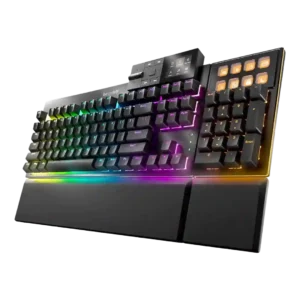
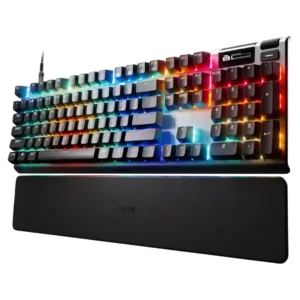
Multiple reviewers call the Dark Mount exceptionally quiet, with muted mechanical character instead of clacky feedback.
Reviews describe the acoustics as improved and pleasing overall, with quieter thockier notes than earlier models, though a few still mention some hollowness or remaining rattle.
Switch action is described as consistent and precise, with steady pressure and predictable travel.
The adjustable actuation system is praised for its range and usefulness, but evidence is mixed on precision because some reviews found the programmed points less accurate than expected.
Reviewers explicitly note standard mechanical switches with no analog, optical, or hall-effect functionality.
One review says the keyboard lacks deeper analog-style gamepad emulation, so analog-style switch behavior is present but full analog control support appears limited.
Brightness is adjustable, and reviewers note vivid lighting, though underglow intensity is not universally praised.
Backlighting is usable and visibility is generally good, but multiple reviewers wanted brighter lighting or found the illumination less bright than expected.
Wireless reviews point to roughly 35 to 45 hours of use, with one reviewer also describing about two days of heavy gaming before recharge.
The main board is repeatedly described as solid and premium, though some add-on modules show minor play.
Build quality is a major strength, with reviewers repeatedly calling the board sturdy, tank-like, and premium-feeling across full-size, TKL, and mini variants.
Included cabling is braided and detachable, which reviewers generally treat as a quality convenience.
The detachable braided cable is consistently described as a quality inclusion that feels less intrusive and easier to live with or transport.
Web-based setup broadens support across Windows, Mac, and Linux, reducing software lock-in.
A review highlights compatibility with MX-style keycaps, suggesting the board works well with existing keycap collections and aftermarket cap swaps.
Connectivity is stable but limited to wired use, with no Bluetooth or 2.4GHz option.
The keyboard supports wired and wireless connections, and setup is often smooth, with Bluetooth and 2.4GHz options appearing prominently in the evidence.
Modularity, lighting, remapping, and attachment placement give the Dark Mount unusually deep customization.
Customization is extensive, with reviewers citing deep per-key tuning, presets, profiles, RGB controls, and enthusiast-level adjustment options.
The removable numpad helps reclaim mouse space and makes the layout more adaptable to tight desks.
Desk-space efficiency depends heavily on the chosen size: mini and TKL models free up room, while the full-size board is clearly space-hungry.
PBT caps and sturdy construction point to good long-term wear resistance on the main typing surface.
Durability is presented positively through sturdy frames, durable-feeling construction, and long-wearing keycap or switch claims.
Hot-swap support and included tools make switch or keycap changes straightforward.
Ease of replacement is helped by included pullers and removable parts, but the broader switch-swapping story is not universally simple across variants.
Magnetic feet, movable modules, and wrist-rest options improve fit, though comfort is not perfect for everyone.
Ergonomics are generally strong, with comfortable angles, reachable layouts, and palm-rest support helping longer sessions feel easier.
Display keys, onboard controls, and quick-access functions add utility, but they are not esports-focused extras.
Rapid Trigger, Rapid Tap, Protection Mode, dual-action bindings, and similar features give the Apex Pro Gen 3 one of its clearest gaming-specific advantages.
The keyboard frame is repeatedly described as rigid with very little flex.
Frame rigidity is a strength, with reviewers noting dense construction, little wobble, and cases that stay planted on the desk.
Core gaming response is strong, but reviewers frequently say it lacks standout competitive features.
Gaming performance is repeatedly described as fast, precise, and especially strong for shooters, esports titles, and other quick-response games.
Hot-swap support is consistently highlighted as a major strength.
Hot-swap support is mixed in the review set: several reviewers say the switches are not hot-swappable, while others describe at least partial hall-switch swapping.
PBT double-shot keycaps are widely praised for texture, durability, and overall finish.
Keycaps are generally praised for textured, premium-feeling double-shot PBT construction and good overall feel under the fingers.
NKRO and quick response are repeatedly noted, with reviewers saying fast inputs register cleanly.
Key responsiveness is one of the most consistently praised traits, with reviews emphasizing quick registration, snappy response, and precise inputs.
Key spacing and reach are generally comfortable, with reviewers saying keys are easy to access and not overly stretched or cramped.
Large keys and stabilizer-supported presses are described as controlled, with low wobble.
Key stability is mostly positive thanks to reduced wobble and steadier larger keys, though a few reviews still note some rattle or inconsistency.
Responsiveness is solid for normal gaming, but the 1,000Hz class spec is not positioned as elite.
Latency is usually low in wired use, but wireless evidence is more mixed because at least one reviewer reports noticeable latency or connection-related delay.
The Dark Mount flexes between TKL-style and full-size use, with left/right attachment flexibility.
The lineup offers multiple layout choices, including full-size, TKL, and mini or 60 percent variants depending on the review source.
Legends generally light clearly, but some secondary icons are hard to read on the dark board.
Legend visibility is strong in the evidence, with labels staying readable and backlighting helping the legends remain clear.
Macro setup is a major selling point, especially on the display keys and remappable controls.
Macro customization is well supported through software and onboard controls, with reviewers noting macro recording, reassignment, and dual-action possibilities.
Materials feel robust overall, led by the aluminum top plate, though plastic remains part of the build.
Material quality is usually seen as premium through aluminum plates, sturdy plastics, textured surfaces, and PBT caps, though some mini-case criticism appears.
Dedicated media controls are useful, but several reviewers criticize the dock buttons or wheel feel.
Media controls are included and useful in principle, but several reviewers say the wheel or screen-based controls can feel awkward or cumbersome.
The Dark Mount stands out as one of the quietest mechanical keyboards reviewers tested.
Noise levels are generally moderate and improved over older or louder gaming boards, with multiple reviews saying the board avoids being distractingly loud.
Profiles and settings can be stored on the keyboard, reducing reliance on active software.
Onboard memory and hardware-stored presets are a real convenience, allowing profiles or settings to travel with the keyboard without constant software reliance.
Attachment ports are proprietary, and reviewers explicitly note the lack of true passthrough.
USB passthrough is absent or missing in the reviewed units, and that omission is called out as a downside more than once.
Per-key lighting is present and software-adjustable, with broad effect control.
Per-key lighting control is widely supported, with reviewers citing individual-key RGB customization and fine-grained lighting adjustments.
Polling is a standard 1,000Hz, acceptable for mainstream play but not a headline feature.
The 1000Hz polling rate is considered adequate for most use cases, though some reviewers note it is no longer class-leading at this price.
Heavy weight and modular bulk make this a poor travel keyboard.
Portability is decent for detachable-cable and compact versions, but full-size models remain less travel-friendly than TKL or mini options.
Multiple profiles and on-board switching are well supported through software and hardware controls.
Profile management is robust, with QuickSet menus, multiple saved profiles, and easy switching called out across several reviews.
Rapid trigger and related advanced actuation features are repeatedly called out as missing.
Rapid Trigger support is a headline feature and is consistently described as effective for faster resets and quicker repeated inputs.
Core typing is dependable, but reviewers note software hiccups, module play, and easy-to-lose covers.
Reliability is mostly positive in typing and gameplay, but one wireless review introduces some caution by reporting intermittent dropouts.
Lighting customization is extensive, with multiple effects, colors, and segment control.
RGB customization is broad and feature-rich, with Prism, effects, reactive lighting, and per-key color changes repeatedly mentioned.
RGB output is generally vivid and attractive, though some reviewers note minor unevenness or weaker accents.
Lighting quality is usually attractive and even, but not perfect, since some reviews mention limited brightness or imperfect color accuracy.
The format is versatile but still physically large once attachments are installed.
Form-factor choice is a core part of the product family, with TKL and mini options praised for compactness while full-size boards stay substantial.
IO Center is generally well received, especially its web mode, but it still shows early rough edges.
SteelSeries GG is feature-rich and usually workable, but many reviewers describe it as bloated, cluttered, or less intuitive than it could be.
Multiple dampening layers meaningfully suppress resonance, echo, and harsh key noise.
Sound dampening is a real improvement point, with multiple layers of foam or dampening material frequently credited for the quieter, fuller sound.
Stabilizers are consistently praised for reducing rattle and keeping larger keys controlled.
Stabilizer quality shows improvement in several reviews, especially on larger keys, though some reports still mention spacebar noise or inconsistent tuning.
Switch feel is smooth, quiet, and refined, with linear and tactile variants both framed positively.
Switch feel is usually described as smooth, buttery, light, and fast, but a few reviewers think the switches are too light or not especially impressive.
Buyers can choose between silent linear and silent tactile stock switches.
Switch options vary within the family, with size and wireless choices available, but some reviews note mixed switch types on certain rows or keys.
Typing is widely described as comfortable, soft, and pleasant over long sessions.
Typing comfort is a standout strength for many reviewers, especially with the included wrist rest, though a few ergonomic caveats appear on some variants.
The overall typing feel is polished and satisfying, especially for quiet-focused users.
Typing feel is widely praised for writing and general use, with smooth travel and enjoyable feedback, although one mini-focused review found it less special.
Value is divisive: some reviewers justify the feature set, while many still call the price high.
Value for money is the most divided attribute: some reviewers think the features justify the premium, while others say the price remains hard to defend.
Volume control is convenient, but precision and wheel feel draw repeated criticism.
The volume wheel or roller is one of the more appreciated hardware controls, with multiple reviews specifically calling out easy volume adjustment.
Wireless performance is effectively absent because the Dark Mount is wired-only.
Wireless performance is convenient and sometimes near-wired in feel, but the evidence is mixed because one review reports latency and intermittent issues.
Magnetic wrist rests are usually liked for softness and stability, though not every reviewer finds them ideal.
The magnetic wrist rest is a commonly praised inclusion for comfort and stability, even if some reviewers find it firmer or less cushioned than they prefer.