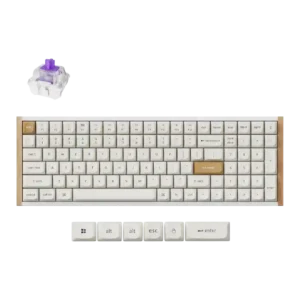
Multiple reviewers praise the K4 HE’s sound, describing it as marvellous, thocky, or simply nice, with little rattle mentioned.
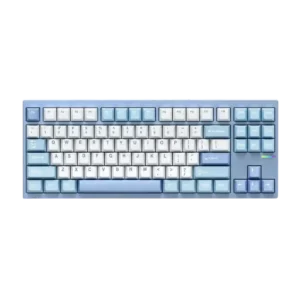
Reviewers praise the GX87’s stock sound as a standout, describing it as refined, lively, and unusually satisfying for a prebuilt board.
One review explicitly describes the magnetic switches as consistent and responsive in action.
One review specifically says the switches deliver a consistent key press.
Reviews consistently note analog-style input support, including gamepad or joystick emulation and variable control based on key depth.
One review says the backlight is too dim to see well in daylight.
Battery life is generally viewed as good, with evidence citing roughly 100 to 110 hours, though one reviewer notes stronger battery life exists elsewhere.
Battery life is a clear strength, with multiple reviews calling out the large 8,000mAh capacity and very long runtime.
Reviewers repeatedly describe the board as sturdy, solid, or premium-feeling, with little or no flex reported.
Multiple reviewers describe the GX87 as very well built, with strong assembly, solid casework, and no obvious quality-control issues.
Cable feedback is mixed: reviewers like the included cable quality or angled design, but several also call it short.
One video calls the included cable cheap and unimpressive.
Reviews say the K4 HE works across Windows and macOS, and one review also mentions Linux support.
Key mappings are described as persisting across multiple devices, which supports multi-device use.
Multiple reviews confirm wired, 2.4GHz, and Bluetooth support, with easy switching and multi-device use.
The board offers Bluetooth and 2.4GHz wireless modes, but one review also reports minor connectivity issues.
The K4 HE offers unusually deep customization in the evidence, especially around per-key actuation, remapping, and gaming settings.
Reviewers consistently say the GX87 is easy to customize, thanks to straightforward disassembly and mod-friendly design, with one video also mentioning swappable top colors.
The 96% layout is repeatedly framed as saving desk space while keeping most of a full-size board’s utility.
The TKL layout is described as saving desk space versus full-size boards while keeping a familiar key set.
One reviewer reports the board survived a coffee spill and kept working afterward.
One review explicitly says the GX87 feels built to last.
Switch swapping is possible, but replacement is constrained to specific magnetic Gateron HE options.
Switch replacement is described as very easy because switches can be removed and replaced without soldering.
Ergonomics come across as decent thanks to angled rows and a posture-friendly typing stance, though nothing suggests a low-profile feel.
The fixed typing angle is presented as standard enough that it should not bother most users.
The review set repeatedly mentions quad-actuation, Snap Tap or LKP, dynamic keystrokes, and similar Hall Effect gaming extras.
A dedicated ultra low latency mode is explicitly mentioned in the software.
Reviewers report no body flex and very stable behavior on the desk.
The chassis is praised for having no flex or rattles, though one video notes the quick-release design may feel less rigid than a screwed-in case.
Across shooter and general gaming use, reviewers consistently describe the K4 HE as fast, capable, and competitive.
Reviewers say the GX87 handles gaming well, especially for hybrid work-and-play use, even if it is not framed as a specialist Hall Effect board.
The switches are hot-swappable, but that advantage is limited by the restricted switch ecosystem.
Hot-swap support is clearly confirmed across reviews, making switch swaps part of the board’s appeal.
Reviews praise the included PBT or OSA keycaps for feel, shape, and durability cues.
One review specifically praises the included PBT keycaps as high quality.
Magnetic switches are consistently described as quick to register and helpful in fast gameplay.
One review says the switches feel fairly responsive in play.
The condensed 96% layout is the most common complaint, with several reviewers calling the keys cramped or easy to mis-hit.
Double-rail magnetic switches are credited with reducing wobble and improving key stability.
Latency is generally strong for the category, though some evidence says it is not class-leading.
Latency is framed positively for normal gaming use, with reviewers noting reduced latency concerns and immediate-feeling keypresses.
Legend visibility is mixed: one review praises clear legends, while others note non-shine-through caps and harder-to-see lighting on the Special Edition.
Reviews confirm robust macro support, including complex macros and flexible mapping.
Macro support is explicitly mentioned as part of the board’s deeper customization toolkit.
Materials get mixed-positive remarks: aluminum framing and real wood accents add quality, while some plastic remains in the shell.
The materials are consistently praised, especially the aluminum chassis and PBT keycaps, with one reviewer also highlighting the smooth finish.
Media controls are available through FN combinations rather than dedicated keys.
One review specifically says the switches are not very loud.
The sound profile is described as muted rather than sharply loud, keeping the board’s thock controlled.
Reviews confirm onboard memory for saving settings or profiles on the keyboard itself.
Customizations are explicitly described as being stored on the keyboard itself.
One review explicitly says there is no per-key lighting customization for custom colors.
Polling rate is consistently cited at 1,000Hz, which reviewers view as solid for the price but not top-tier.
The keyboard is repeatedly described as running at 1,000Hz, with one video also discussing a low-latency mode.
One review highlights the relatively light weight and says it is easy to carry in a backpack.
Its heavy all-metal build makes it less convenient to carry around or reposition frequently.
Reviews mention multiple saveable profiles, typically three, for work and gaming setups.
Rapid Trigger support is a core selling point across the review set and is repeatedly described as useful for fast inputs.
Reliability evidence is positive, with one reviewer expecting years of use and another reporting no issues after a spill.
One review reports rare duplicate key registrations and a fringe long-hold input issue, so reliability is good but not flawless.
Lighting customization includes selectable effects and colors, though the evidence does not show full per-key color control.
Lighting customization exists and can be adjusted, but the experience is not unanimously polished, with one review calling it clunky.
RGB quality is mixed: some reviewers call it vibrant or solid, while others say the Special Edition lighting looks subdued.
The 96% form factor is repeatedly framed as near-full-size functionality in a smaller footprint.
The GX87 is explicitly described as an 80% TKL, giving it a compact-but-not-tiny footprint.
Keychron Launcher is widely praised for being easy and flexible, though several reviews note that changing settings usually requires a wired connection and one calls the UI cluttered.
Software support is generally seen as good for the category, with QMK/VIA support and dedicated software, though one reviewer still found VIA basic.
Several reviews mention foam, acoustic pads, or low rattle, suggesting effective sound dampening.
Internal foam and damping layers are specifically credited with reducing ping and cleaning up the typing sound.
Stabilizers are mixed but acceptable overall: one review says they are nearly silent, while another wanted a bit more lube.
Switch feel trends positive overall, with reviewers calling the magnetic switches airy or satisfying, though one found them too soft for typing.
The stock linear switches are described as satisfying, bouncy, crisp, and snappy in everyday use.
Switch choice is limited, with several reviews noting support only for specific double-rail magnetic switches.
Switch choice at purchase is limited, with one review explicitly noting only two similar linear options and no tactile choice.
Typing comfort is generally good in the evidence, with comfortable profiles and approachable feel once acclimated.
Typing comfort is positively described, with reviewers calling out a soft, bouncy, comfort-focused feel.
Typing feel is mostly praised for sound and smoothness, but one reviewer found it sloppy for typing out of the box.
Typing feel is strongly positive, with reviewers describing the GX87 as joyful, smooth, and satisfying to type on.
Value is one of the clearest strengths, with multiple reviews explicitly calling the K4 HE well-priced or high value for its feature set.
Reviews repeatedly frame the GX87 as unusually strong value, pairing premium-feeling features with a budget-friendly price.
Volume control exists through function-key shortcuts rather than a dedicated knob or wheel.
Wireless use looks strong in the reviews, with easy multi-device use and quick wake behavior.
Wireless behavior is praised for reconnecting quickly after idle and feeling responsive in use.