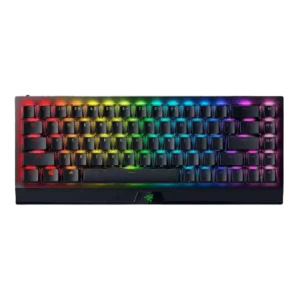
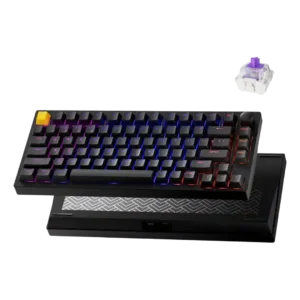
Sound is mixed: some reviewers like the sharper click or subtle tap, while others say larger keys sound louder or less refined.
Reviewers describe the sound as pleasant overall, with a lovely sound profile, a soft thud, and strong overall acoustics.
One review notes keys register reliably and consistently during typing and gaming.
Reviews mention analog-style features including a gamepad simulator and variable movement based on how far keys are pressed.
Brightness can be adjusted directly in software alongside other lighting settings and effects.
Shine-through, north-facing lighting is repeatedly described as bright and effective at illuminating the legends.
Battery life is highly dependent on lighting: reviewers cite very strong endurance with RGB off or dimmed, but much shorter runtimes at high brightness.
Battery life is decent rather than standout, ranging from a few days to about a week of moderate use, with better longevity when lighting is off.
Build is a consistent strength, with frequent praise for the sturdy aluminum-and-plastic construction and premium feel.
Multiple reviews call out the P1 HE's solid aluminum construction and high-quality feel.
The included USB-C cable is generally viewed as useful and generous, with some reviews calling it long, braided, or easy to use while charging.
It works with PCs, phones, tablets, and multiple Bluetooth devices, but compatibility is not universal and one reviewer could not use it with PS5.
It works with Windows, macOS, and Linux, but Mac support is less polished because Mac keycaps and some Mac mappings are missing.
Triple-mode connectivity is a major selling point, with USB-C, Bluetooth, and 2.4GHz HyperSpeed all repeatedly highlighted.
Wired, 2.4GHz, and Bluetooth modes are all present and reviewers say switching and general use work smoothly.
Reviewers consistently highlight broad customization for keys, layers, macros, and lighting, especially through Synapse and HyperShift.
The keyboard offers deep customization through actuation tuning, remapping, macros, RGB settings, and other Hall-effect controls.
Multiple reviewers explicitly say the board clears desk space and leaves more room for mouse movement or cluttered setups.
The 75% layout frees up mouse room while keeping the arrow keys and function row.
Reviews cite tough construction, strong keystroke ratings, and even surviving drops or heavy use without obvious damage.
Reviewers expect good longevity from the full-metal build and Hall-effect components.
The board can be disassembled and rebuilt, but switch changes still involve disassembly rather than effortless swapping.
The compact layout can help posture and desk use, but the board’s height and lack of wrist support can strain wrists for some users.
One review says the gasket-mounted feel is better for long productivity sessions.
One review specifically calls out a gaming mode that can lock the Windows key and disable Alt-Tab and Alt-F4.
Reviews repeatedly highlight quad-actuation and dynamic keystroke features, snap and last-key tools, and other advanced gaming extras.
The chassis is described as planted and solid, with no flex or creaking in use.
The CNC aluminum chassis and full-metal construction give the board a very rigid, substantial shell.
Across many reviews, the keyboard is praised for fast inputs, compact gaming-friendly layout, and easy movement, making it excellent for gaming.
Reviewers describe it as excellent for gaming, with Hall-effect features that keep performance competitive in fast games.
Magnetic switch swapping exists, but support is limited to compatible Gateron Double-Rail magnetic options.
Doubleshot ABS keycaps are repeatedly praised for thickness, durability, shine-through legends, and resistance to wear, though they are still ABS rather than PBT.
The included double-shot PBT keycaps are highlighted as soft-touch, sturdy, and generally high quality.
Reviewers say inputs keep up well in games, with precise keypresses and fast response from the lighter switches.
Keys are described as highly responsive, with analog switches feeling quicker than conventional ones.
One review specifically says the keys are properly spaced and easy to hit accurately.
One review specifically praises the spacious case layout.
Wider keys can wobble, especially the right Shift in one review, so stability is not as strong as the rest of the board.
Wired is still seen as fastest, but HyperSpeed is usually near latency-free; Bluetooth is slower and can feel sluggish or less ideal for gaming.
Input lag is described as low enough to be a non-issue in testing, though this is not a bleeding-edge 8K board.
The 65% layout is widely seen as a sweet spot because it keeps arrow or navigation access and secondary functions without taking full-size desk space.
Reviews describe a 75% layout, with one noting that ISO is not currently available.
Main legends are usually easy to read and shine through well, but secondary or darker legends are not equally clear in every setup.
Shine-through legends and north-facing lighting make the legends easier to see than on darker Keychron boards.
Macro support is flexible through Fn-layer keys, Synapse, and on-the-fly recording, though the compact layout limits dedicated macro convenience.
Lemokey Launcher supports recording or assigning macros, including multi-action key behavior.
Aluminum top or case materials help the board feel more premium than cheap plastic-only designs.
Reviews consistently point to aluminum construction, PBT keycaps, and premium-feeling materials.
Media control support exists through Fn-layer shortcuts, but reviewers also note the lack of dedicated media keys.
The knob can handle media-related tasks and is customizable beyond the default behavior.
Noise is moderate overall: quieter than clicky alternatives with Yellow switches, but still loud enough that some reviewers noticed it.
The board is generally quiet to moderate in noise, though some reviewers note a louder space bar or a bit of spring ping.
The keyboard stores multiple profiles locally, but onboard use can be less obvious or more limited than the software experience.
One review explicitly mentions three profiles saved in the keyboard's internal memory.
One review explicitly notes the keyboard has no USB passthrough.
Synapse gives granular control over individual key lighting and logo RGB.
Reviews specifically criticize the lack of true per-key RGB control.
One video review explicitly says HyperSpeed is required for 1000 Hz polling.
The 1,000Hz polling rate is presented as sufficient for most players, even if some competitors go higher.
The compact size, lighter carry profile, and dongle storage make it easy to move between rooms, desks, trips, or bags.
Wireless modes help, but the heavy metal body makes this a keyboard most reviewers would rather keep on a desk.
Multiple reviews mention easy profile setup and storage for games or apps, with both onboard and software-based profiles.
Reviews mention multiple profiles, including onboard storage and software-based switching.
Rapid Trigger is repeatedly highlighted and described as easy to enable or use.
General day-to-day reliability is strong in some reviews, but unified-dongle issues and device sleep or wake glitches keep it from being flawless.
In testing, reviewers report no input lag issues and no obvious connectivity or software hiccups.
Reviews note lots of color choices and effects, with the lighting flexible enough to suit different tastes.
RGB customization exists through presets and modes, but several reviews say it stops short of full per-key freedom.
RGB is bright, vivid, and attractive, with shine-through keycaps and a strong visual effect.
The RGB looks brighter and more functional than older Keychron designs, though one review notes uneven case glow between keys.
The compact 65% size is one of the board’s biggest strengths, balancing a small footprint with more practicality than 60% boards.
The compact 75% format is widely praised as a strong balance between gaming space savings and everyday usability.
Synapse is generally viewed as capable and easy enough to use, though some reviewers still note bugs or dependence on software for advanced functions.
The browser-based software is generally seen as useful and easy enough to use, but it has limits around Mac mapping and deeper RGB control.
The Yellow switches’ dampers do reduce noise versus louder mechanical options, but they do not make the board truly silent.
Reviews credit the gasket mount and internal sound-absorbing materials for the soft, damped sound.
Stabilizers are a recurring weak spot, with reports of rattling, catching, wobble, and poor lubrication on larger keys.
Stabilizers are described as screw-in and lightly lubed, with one reviewer saying the H version's stabilizers are clearly improved over the non-H model.
Yellow switches are repeatedly described as smooth, fast, comfortable, and responsive, though a few reviewers needed time to adjust to the lighter touch.
The magnetic switches are described as smoother, quieter, and better-feeling than expected.
Reviews confirm both clicky Green and quieter Yellow switch versions are sold, giving buyers a clear choice between louder tactile feedback and quieter linear action.
There are some magnetic switch choices, but overall switch compatibility is narrow and tied to Gateron Double-Rail magnetic options.
Comfort is decent once adjusted, but prolonged typing can expose wrist strain or cramped-feeling tradeoffs.
Low actuation force and the cushioned typing feel help keep longer sessions comfortable.
Typing is generally smooth and direct, but the 65% layout and quicker switches can hurt accuracy or feel cramped for some typists.
Multiple reviews praise the typing experience as highly enjoyable, comfortable, or close to ideal.
Performance and features are praised, but the high price is one of the most common complaints across reviews.
Across reviews, the $169 price is framed as very competitive for the materials and Hall-effect feature set.
Volume adjustment and mute are available through Fn-based shortcuts rather than a dedicated wheel or knob.
The knob handles volume by default.
HyperSpeed wireless is usually described as fast and reliable, but Bluetooth and unified-dongle use draw occasional lag, interference, or buffering complaints.
Bluetooth and 2.4GHz use are described as stable, with no major issues in testing.
Reviewers repeatedly note there is no included wrist rest, which hurts comfort at this price.