Sound character is mixed but not universally harsh in these reviews. Some describe the switches as quiet or at least not cacophonous rather than grating.
The sound profile is a major strength, with reviewers calling it amazing, tighter, quieter, thocky, or creamy depending on preference.
Multiple reviews confirm the keyboard can emulate controller-like analog input and smoother movement. The feature is meaningful in compatible titles but still niche, with several reviewers saying it takes practice and does not fully replace a controller.
Several reviews note controller-like analog behavior, including light presses, variable input depth, and better fit for racing or movement control.
Lighting brightness is generally strong enough to create visible desk glow, but one review says the legends themselves can look dim with the stock keycaps.
Reviews mention onboard brightness controls and say the lighting remains visible even under strong ambient light.
One review cites up to 120 hours with RGB off, but notes heavier lighting use can require recharging every few days.
Build quality is regularly described as sturdy, premium, and well made, helped by the aluminum frame and substantial overall construction.
Reviews consistently describe the keyboard as premium, solid, and well made, with aluminum, wood accents, and strong overall finish.
Cables are described as thick or braided and generally solid, but several reviews dislike that they are non-detachable or messy to route.
Cable mentions are limited but positive, calling out a braided USB-A to USB-C cable and a nice angled USB connector.
Compatibility is a repeated caveat. Analog features depend on supported games, and some titles or input-switching behavior can be troublesome.
Reviews confirm support across Mac, Windows, Android, and major browsers for the web launcher.
Connectivity centers on a wired USB-C plus USB-A arrangement with an included adapter. Reviews like the flexibility but note that the dual-connection setup can feel awkward.
Reviews consistently note triple-mode use, covering Bluetooth, 2.4 GHz wireless, wired USB-C, and multi-device pairing.
Customization is a major strength, with reviewers highlighting actuation tuning, remapping, dual-stage inputs, and broad software control.
Reviews repeatedly highlight adjustable actuation, per-key tuning, remapping, and other configuration depth as major strengths.
Desk space efficiency is limited. Reviews say the full-size chassis and large wrist rest consume a notable amount of desk space.
One review says the large full-size layout is not ideal for small desks.
Durability is supported by mentions of increased optical-switch longevity and keycaps designed to resist wear and fading.
Reviews connect durability to the aluminum frame, PBT caps, matte finish, and oil resistance.
One review says switch swapping is seamless when using compatible switches.
One review says the upgraded wrist rest and overall shape make it easier to find a comfortable typing position.
Adjustable feet and multiple typing angles are praised, and one reviewer explicitly says a higher incline feels more comfortable.
Beyond analog input, reviews mention useful gaming extras like dual-step commands, gaming mode, NKRO, anti-ghosting, and controller-style tricks.
Reviews call out advanced gaming tools such as DKS, Snap Click, turbo-like long press behavior, and rapid trigger-based input tricks.
One review explicitly describes the chassis as built like a tank and notes that the heavy aluminum structure keeps it planted on the desk.
Reviewers describe the board as weighty, stable on the desk, and resistant to twisting.
As a regular gaming keyboard, reviews consistently report strong performance. Several say the board feels fast or even game-changing when per-key actuation is tuned well.
Reviews describe gaming as fluid, accurate, and highly responsive, with clear benefits in FPS and other input-sensitive games.
One review confirms support for hot-swapping compatible magnetic switches.
Reviews praise the doubleshot PBT keycaps for feel and durability, noting textured surfaces and good long-term resistance to wear.
Reviews praise the double-shot PBT keycaps for grip and oil resistance, though one review notes the special edition does not use shine-through caps.
Reviews say tuned actuation can make gameplay feel sharper and more immediate, especially in games where fast repeated inputs matter.
Reviews highlight fast, responsive inputs with precise control and especially strong responsiveness in gaming use.
One review specifically says the layout is well spaced and easy to use for long sessions.
Reviews report stable keypresses and improved large-key stability from the upgraded stabilizers.
One review explicitly describes the Hall Effect implementation as ultra low latency.
Reviews note a familiar full-size layout and mention support for different region layouts, but they do not discuss multiple size variants for this exact model.
Legend visibility is a recurring weakness. Reviews repeatedly say the thin fonts and some media labels can be hard to read or imperfectly illuminated.
Legend visibility is mixed. One reviewer found the legends more legible than an older K10, while others note the caps are not shine-through, which can limit readability in darker conditions.
Reviews confirm macro functionality, including on-the-fly macro assignment and software-based remapping, even without dedicated macro columns.
Multiple reviews confirm macro support through the launcher, including standard macro assignment and more advanced command behavior.
Reviews call out premium material choices such as the aluminum top or case, plastic bottom, and upscale doubleshot PBT keycaps.
Aluminum, rosewood, and PBT keycaps are repeatedly highlighted as premium materials.
Reviews generally like the dedicated media controls and see them as a helpful premium feature.
One review highlights F-row shortcuts for media control.
Noise level is a common downside. Multiple reviews say the keyboard can get loud, especially on bottom-out or with the spacebar.
Reviews generally describe the board as quieter than expected, with smooth linear switches and calmer large-key sound.
Reviews confirm onboard storage for several profiles, which helps carry settings between systems, even if RGB behavior can still be limited.
One review explicitly says the keyboard can store two layouts onboard.
The USB 3.0 passthrough is regularly called useful and unusually premium for a gaming keyboard.
Per-key lighting control is supported through Synapse and Chroma, letting users assign individual colors or effects to specific keys.
One review explicitly confirms per-key RGB adjustment.
Multiple reviews call out the 1000 Hz polling rate as a reason the keyboard feels responsive for gaming and close to wired performance.
Portability is poor. Reviews describe the keyboard as heavy, chunky, and better suited to staying on a desk.
One review says the full-size chassis is heavier and less portable than a smaller board.
Reviews say the keyboard supports multiple profiles with quick switching and storage for different use cases, though some setup still feels manual.
Reviews mention customizable modes and onboard storage for two layouts, suggesting some profile-style management even if it is not deeply discussed.
Reviews note Rapid Trigger can reset inputs as soon as keys rise, enabling faster repeated keystrokes, though it is described as niche.
Reviews confirm Rapid Trigger support and frame it as one of the K10 HE’s main performance features for faster repeated inputs.
Reviews describe Razer's RGB control as a major strength, with strong effect customization and polished software options.
Reviews note lots of RGB effects and modes, plus lighting customization through the web tool.
RGB lighting quality is widely praised for looking vivid, sharp, and well integrated, especially with the underglow around the board and wrist rest.
One review says the RGB looks fantastic and visually appealing around the keys rather than through them.
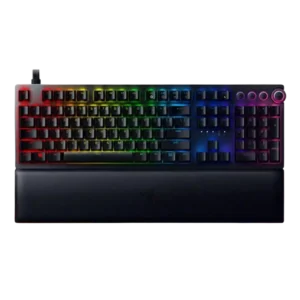
Reviews consistently frame the Huntsman V2 Analog as a big flagship full-size keyboard that prioritizes features over compactness.
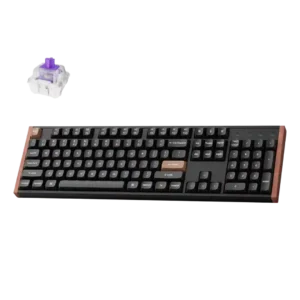
The K10 HE is consistently presented as a full-size or 100% board that keeps the numpad and favors users who want the full layout.
Synapse offers deep control and useful features, but the software is divisive. Some reviewers find it intuitive and capable, while others call parts of it messy or time-consuming.
Software impressions are mixed but mostly positive. Reviews like the web-based launcher for ease, labeling, and no-install setup, while one says it still feels barebones and lacks better macro tools or offline access.
One review says the board does not damp sound very much, which contributes to a sharper clacking character.
Multiple reviews explicitly mention acoustic foams or damping layers contributing to the board’s sound and feel.
Upgraded stabilizers are credited with firmer large keys, reduced rattle, and quieter operation.
Reviews describe the analog optical switches as somewhat heavier and more resistant than typical linear switches. That gives some users a more deliberate feel, while others think the switches feel less refined than Razer's other options.
Reviewers consistently describe the magnetic switches as nice, smooth, and stable, though one review says the linear action can feel a bit sterile for general typing.
One review notes the switch ecosystem is limited because compatible switches are proprietary and must be bought from Keychron.
Reviewers who liked the board for general use say it stays pleasant to type on, especially for users comfortable with lighter linear keypresses and textured caps.
Reviews describe the full-size layout as comfortable for work and say actuation tuning lets users shape the feel to preference.
Typing feel is generally praised, with reviewers calling it pleasant, clicky-smooth, and satisfying once they adapt to the analog optical switch behavior.
Typing is described as butter smooth and very smooth overall, but one review says the linear feel can come across as sterile for general typing.
Value for money is the biggest recurring tradeoff. Reviewers respect the features and build, but many say the board makes the most sense only for people who will really use its analog features or catch it on sale.
Reviews generally say the K10 HE justifies its price through its build, switch tech, and feature set, though the cost is still premium.
The volume wheel or dial is usually praised for convenience and feel, though some reviewers still call it merely okay or note odd behavior elsewhere.
Reviews say wireless feels close to wired, with no obvious performance loss in use.
The wrist rest is one of the most praised parts of the keyboard, with repeated mentions of plush padding, magnetic attachment, and strong comfort.