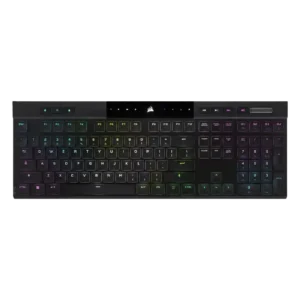
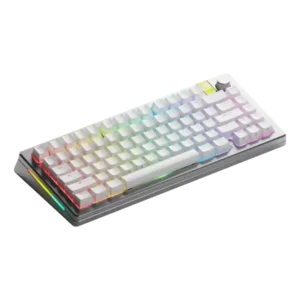
Reviewers describe the keyboard’s sound as mixed but often louder than ideal, with only limited praise for how it sounds.
Acoustic character is build-dependent; one reviewer found the sound divisive, while another liked the deeper thud from its damped setup.
HE models are explicitly said to support analog inputs or analog response for compatible gaming use.
Backlight brightness is decent, but several reviews say it is less bright or vibrant than some competing or larger boards.
On at least one build, the backlighting was bright enough to illuminate the legends.
Battery life is a major strength, with repeated praise for long runtime and infrequent charging in real use.
Battery life lands in a decent-not-exceptional range, with real-world reports from about 20 hours to roughly a week depending on use and lighting.
The chassis usually feels sturdy and premium, though at least one reviewer expected better execution for the price.
Build quality is consistently praised, with reviewers calling the board very well-built, premium, and among the best they tested.
The included cable is described as braided or fabric-covered and generally feels well made.
Included cable options are described as well-built, with thicker sleeving and braided or coiled premium-style construction.
Compatibility is broad across Windows, Mac, mobile, Xbox, and PlayStation, though Mac-specific labeling remains a drawback.
Reviews repeatedly confirm support across Windows and macOS as well as broad compatibility with Hall-effect and traditional MX-style switch ecosystems.
Wired, Slipstream, and multi-device Bluetooth connectivity are consistently praised and easy to switch between.
Wired USB-C, Bluetooth, and 2.4GHz options are repeatedly confirmed, though one review criticized unclear mode labeling.
The K100 AIR offers extensive remapping, lighting, and software-driven customization across multiple reviews.
The product's defining strength is deep customization, with reviews repeatedly describing it as exceptionally customizable.
Despite being full-size, the thin layout uses desk space efficiently and can fit into tighter setups than bulkier boards.
Reviews indicate strong durability, with successful drop testing, good transit resilience, and solid long-term wear.
Thick PBT caps and related materials are described as supporting longevity in use.
Serviceability is a clear weakness because removing caps or accessing the switches can be difficult and risky.
Switch swapping is consistently described as easy, breezy, or quick.
Its low height, adjustable feet, and minimal need for a palm rest make the board comfortable to use ergonomically.
Comfort is helped by the typing angle and palm support area, though some builds may still benefit from a wrist rest.
Gaming-focused extras such as PlayStation mode, streaming integration, and dedicated shortcut controls add useful functionality.
Beyond Rapid Trigger, reviews mention Dynamic Keystroke, custom deadzones, dual-action key behavior, and other advanced HE features.
The ultra-thin chassis still feels impressively rigid, with little to no concerning flex in the cited reviews.
The aluminum case is described as premium and sturdy, indicating a rigid chassis.
Gaming performance is consistently strong, with fast response and accurate input across wired and wireless use.
Across reviews, the board is described as strong for gaming, especially once Hall-effect features are configured.
The keyboard is explicitly described as not hot-swappable.
The HE implementation allows hot-swap support and broader switch flexibility than many competing boards.
Keycap quality is mixed: the shape helps finger placement, but the ABS material and surface quality draw criticism.
Keycap impressions are generally positive, with thick PBT or double-shot PBT caps described as good quality and pleasant in use.
Keys are repeatedly described as quick, accurate, and highly responsive.
In gaming use, key response was described as reacting very well once the board was configured.
One review specifically praises the extra spacing between keys for preserving familiar finger positioning.
One review specifically praised the key spacing for fast, accurate typing.
One reviewer highlights balanced keys with no spacebar wobble.
Stability depends on build choices; one review praised reduced wobble, while another noticed play and wiggle in its plate and switch setup.
Latency is a standout strength, with very fast wired and wireless response highlighted across several reviews.
Core software exposes very low configurable input latency, with one reviewer noting it can be set as low as 2 milliseconds.
The full-size layout works well for those who want everything onboard, but reviewers also wish smaller variants existed.
The lineup is offered in 65%, 75%, and 100% layouts.
Legend visibility is generally good through shine-through legends, though secondary symbols are not always fully illuminated.
Legend visibility depends on the chosen caps; one review notes the selected keycaps lit the legends sufficiently.
Macro support is flexible and well integrated, though some reviewers find the macro-key position less ideal in play.
Reviews confirm users can assign modifier-based or recorded macro actions to keys.
Premium aluminum surfaces help the board feel upscale, but plastic elements and sharp edges reduce the overall impression.
The full aluminum build is a standout part of the product's premium feel.
Dedicated media controls are consistently praised as useful and well integrated.
The knob supports some media-related reassignment attempts, but one reviewer could not get their desired play or pause function working.
Noise is divisive: some find it workable for general use, while others call it loud or rattly.
One reviewer called it one of the quietest boards they had tested in that specific configuration.
Onboard storage is a strength, with support for many saved profiles and hardware-side customization.
The K100 AIR lacks USB, headset, or similar passthrough connections.
Lighting control is flexible, with per-key or advanced programmable lighting support highlighted in the cited reviews.
Polling-rate capability is one of the board’s headline strengths, especially in wired mode.
Multiple reviews confirm wired polling up to 8000Hz and describe that high rate as working without issue.
The thin design helps portability, but the long full-size footprint can still make transport awkward.
Heavy aluminum builds hurt portability and make the board harder to move around.
Profile management is strong, with onboard profile storage and quick switching options.
Core allows users to save and switch between multiple profiles.
Rapid Trigger is explicitly supported and highlighted as a core Hall-effect gaming feature.
The cited reviews describe reliable connections and stable long-term operation without major functional issues.
One review reported a serious failure involving repeated keys and a dead board before replacement.
RGB customization is deep, with layered effects and extensive lighting control repeatedly praised.
Core software lets users program RGB lighting behavior and effects.
RGB lighting quality is generally good, though it is not the brightest implementation in the segment.
RGB lighting is described as generous and strong-looking, with good diffusion and visible accent lighting around the board.
The ultra-thin full-size form factor is one of the keyboard’s most distinctive and most praised traits.
Reviews confirm multiple sizes, with the range spanning compact and full-size options.
iCUE is widely viewed as powerful and feature-rich, even if some users may find it heavy or complex.
Software is feature-rich but mixed in execution; several reviews cite bugs or barebones behavior, while others found current versions easy to use or improved.
Sound dampening is weak in the cited evidence, with leakage through the chassis noted in one review.
Reviews directly mention dampening materials and note that the frame and internals help deaden keystrokes and sound.
Stabilizer quality is inconsistent, with multiple complaints about looseness or rattle despite one positive stability note.
Stabilizers are described as lubed out of the box, a positive sign for the stock stabilizer setup.
The low-profile tactile switches are widely praised for feeling fast, tactile, and satisfying.
Reviewers describe the switches as more uniform than wobblier builds, with Panda HE switches also getting positive feel-and-sound impressions.
Switch choice appears limited on this board, with reviewers noting tactile-only availability or a lack of alternatives.
The HE version is offered with multiple Hall-effect switch choices, including linear, silent, tactile, and clicky options in Glorious' lineup.
Typing comfort is a strong point once users adjust to the low-profile format.
Typing comfort is generally good, but some reviewers still wanted better angle adjustment or a wrist rest.
Typing feel is generally described as enjoyable, fluid, and tactile.
Reviewers repeatedly say the board feels excellent to type on, with silky or premium-feeling key travel depending on the build.
Value for money is mixed to poor because the feature set is strong but the premium price is hard to justify.
Reviewers widely note the premium price, though some still see the value as more defensible in light of the feature set and customizability.
The dedicated volume wheel or roller is consistently well liked.
The rotary knob can control mute and unmute via press.
Wireless performance is a clear strength, with fast low-latency behavior and no meaningful lag reported.
Wireless use is described positively, with reports of stable connections and no noticeable lag.
No wrist rest is included, and at least one reviewer calls that out as a miss at this price.