Most coverage describes a cleaner, dampened sound profile, with foam, gasket mounting, and lubrication helping reduce harshness; a minority of reviews still found the sound sharp, hollow, metallic, or clacky.
Case foam and internal tuning keep the sound controlled, with reviewers describing the board as full and free of obvious ping.
Reviewers cite fast 1.8 mm actuation and consistent keypresses, but the experience is mixed: some found the switches responsive, while others mentioned deep presses, misinputs, or sensitivity that takes adjustment.
Switch feel may need break-in, with some early inconsistency noted before the board feels more even from key to key.
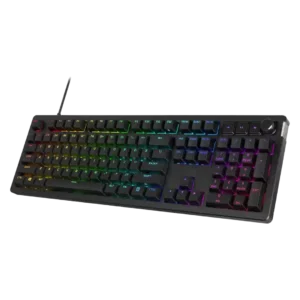
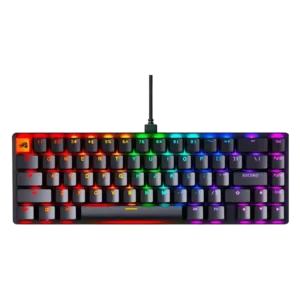
Brightness is generally treated as a strength, with ambient auto-adjustment, vivid output, and multiple brightness stages; reviewers also note RGB backlighting as a visible part of the board’s identity.
Backlighting is bright and vivid, helped by transparent switch housings and shine-through design.
Wireless reviews are positive on battery life, repeatedly referencing long runtime claims around 80 hours with RGB and up to 1,500 hours without lighting, with some reviewers reporting long real-world use between charges.
The board is generally described as sturdy, well-built, or high-grade, with several reviews pointing to a solid chassis and premium-feeling construction; the praise is stronger for overall structure than for every removable part.
Build quality feels solid overall, with sturdy construction and enough weight to avoid a flimsy impression.
The wired model’s detachable braided USB-C cable is noted positively in one review, while other coverage criticizes the cable area or describes the cable as only moderately premium.
The included braided USB-C cable is generally viewed as decent and serviceable rather than a weak extra.
The limited direct compatibility evidence points to broad device support, including PC and several game consoles in the cited reviews.
Reviews confirm official Windows and Mac support, plus successful use on PlayStation, Xbox, and Android.
Connectivity depends heavily on model: wired reviews note the lack of wireless as a drawback, while Alloy Rise 75 Wireless reviews praise tri-mode support across USB-C, 2.4 GHz, and Bluetooth.
Wired connectivity is reliable in the available testing, with direct no-issue reports over USB.
Customization is one of the clearest strengths, with repeated support for magnetic top plates, removable badges, hot-swappable switches, keycaps, RGB effects, macros, profiles, and optional accessories.
Customization is one of the keyboard’s biggest strengths, spanning switches, keycaps, lighting, and broader build choices.
The 75% model is praised for saving desk space and keeping essential keys within reach, while full-size coverage notes the numpad can reduce mousing room.
The compact footprint saves desk space without stripping away core functionality.
Durability evidence centers on thick or double-shot PBT keycaps, wear resistance, oil-mark resistance, and comments that the board is built to last.
The board survived a drop test and is helped by replaceable switches for longer-term use.
Most reviews describe switch replacement as a major benefit because the board supports compatible mechanical switches without soldering, though one review found switch removal stiff and challenging.
Replacing switches is easy and beginner-friendly, with multiple reviews emphasizing simple, tool-based swapping.
Ergonomics are mixed: the gasket structure, compact reach, and wrist placement help comfort for some reviewers, but the tall chassis and lack of an included wrist rest caused discomfort for others.
Ergonomics are decent thanks to usable typing angles, but the high profile and lack of an included wrist rest can reduce comfort for some users.
Direct evidence is limited but positive, with one review calling out 100% anti-ghosting and game-mode behavior as gaming-focused extras.
Gaming extras include hotkey-based onboard controls plus features like N-key rollover and Windows key lock.
Frame feedback is mixed: one review praises a sturdy, flex-free build, but several reviews say the magnetic top plate can feel loose or detach too easily.
The frame feels very rigid, with reviewers specifically noting no twisting, creaking, or flex.
Gaming performance is broadly positive, with reviewers describing responsive, capable, competitive-ready use; the main caveat is that some did not find it exceptional versus more advanced gaming keyboards.
Gaming performance is strong, with reviewers reporting responsive play and noticeable benefits from tuning latency.
Hot-swappable switch support is widely documented, with multiple reviews confirming support for 3-pin or 5-pin switches and easy mechanical switch replacement.
Hot-swap support is a major selling point, with broad 5-pin support repeatedly highlighted.
Keycap quality is frequently praised, especially double-shot or PBT construction, texture, durability, grip, and clean legends.
The stock doubleshot ABS caps feel comfortable in use, but reviewers still flag ABS as a step down from PBT.
Responsiveness is a recurring strength, with reviewers citing fast input registration, rapid strokes, reliable gaming response, and minimal input delay.
Reviewers consistently call the keys responsive in use, with quick reactions that work well for games.
Direct spacing evidence is narrow but positive, with one reviewer stating the spacing between keys felt perfect during long typing use.
Key spacing is a mixed point: some find it fine, but the tighter 96% layout can cause adjustment errors.
The limited direct evidence is positive, with box-style stems intended to reduce wobble and another review noting the keys remained stable and in place.
Keys are described as stable and pleasant to type on in the standardized usage review.
Latency evidence is strong across wired and wireless reviews: high polling, low-latency 2.4 GHz, no noticeable input delay, and instant transmission are repeatedly mentioned.
Input latency is adjustable down to 2ms, and reviewers reported a more competitive feel after lowering it.
Reviewers confirm multiple layout options and tradeoffs, including full-size and 75% versions; the compact layout saves room but can move some keys to function layers.
Reviewers like the choice between 65% and 96%, with both sizes seen as useful rather than filler.
Legend visibility is supported by backlit legends, side-printed secondary legends, and clean readable keycap fonts, with the strongest comments coming from typing and lighting-focused reviews.
Shine-through doubleshot legends stay readable and are integrated well into the keycaps.
Macro customization is well supported through NGENUITY, with reviewers mentioning macro recording, key remapping, secondary functions, and programming options.
Macro support is robust, with dedicated layers and macro creation available through the software.
Materials feedback is mostly positive, including metal or aluminum top pieces, PBT keycaps, and metallic removable plates, though some reviews note plastic bases or less refined cable integration.
Material choices balance an aluminum top with plastic or polymer sections, landing as good rather than all-premium.
Media controls are a repeated strength, with volume dials, media keys, tactile buttons, and programmable knobs called out across several reviews.
Media controls are available directly on the keyboard through function combinations.
Noise is mixed but generally better than many mechanical boards: some call it quiet or not too loud, while others describe it as louder, sharp, or less refined.
For a mechanical keyboard, noise is kept moderate enough that reviewers call it quiet or non-bothersome in shared use.
Onboard memory and saved configurations are supported in wireless-focused reviews, with mentions of saving profiles or settings directly to the keyboard.
Users can save up to three onboard profiles directly on the keyboard.
Per-key RGB is well supported, with reviewers noting fully per-key lighting, individual-key color control, and side lighting on some models.
Per-key RGB control is confirmed across multiple reviews, including individual color setting and individually lit keys.
Polling-rate coverage is strong for wired models, with repeated 8,000 Hz references; one wireless review notes a 1,000 Hz polling rate for Bluetooth/wireless use.
Users can tune polling rate up to 1000Hz, giving the board a full-speed wired setup.
Portability evidence is mixed: the 75% model is compact in dimensions, but at least one review notes its weight is over a kilogram.
The 65% version is presented as a better fit for on-the-go use than larger layouts.
Profile support is well covered through ten profiles, profile storage, onboard profile switching, Bluetooth profiles, and software-managed profiles.
Profile management is present, with multiple onboard profiles available for different setups.
Reliability is mostly positive for core typing and gaming performance, but one wireless review reports occasional inconsistency and disconnections.
Reviewers report dependable day-to-day behavior, with the board working without issue and seeming built for repeated refreshes.
RGB customization is consistently supported, with reviewers mentioning software-controlled effects, per-key setup, presets, layering, and detailed backlight adjustments.
Lighting customization is flexible, with easy setup, preset selection, and manual per-key adjustment options.
RGB lighting quality is broadly praised as bright, vibrant, sharp, evenly distributed, or visually impressive, though a few reviewers note side/underglow limitations or occasional lighting issues.
Reviews praise the RGB for richer colors, smoother transitions, and an overall strong visual presentation.
The product is covered in both full-size and 75% contexts; reviewers generally like the compact 75% footprint, while full-size coverage values the numpad for productivity.
The 65% and 96% variants keep the board compact while retaining the functions reviewers cared about.
Software quality is one of the most divided areas: NGENUITY is described as easy, lightweight, or functional by some, but basic, limited, inconsistent, or buggy by others.
Glorious Core is capable and sometimes easy to use, but reviews also call out bugs and limited Mac support.
Sound dampening is a repeated strength, with foam, gasket mounting, and dampening layers credited for softer keystrokes and reduced resonance.
Internal case and PCB foam are repeatedly credited for reducing hollowness and sharpening the sound profile.
Stabilizer feedback is positive where mentioned, with reviews describing them as well-tuned, lubricated, stable, and not rattly.
Stock stabilizers are generally decent and pre-lubed, though some larger keys still show mild rattle or less-refined feel.
Switch feel is generally praised for smooth, soft, responsive, pre-lubed red linear performance, though some reviews found the feel harsh or too sensitive.
Across reviews, the Fox linear switches are described as smooth and satisfying, with strong feel for both typing and games.
Switch options are supported through linear and tactile choices and compatibility with 3-pin or 5-pin switch replacements; one Dutch review also confirms Red Linear switches.
Switch choice is flexible through barebones builds and configurator options, though prebuilt buyers are largely limited to Fox linears.
Typing comfort is one of the product’s strongest areas, with many reviewers praising soft, dampened, responsive typing, though wrist comfort depends on chassis height and wrist-rest use.
Typing comfort is a clear strength, with reviewers reporting low fatigue, smooth movement, and long-session comfort.
Typing feel is broadly praised as premium, smooth, soft, or satisfying, but a few reviews describe harsher keystrokes or less pleasing feel versus high-end competitors.
Typing feel is a standout, with reviews repeatedly calling it smooth, satisfying, and impressive out of the box.
Value is heavily price-dependent: several reviewers find the keyboard expensive or weak at full price, while others say its premium features or sale pricing make it easier to recommend.
Value is one of the strongest themes, with several reviews arguing the feature set feels especially compelling at the asking price.
Volume control is widely supported, with reviewers noting click-to-mute dials, notched rotary knobs, and convenient volume controls.
Volume control is available on-board through function-layer shortcuts.
Wireless performance is generally praised on the 75 Wireless for smooth connections, low latency, Bluetooth/2.4 GHz flexibility, and strong autonomy, though some reviews note disconnections or model limits.
The wrist-rest evidence is negative: multiple reviewers note that no wrist rest is included and that this omission can hurt comfort at the keyboard’s height or price.