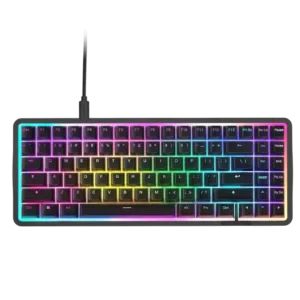
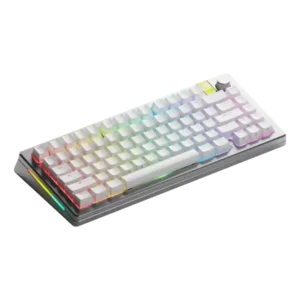
The sound profile was one of the clearest strengths: reviewers repeatedly described the board as satisfying, thocky, pleasing, and quiet enough for comfortable use, with the gasket, foam, and tape-enhanced construction doing much of the work.
Acoustic character is build-dependent; one reviewer found the sound divisive, while another liked the deeper thud from its damped setup.
Actuation control was consistently praised, with reviewers citing 0.6-4.0 mm tuning, 40 adjustment levels, and per-key sensitivity control. The main caveat is that some competitors go lower than NZXT's minimum actuation point.
Analog-style support is useful but not class-leading. Reviewers pointed to dual-actuation, walk/run behavior, and analog-like gas-pedal control, but the evidence centers on two-stage inputs rather than full controller-level analog depth.
HE models are explicitly said to support analog inputs or analog response for compatible gaming use.
Brightness feedback was mixed. Several reviewers liked the bright perimeter and key lighting, while others noted color mismatch, finicky RGB behavior, or that the key lighting was not the brightest available.
On at least one build, the backlighting was bright enough to illuminate the legends.
Battery life lands in a decent-not-exceptional range, with real-world reports from about 20 hours to roughly a week depending on use and lighting.
Build quality was usually treated as premium, with reviewers praising the sturdy feel, aluminum-heavy construction, and solid weight. A minority view criticized the hollow or plastic lower shell, keeping this from being universally flawless.
Build quality is consistently praised, with reviewers calling the board very well-built, premium, and among the best they tested.
The detachable USB-C cable was generally viewed as a solid inclusion, with multiple reviewers noting braided construction and useful length. No review treated the cable as a major weakness, though the wired-only design affected connectivity scores.
Included cable options are described as well-built, with thicker sleeving and braided or coiled premium-style construction.
Basic device compatibility is solid because the keyboard works over USB and can operate without drivers, but software compatibility is narrower. Reviews specifically noted that NZXT CAM is Windows-focused or unavailable on Mac.
Reviews repeatedly confirm support across Windows and macOS as well as broad compatibility with Hall-effect and traditional MX-style switch ecosystems.
Connectivity is the product's most repeated limitation: the keyboard is wired-only, usually through USB-C to USB-A. This supports high polling performance but limits setup flexibility and travel convenience.
Wired USB-C, Bluetooth, and 2.4GHz options are repeatedly confirmed, though one review criticized unclear mode labeling.
Customization depth is strong, especially around actuation, key behavior, remapping, and software-controlled performance features. The criticism is not lack of options, but that some options depend heavily on CAM and branded software.
The product's defining strength is deep customization, with reviews repeatedly describing it as exceptionally customizable.
The compact MiniTKL/75% footprint was consistently tied to better desk space and more mouse room, especially for gaming. Reviewers who liked the size saw it as a practical reason to choose the board.
Durability evidence is positive overall, with reviewers pointing to the stronger aluminum frame, sturdy feet, and claimed long switch life. One review also noted a small USB-C port wiggle, so long-term reliability is not completely unquestioned.
Thick PBT caps and related materials are described as supporting longevity in use.
Switch replacement is workable because tools and spare switches are included and reviewers described removal or replacement as easy enough. The main restraint is compatibility with magnetic/proprietary switches rather than broad mechanical-switch freedom.
Switch swapping is consistently described as easy, breezy, or quick.
Ergonomic feedback was mostly positive due to the compact stance, grippy sides, adjustable feet, and comfortable typing angles. The missing wrist rest prevents the ergonomics package from feeling fully complete.
Comfort is helped by the typing angle and palm support area, though some builds may still benefit from a wrist rest.
The extra gaming feature set is a major strength: reviewers repeatedly cited Rapid Trigger, Snap Overrides/SOCD, dual-actuation, genre presets, and competitive movement advantages, while warning that some SOCD features may be restricted in games.
Beyond Rapid Trigger, reviews mention Dynamic Keystroke, custom deadzones, dual-action key behavior, and other advanced HE features.
Frame rigidity scored very well across reviews thanks to the heavy body, aluminum trim or top plate, secure desk grip, and rock-solid typing surface. The board was repeatedly described as stable rather than lightweight.
The aluminum case is described as premium and sturdy, indicating a rigid chassis.
Gaming performance was broadly strong, especially for competitive play. Reviews connected the fast switches, high polling rate, Rapid Trigger, and Snap Overrides to responsive movement, quick inputs, and strong FPS performance.
Across reviews, the board is described as strong for gaming, especially once Hall-effect features are configured.
The keyboard is technically hot-swappable, and reviews mention included tools and removable switches. However, support is limited by Hall-effect/proprietary switch compatibility, so it is less flexible than many mechanical hot-swap boards.
The HE implementation allows hot-swap support and broader switch flexibility than many competing boards.
Keycap quality was widely liked, with frequent praise for double-shot PBT, textured feel, durability, and shine-through legends. One reviewer found the texture abrasive over longer sessions, so comfort may vary.
Keycap impressions are generally positive, with thick PBT or double-shot PBT caps described as good quality and pleasant in use.
Responsiveness was a standout strength. Reviewers described snappy inputs, improved responsiveness, rapid keystrokes, and gameplay precision, especially when using the Hall-effect switches and low actuation settings.
In gaming use, key response was described as reacting very well once the board was configured.
Key spacing is mixed. Some reviewers found the layout nicely balanced or comfortable, while others said the compact format makes arrow/navigation areas cramped or slightly squashed.
One review specifically praised the key spacing for fast, accurate typing.
Key stability was generally praised because of dual-rail switches, stable presses, and smooth travel. One review noted a slight wobble when compared side by side with a competitor, but most evidence remained positive.
Stability depends on build choices; one review praised reduced wobble, while another noticed play and wiggle in its plate and switch setup.
Latency performance was rated very highly. Reviewers linked near-zero latency, quick reporting, 8K polling, and near-instant keystroke response to faster typing and gaming inputs.
Core software exposes very low configurable input latency, with one reviewer noting it can be set as low as 2 milliseconds.
Layout option evidence is narrow: the reviewed model keeps a convenient 75% layout with a function row, arrows, and navigation column. However, the uploaded reviews did not show broad size-choice flexibility for the Elite model.
The lineup is offered in 65%, 75%, and 100% layouts.
Legend visibility was generally strong thanks to shine-through keycaps, crisp illumination, and RGB that helps side-printed or keycap legends stand out in low light.
Legend visibility depends on the chosen caps; one review notes the selected keycaps lit the legends sufficiently.
Macro customization is supported through CAM and remapping tools, with reviewers mentioning macro creation and retained macro setups. Dedicated macro hardware is absent, but software-level macro support is clear.
Reviews confirm users can assign modifier-based or recorded macro actions to keys.
Materials were usually viewed as premium because of aluminum, PBT keycaps, and sturdy construction. Several reviews still noted a plastic underside or hollow base, so materials are strong but not uniformly premium throughout.
The full aluminum build is a standout part of the product's premium feel.
Media controls are serviceable but compromised. Reviews repeatedly noted that controls are handled through secondary function assignments rather than dedicated media buttons or stronger physical controls.
The knob supports some media-related reassignment attempts, but one reviewer could not get their desired play or pause function working.
Noise level depends on taste. Reviewers liked the thocky and satisfying sound profile, but some found it louder or clackier than expected, so it is not a silent board.
One reviewer called it one of the quietest boards they had tested in that specific configuration.
Onboard memory/profile support is useful, with reviews citing four or five profile slots depending on the source. This helps users keep gaming or work setups without constant software reconfiguration.
Passthrough features are essentially absent in the scored evidence. The clearest review evidence explicitly states there is no USB passthrough.
Per-key lighting control is a strength. Reviews repeatedly mention per-key RGB, individually adjustable lighting, and control over both the keys and the perimeter lighting.
Polling rate is one of the strongest technical scores. Multiple reviews cite the 8,000 Hz rate and connect it to faster input reporting, even when some reviewers questioned whether casual players will notice.
Multiple reviews confirm wired polling up to 8000Hz and describe that high rate as working without issue.
Portability is mixed to weak. The compact footprint helps with moving or travel, but several reviewers emphasized the heavy body and wired-only design as practical barriers.
Heavy aluminum builds hurt portability and make the board harder to move around.
Profile management is solid, with reviews citing built-in profiles, genre presets, and onboard memory. It is useful for switching between work, typing, and game-specific setups.
Core allows users to save and switch between multiple profiles.
Rapid Trigger support is consistently strong. Reviewers described instant reset, faster repeat presses, and competitive movement benefits, with little disagreement that the feature works.
Rapid Trigger is explicitly supported and highlighted as a core Hall-effect gaming feature.
Reliability is the most concerning technical area. One review noted a wiggly USB-C port, while another reported switch failure and software lockout issues, so confidence is uneven despite generally sturdy hardware.
One review reported a serious failure involving repeated keys and a dead board before replacement.
RGB customization is deep, with reviewers citing color, speed, transition, per-key, perimeter, and software controls. The main complaints involved color accuracy or reliance on CAM rather than lack of options.
Core software lets users program RGB lighting behavior and effects.
RGB lighting quality is mostly positive: reviewers liked the tasteful look, vibrant colors, perimeter strip, and shine-through keycaps. Some criticized the strip or described the implementation as mixed or finicky.
RGB lighting is described as generous and strong-looking, with good diffusion and visible accent lighting around the board.
The size and form factor were broadly praised as compact and practical, sitting around the 75%/MiniTKL range while preserving many useful keys. It is not ideal for users who need a numpad or full-size board.
Reviews confirm multiple sizes, with the range spanning compact and full-size options.
Software quality is mixed but generally usable. Many reviewers found CAM clean, simple, and powerful, while a few described it as overwhelming, Mac-limited, or seriously buggy.
Software is feature-rich but mixed in execution; several reviews cite bugs or barebones behavior, while others found current versions easy to use or improved.
Sound dampening is a clear strength, with repeated references to gasket mounting, layered foam, tape mods, and sound-reducing construction. Reviewers often linked these parts to the satisfying acoustic profile.
Reviews directly mention dampening materials and note that the frame and internals help deaden keystrokes and sound.
Stabilizer quality is strong overall. Reviews praised tuned or screw-in stabilizers and smooth larger-key behavior, though one reviewer noted a spacebar ping that slightly reduced the score.
Stabilizers are described as lubed out of the box, a positive sign for the stock stabilizer setup.
Switch feel was mostly positive, with many reviewers describing the Hall-effect switches as smooth, light, precise, or buttery. One sharply negative review found them rough and unpleasant, creating the main counterweight.
Reviewers describe the switches as more uniform than wobblier builds, with Panda HE switches also getting positive feel-and-sound impressions.
Switch options are limited. Reviews specifically noted that only manufacturer magnetic switches fit or that switch choice is very limited, even though replacement is possible.
The HE version is offered with multiple Hall-effect switch choices, including linear, silent, tactile, and clicky options in Glorious' lineup.
Typing comfort was generally positive over longer use and for smooth sessions, but not universal: one reviewer found the textured keycaps uncomfortable after sustained use.
Typing comfort is generally good, but some reviewers still wanted better angle adjustment or a wrist rest.
Typing feel was often praised as smooth, pleasant, buttery, thocky, or satisfying. A minority review criticized it as lacking punch, so the average is strong but not unanimous.
Reviewers repeatedly say the board feels excellent to type on, with silky or premium-feeling key travel depending on the build.
Value for money is divided. Some reviewers thought the pricing was fair or competitive against premium Hall-effect boards, while others saw cheaper rivals, missing wireless, and software issues as reasons the price is hard to justify.
Reviewers widely note the premium price, though some still see the value as more defensible in light of the feature set and customizability.
Volume control is weak because there is no dedicated dial or rotary knob. Reviews only found secondary or absent controls, making this a clear feature omission.
The rotary knob can control mute and unmute via press.
Wireless performance is effectively unavailable because the keyboard has no wireless mode. Reviews repeatedly called out the lack of Bluetooth or 2.4 GHz as a major drawback.
Wireless use is described positively, with reports of stable connections and no noticeable lag.
Wrist rest quality scores low because the reviews consistently discuss the absence of an included wrist rest rather than praising any wrist support.