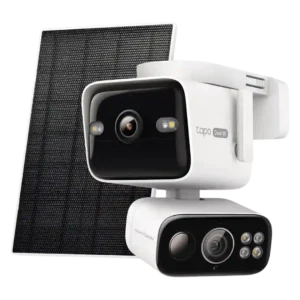
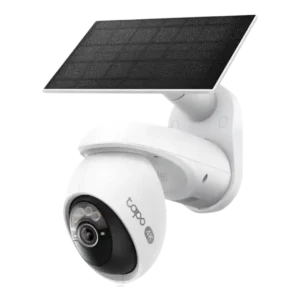
The app exposes practical controls for detection types, sensitivity, motion zones, activity zones, notifications, storage settings, and tracking behavior. Reviewers found the controls useful, though advanced notification controls are not perfect.
The Tapo app earns consistent praise for deep controls, presets, patrols, privacy options, and easy setup, though a few note confusing power-button steps and occasional preset inaccuracies.
The pan/tilt lens offers wide mechanical movement and tracked a sprinting reviewer almost the entire time. Extreme close, fast motion can briefly exceed the motor speed.
Pan coverage is broad, but tilt range is limited upward, so the camera works best when mounted higher and angled down; several users report difficulty capturing faces when mounted lower.
Audio is mixed. One hands-on reviewer found the recordings tinny and wind-sensitive, while another noted that two-way audio worked well during setup.
Two-way audio is typically clear enough for conversation, though one reviewer notes audio can be overwhelmed by ambient noise at distance and another mentions sync issues in playback.
Battery performance is a strength across reviews. Claims and hands-on testing point to long standby, useful solar replenishment, and meaningful charge recovery even under heavy settings.
Battery life is widely praised, especially when paired with solar, yet a minority report noticeable daily drain under heavy settings or limited sunlight, implying outcomes vary by site.
The physical build was described as solid during setup. No reviewer raised a general build-quality concern, though theft protection depends on installation and alarm setup.
Most impressions are positive on fit and finish, but the unit is bulky and largely plastic; some note front-heavy design and mount wobble if not fully secured.
Cable management is helped by the included long USB-C extension cable and weatherproof cabling. Reviewers could place the panel away from the camera while keeping the setup clean.
The bundled solar-panel cabling and extension options help tidy installs and allow better solar placement, improving real-world flexibility.
Storage value is favorable because core use does not depend on a paid plan. Cloud storage is optional, while local microSD and Tapo hub options reduce subscription pressure.
Cloud plans add conveniences like rich notifications and longer retention, and multi-device pricing can be attractive, but many reviewers consider cloud optional if local storage is used.
Color output at night was described as crisp and balanced in testing, especially when comparing infrared and color night-vision modes.
Daytime colors look realistic, but not highly vibrant; opinions diverge on color night vision, with some reporting clean results and others noticing ghosting.
Connectivity was praised in the off-grid review, where the camera held signal well on Starlink. Other reviews confirm 2.4GHz and 5GHz Wi-Fi support.
Connectivity is generally easy to set up and supports 2.4/5GHz Wi-Fi, but outdoor Wi-Fi strength can affect PTZ responsiveness and stability.
Continuous capture is supported, but it is closer to interval snapshot capture than full wired-camera-style video. Reviewers still found it useful for daily timelines and reducing missed events.
The C660 commonly offers a 24/7 capture mode that is snapshot or time-lapse style rather than full-frame continuous video; some like the added context, while others want true continuous recording and scrubbing.
The two-lens tracking design is a major strength. Multiple reviews describe the fixed lens detecting motion while the moving lens tracks the subject for more context and detail.
Custom activity zones are supported and used to narrow where alerts fire, helping reduce irrelevant activity from streets or nearby areas.
Motion zones are available and can be set per detection type, but multiple reviewers note zones shift when the camera pans, so careful placement and presets matter.
Detection features are broad and well regarded. Reviews mention people, pets, vehicles, on-device AI, and hands-on testing where events were consistently detected.
Detection options are robust, including person, pet, and vehicle categories, plus auto-tracking; accuracy is generally strong, but environment and tuning affect false alerts.
Detection range is strong for an outdoor battery camera. Reviews cite up to 60 feet in product coverage and hands-on nighttime detection beyond 30 feet.
Detection range varies by mode: PIR-only detection can be modest, while the 24/7 capture or camera-based detection can trigger sooner and farther away; tuning sensitivity is key.
Zoom is useful but not perfect. Reviews cite 18x or nearly 11x digital/telephoto zoom and tap-to-zoom, while one reviewer noted that AI zoom is digitally applied in-app rather than changing downloaded footage.
The 18x digital zoom benefits from 4K and is useful for inspecting scenes, but it cannot fully overcome distance and night limitations, and one review finds detail insufficient for far identification.
Dual-band Wi-Fi support is repeatedly confirmed, including 2.4GHz and 5GHz operation. One review specifically valued 5GHz for reducing network congestion from Wi-Fi cameras.
Dual-band Wi-Fi support helps, but outdoor signal quality still varies; several suggest mesh or repeaters if the camera is far from the router.
The dual-camera design is the defining feature. Reviewers repeatedly highlight the combination of a fixed wide lens with a separate tracking lens, giving both context and close-up detail.
Dual-stream recording is supported through separate 4K views. Reviewers mention two 4K recordings and simultaneous full-scene plus close-up coverage.
Durability testing was positive: one reviewer left the camera outside in minus 20 Celsius weather with no issues, and the camera is described as weatherproof.
Durability is generally acceptable for outdoor use with IP65, but the plastic build and easy-to-remove mount make it less suited to high-vandalism locations.
Noise handling is a weakness. One reviewer specifically reported wind sensitivity and a lot of wind noise in recordings.
Most tests find motor noise minimal in live use, but some report it can be heard on recorded clips and that windy or noisy scenes can reduce clarity.
Event recording reliability tested very well. One reviewer found every event captured during a two-week test, and another described the camera as one of the few options that consistently worked.
Event clips generally appear consistently in the app, and 24/7 capture can reduce missed detections, but it is not a replacement for full continuous recording workflows. Event-based recording is generally reliable, but expectations around full continuous playback can lead to dissatisfaction when the camera provides event clips plus a snapshot-style timeline.
False alert filtering is generally helpful, but not flawless. Reviews mention fewer noisy alerts and onboard filtering, while one hands-on test found some vehicle events were also classified as motion.
AI filtering and sensitivity controls can reduce false alerts, yet some still see triggers from shadows or moving branches, especially without careful zone tuning.
Field of view is excellent. Several reviews cite a 169-degree or 169.7-degree wide view, and reviewers frame it as useful for broad yard or driveway coverage.
The 105-degree lens plus pan coverage provides wide-area monitoring, but tilt limitations can reduce usable coverage if mounted too low or aimed level rather than downward.
The spotlights are bright enough to affect full-color night mode and deterrence. One reviewer called even the first brightness level huge.
Built-in spotlights are effective for color night vision and deterrence, with adjustable brightness, but using them more often increases power draw.
Frame rate is acceptable but not exceptional. One reviewer noted 15 fps at night and warned that very fast movement can blur.
Most testing cites 15 fps by default with an option up to about 20 fps; the 24/7 mode typically lowers frame rate drastically, which is acceptable for security but not for smooth motion.
HomeKit support is limited. A reviewer got Apple-related routing working through Home Assistant, but also noted there was no direct integration for that path.
Multiple reviewers explicitly call out the lack of Apple Home or HomeKit support.
A hub is optional rather than mandatory. Reviews mention direct microSD recording and also describe the Tapo H500 as an add-on that provides local storage and Wi-Fi backup.
No hub is required for core operation; optional hubs can add storage, but may not support every recording mode.
Automation performance is strong when routed through supported systems. One reviewer measured near-zero delay, while also noting that some workarounds may be needed.
Included accessories are generous. Reviews mention the solar panel, extension cable, mounting hardware, anchors, screws, and related installation pieces.
You get mounts, screws, templates, and a solar panel in the kit, but multiple sources note a microSD card is not included.
Installation is straightforward. Reviews describe a simple bracket/click-in process and a setup that can be completed without running power wires.
No summary yet.
Local storage is one of the strongest features. Reviews repeatedly note microSD support, local recording without cloud dependence, and continued recording even when Wi-Fi or internet status changes.
Local microSD recording up to 512GB is a major plus, with easy in-app playback and options like encryption or password protection; many see it as a subscription alternative.
Low-light performance is a major strength. Reviewers mention starlight sensors, clear nighttime footage, and strong performance even when the camera is placed farther back.
Low-light performance is usually good for an outdoor camera, especially with spotlights, but fine detail and motion clarity drop versus daylight, and results vary heavily with ambient light.
Microphone sensitivity is mixed. It picked up voices from distance in one setup, but another reviewer found the recordings too sensitive to wind.
The mobile app is generally reliable and easy to use. Reviewers said live view loaded quickly, pairing was smooth, and the app layout was easy to navigate.
App stability is broadly praised, with fast live view and deep settings, though a few mention missing home-screen previews and occasional preset or PTZ quirks.
Mounting flexibility is strong because the camera is wireless, solar-assisted, and has a tracking lens that can be aimed after installation. Cable length also helps panel placement.
Mounting options are flexible, including wall, fence, and eaves/ceiling, with the solar panel able to mount together or separately via an extension cable.
Night vision is consistently praised. Reviews mention infrared, full-color, and color night vision, with hands-on tests showing strong night footage.
Night footage is generally usable with both IR and spotlight-assisted color, though several note blur or ghosting on moving subjects and during PTZ movement, and one review reports severe ghosting in color mode. Infrared night vision range is commonly cited around 40 feet, but practical clarity for faces and small details still falls off with distance.
Notification management has caveats. Notification speed is good, but one reviewer wanted snooze alerts and custom notification sounds, and rich notification snapshots require a subscription.
Notification controls are flexible, letting users pick event types, schedules, and cooldown behavior; rich notifications with thumbnails are typically tied to the cloud plan.
Notification speed is strong. Reviews mention faster alerts from local processing, less-than-a-minute notification timing, and lightning-fast smart-home responses.
Notification speed is generally quick for a battery camera, often under a minute, but can vary with network strength, detection mode, and cooldown settings.
On-device features are useful but not complete. The camera includes smart detection and local processing, but one test noted it lacks a physical tamper switch.
On-device AI is a strength. Reviews describe local processing, on-camera smart detection, and AI that recognizes people, pets, vehicles, or other events without relying on cloud processing for basics.
On-device AI for person, pet, and vehicle detection is a standout and generally does not require a subscription; tracking can be strong, but a few report occasional tracking oddities.
Several reviews point out the lack of RTSP or ONVIF, limiting direct NVR integration.
Cold-weather performance was proven in testing when the camera handled minus 20 Celsius weather without issues.
Battery power is practical because the camera has a large built-in rechargeable battery and can also be topped up through USB-C or the included solar panel.
Solar power is one of the clearest strengths. Reviews mention autonomous placement, quick charging from sunlight, and hands-on testing where the panel charged the camera substantially per day.
Solar charging often keeps the 10,000mAh battery near full, but performance depends on sunlight, season, and settings, and heavy use can outpace recharge in poor weather.
Pre-event coverage is improved by continuous capture snapshots. Reviews describe interval captures from 1 to 60 seconds and note that this helps reduce missed beginnings of events.
The app offers buffer and clip controls that can help capture more of an event, but actual pre-event coverage depends on the chosen recording and 24/7 capture settings.
Value is favorable for the feature set but not cheap. Reviews cite a price around $199 to $229.99, while one reviewer called it not a bad deal and another noted it is well over $200.
Many consider the feature set strong value for a 4K solar PTZ kit, especially on sale, while one reviewer feels the price premium over cheaper Tapo models is hard to justify.
Privacy zones and privacy mode are available and straightforward, helping mask neighboring areas or disable recording when desired.
PTZ performance is mostly strong. Reviews praise 360-degree tracking, quiet pan/tilt movement, and manual control, though extreme close fast motion can briefly outrun the motor.
Auto-tracking is often responsive, but manual pan/tilt can be slow or imprecise on weaker Wi-Fi, and several mention limited upward tilt and occasional need for recalibration.
Recording start lag appears low in hands-on testing. One reviewer said motion was detected already before the walking-toward-camera test could fully begin.
The camera is physically large compared with smaller Tapo models. That size supports powerful hardware, but buyers should expect a noticeable outdoor unit.
Smart-home integration is useful but uneven. Amazon integration was praised, Alexa and Google Assistant support were cited, while direct HomeKit/Home Assistant support was not available without workarounds.
Smart home integration works with Alexa and Google for live view and basic control, but integrations are limited compared with broader ecosystems.
Accessory and platform compatibility is solid for Amazon, Google, and SmartThings-related setups. Apple/HomeKit-style workflows require workarounds rather than direct support.
Speaker and talk-back functions are usable. Reviews mention two-way audio and the ability to talk back through the camera, plus siren/alarm functions elsewhere.
Speaker output is generally loud enough for talkback and deterrence, with in-app volume controls available.
Spotlight and deterrent features are strong. Reviews mention built-in spotlights, full-color night vision, and red/blue warning or alarm lights.
Spotlights enable full-color night vision and can be set to trigger on motion or be controlled manually; they improve visibility but can draw more power.
Streaming and live access appear reliable. Reviews mention quick live view loading, monitor streaming when smart motion is detected, and local recordings remaining accessible through hub-style backup.
Streaming is smooth with strong Wi-Fi, but outdoor placement can introduce delays or occasional dropouts, making network planning important.
System scalability is strongest inside the broader Tapo ecosystem. The H500 hub was described as adding value to every Tapo camera owned.
The camera fits best in small-to-medium Wi-Fi deployments; some reviewers recommend wired/NVR systems for larger, higher-reliability multi-camera installs.
Video detail is a major strength. Reviews repeatedly cite dual 4K recording, full 4K resolution on both lenses, and clear footage.
Most reviews praise crisp 4K daytime detail and readable fine textures, though one critical tester felt real-world identification drops quickly beyond about 5 meters despite the resolution.
Weather resistance is well supported. Reviews cite IP65 or IP66 protection, outdoor mounting, and performance in rain, dust, snow, and cold conditions.
The camera is commonly cited as IP65-rated and generally handles typical rain and dust, though some would prefer a higher rating for harsher exposure.