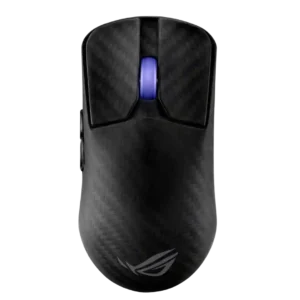
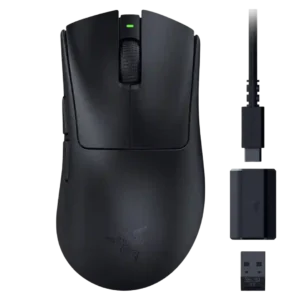
Reviews consistently identify 2.4GHz wireless as the main performance connection, often tied to the Omni receiver or polling-rate booster. The mode is treated as the best route for high polling and gaming responsiveness.
The mouse is consistently treated as a 2.4GHz HyperSpeed wireless mouse, with reviewers noting the included dongle or 2.4GHz connection as the primary gaming connection.
Sensor acceleration handling is documented through repeated 50G acceleration specifications. The reviews support strong acceleration capability, though they do not describe a separate user-facing acceleration tuning feature.
Dynamic Sensitivity gives the mouse speed-based DPI acceleration control. Reviews describe it as useful for fast turns or low-sensitivity play, though it may require adjustment.
Tracking accuracy is one of the strongest areas: reviewers describe the sensor as accurate, precise, consistent, and difficult to disrupt across testing and gameplay.
Tracking accuracy is a major strength. Reviewers describe precise tracking, strong enemy tracking, pinpoint aiming, and smooth consistent motion in gaming use.
Balance is described positively where tested, with reviewers noting solid balance and excellent weight distribution that does not tilt when lifted.
Weight balance is praised where discussed. Reviewers describe the 55g body as well balanced and easy to control rather than merely light.
Battery life is usable but not class-leading. Several reviews cite 70-hour 2.4GHz figures at 1,000Hz, while high polling and RGB reduce runtime substantially.
Battery life is one of the clearest strengths, with many reviews citing or validating up to 100 hours and several noting week-plus use between charges.
Bluetooth is repeatedly confirmed as present alongside 2.4GHz and wired modes. Reviewers treat it as a convenience mode rather than the main gaming connection.
Bluetooth support is a clear weakness. Multiple reviews explicitly state that the mouse lacks Bluetooth or only uses the dongle for wireless operation.
Build quality is a major strength in most reviews, especially the stiff carbon-fiber top shell, tight buttons, and lack of creaking or flex. A few critiques focus on the nylon/plastic lower section rather than structural weakness.
Build quality is described as strong for a lightweight mouse, with reviewers noting little or no flex, solid sidewalls, and a robust shell.
Button and performance customization are well supported through Armoury Crate Gear, Armoury Crate, and hardware controls. Reviewers cite remapping, DPI, polling, lift-off, lighting, and related adjustments.
Button customization is well supported through Synapse, with reviewers noting rebinding, button assignments, profile-related controls, and remapping options.
Button responsiveness is generally strong, with many reviews praising precise, brisk, instant, or consistent actuation. One review reports a left-click pre-travel defect, so the evidence is strong but not perfectly uniform.
Button response is strong in gaming use. Reviews cite rapid firing, quick response, responsive clicks, and switches that handle fast clicking well.
Cable impressions are mixed. Several reviews call the paracord-style cable flexible or lightweight, while others say it is stiff or not especially good.
Cable flexibility is a weak point. Several reviews describe the included USB-C cable as stiff, rubbery, short, or unsuitable for comfortable wired gaming.
Charging is handled through USB-C and wired operation. Reviews describe it as functional and convenient enough, though wired mode can have polling-rate limits depending on setup.
Charging is convenient because the mouse uses an internal rechargeable battery and USB-C, but several reviewers also criticize the included cable quality or length.
Claw grip support is broadly positive, especially for medium to large hands. Several reviewers identify claw as a natural fit, though smaller hands may find the mouse long or awkward.
Claw grip comfort is generally positive, especially for small-to-medium hands. Reviewers repeatedly describe the smaller ergonomic shape as suitable for claw grip.
Click latency is presented as very low, helped by optical switches and high polling modes. Measurements and subjective comments support fast response, with little reason to worry about delay.
Click latency is consistently strong. Reviews report very low latency, fast response measurements, and imperceptible delay in wireless use.
Click noise is mixed. Some reviewers find the clicks pleasant or not annoying, while others describe the switches or side buttons as loud.
Click noise is a downside for some users. Reviews mention loud primary clicks, louder clackers, or click sounds that may be distracting outside headset gaming.
Connection stability is mostly praised through stable wireless and strong receiver performance, but one review reports wireless disconnects during gameplay, making this a generally strong but not flawless area.
Connection stability is strong. Reviewers describe glitch-free low-latency wireless, no lag issues, and flawless or stable wireless tracking.
Debounce support is mixed in a narrow way: optical switches allow very low debounce behavior, but multiple reviews note no user-adjustable debounce setting.
The DPI/CPI ceiling is repeatedly cited at 42,000, with several reviews also discussing fine adjustment steps. The range is clearly flagship-level.
The DPI range is high enough for competitive play, with reviews repeatedly citing the Focus X 26K sensor, 26,000 DPI ceiling, or 100-to-26,000 DPI range.
Durability evidence centers on structural integrity, carbon-fiber strength, and 100-million-click optical switches. Long-term field wear is not deeply tested, but the stated and observed durability signals are strong.
Durability evidence centers on the shell and switches. Reviews cite durable build quality, 90-million-click switch ratings, or optical switches that should last longer.
Ecosystem integration appears through the Omni receiver, shared ASUS dongle support, Armoury software, and ROG peripherals. Reviewers mention the benefit, though some question how many users will need it.
Razer ecosystem support is meaningful but not perfect. Reviews mention Synapse, HyperPolling compatibility, other Razer mouse compatibility, and HyperSpeed multi-device pairing.
Ergonomics are shape-dependent. The mouse is often comfortable for larger hands and safe grip styles, but some reviewers find the hump, length, or button height awkward.
The right-handed ergonomic design is one of the product’s defining traits, with reviewers calling out its safe ergonomic shape, hand contouring, and palm/claw support.
Fingertip comfort is supported for some hands, but not universally. Larger hands or certain grip styles fare better; smaller-hand reviewers sometimes find the mouse too long.
Fingertip grip comfort is mixed to weak. Some reviews say larger hands can fingertip it, but others do not recommend it for fingertip or note size/shape caveats.
Firmware reliability is mixed because at least one reviewer received updates quickly but also saw sporadic 8K wireless shutoff behavior. The evidence points to active support with some remaining rough edges.
FPS suitability is strong. Reviews repeatedly position the mouse around fast shooters, esports, low weight, fast inputs, and accurate tracking.
FPS suitability is high. Reviewers connect the mouse to FPS, esports, Counter-Strike 2, Apex Legends, fast shooters, and competitive aiming performance.
Glide is a clear strength. PTFE and glass feet are described as smooth, fast, and low-friction, although glass feet may require adjustment.
Glide smoothness is a clear strength. Reviewers praise the PTFE feet, smooth mousepad movement, slick glide across surfaces, and easy low-friction control.
Grip texture is mixed. Carbon fiber is often grippy or secure, but the nylon/plastic sides can feel slippery to some reviewers, making included grip tape useful.
Grip texture is mixed. Some reviews like the smooth-touch coating and grip, while others say it can feel clammy or problematic for sweaty hands.
The shape is symmetrical, but handedness is limited by side-button placement. Reviews support basic ambidextrous hand feel while noting practical right-hand bias.
Handedness options are limited. Reviewers repeatedly describe the mouse as right-handed or unsuitable for left-handed gamers.
Left and right click quality receives strong praise in many reviews for tightness, tactility, and minimal wobble. A few units or reviewers report pre-travel, squishiness, or a defect, so results are not unanimous.
Main click quality is mostly strong, with solid, satisfying, snappy, or tactile clicks. One review notes that the main clicks may feel heavy for some users.
Lift-off distance is well covered through software and hardware controls. Reviews mention LOD adjustment, low/high settings, and surface calibration.
Lift-off controls are available through Synapse features such as LOD adjustment or Smart Tracking, with reviews noting 1mm/2mm settings and consistent lift-off behavior.
Long-session comfort depends on hand size and grip. Some reviews mention prolonged comfort, while others cite fatigue, palm irritation, or awkward shape details.
Long-session comfort is positive. Reviewers cite comfort during long play sessions, daily work/play use, raids, and extended FPS sessions.
Macro support is present but lightly evidenced. Reviews mention macro-related button assignment or programmable control, but this is not emphasized as a major feature.
Materials quality is one of the defining strengths. Reviews repeatedly highlight the carbon-fiber shell, premium construction, and stronger/lighter material story.
Materials are generally seen as good for the class, with premium chassis feel, high-quality plastic, smooth-touch texture, and solid-feeling lightweight construction.
MMO suitability has limited evidence. One review used Final Fantasy XIV and described it as an all-rounder, but the mouse is not framed as an MMO-focused model.
Motion consistency is supported by consistent sensor tracking, Motion Sync, stable polling, and smooth wireless behavior. One source notes Motion Sync is not user-configurable.
Motion consistency is strong where discussed. Reviewers describe smooth, consistent tracking and Synapse tools that can maintain horizontal swipes for angled grips.
Onboard memory is supported by reviews noting saved profiles and the ability to configure settings once, then use the mouse without keeping software open.
Onboard memory is limited. Reviews mention only one onboard profile or basic onboard storage, making it less flexible for players who move between setups.
Palm grip comfort is mixed. Some larger-hand reviewers can palm or relaxed-palm it, while others say the mouse is short, irritating, or less suitable for palm use.
Palm grip comfort is positive for the right hand size. Reviewers mention palm-style use, palm support, and good palm comfort, though size preferences vary.
Polling-rate support is a standout feature, with repeated 8,000Hz references over wireless and, in some reviews, wired mode with the booster. Higher polling trades off heavily with battery life.
Polling support is good but has a caveat: 1,000Hz works out of the box, while higher 8,000Hz polling requires a separate HyperPolling dongle.
Portability is strong because many reviews mention the carrying case, travel case, or accessory storage. The missing onboard dongle slot is offset by the included case.
Portability is helped by the small/light body and dongle storage. Reviews mention an underside dongle slot, storage convenience, and easier movement between systems.
Premium feel is strong in packaging, carbon fiber, accessories, and presentation. Some reviewers still feel the price makes the premium treatment hard to justify.
Premium feel is positive in the reviews that address it, with comments on premium chassis feel, high-quality plastic, and satisfying feedback.
Profile switching is supported through onboard profiles and hardware combinations. Reviews cite up to five stored profiles and mouse-based profile changes.
Profile switching is available through software, with reviews mentioning profile switching or different mouse profiles, though it is not a standout feature.
Programmable controls are supported, but quantity is modest. Reviewers cite five to seven programmable inputs depending on whether scroll directions are counted.
Programmable button support is present. Reviews reference six or eight programmable controls, programmable thumb buttons, and customizable button assignments.
RGB is limited to the scroll wheel. Reviews confirm lighting is present and configurable, but repeatedly frame it as basic or restrained rather than elaborate.
RGB features are essentially absent. Reviews repeatedly mention no RGB lighting, zero bling, or the lack of lighting as part of the minimalist design.
Scroll wheel quality is mixed-to-good. Several reviews praise defined steps and tactility, while others find it stiff, small, recessed, or unremarkable.
Scroll wheel quality is mostly solid but not flawless. Reviews praise defined steps and sturdy feel, while some note wheel movement, loudness, or awkward middle-click feel.
Sensor performance is consistently excellent. Reviews cite the AimPoint Pro/PAW3950-class sensor, high DPI, accuracy, responsiveness, and reliable performance.
Sensor performance is widely praised. Reviews repeatedly cite the Focus X 26K sensor and describe it as precise, high performing, or effectively flawless in real play.
Shape comfort is divisive. The safe symmetrical shape works for many, especially larger hands, but multiple reviewers find it too long, awkward, or not ideal for their grip.
Shape comfort is one of the main positives, especially for users who wanted a smaller DeathAdder. Reviews call it natural, comfortable, and easier to move.
Side button quality is one of the most divided areas. Some reviews praise tactility and implementation, while others find the buttons too small, too far forward, loud, or less accessible.
Side button quality is generally good, with easy reach, good spacing, and accessible thumb buttons. One review finds them mushier than the main clicks.
Skate durability evidence is limited and cautious. One review warns glass feet can wear quickly, so smoothness is clearer than long-term skate durability.
Software stability is inconsistent. Reviewers appreciate lighter Armoury Crate Gear, but report pop-ups, installation confusion, download problems, and troubleshooting.
Software stability is mixed to weak. Some reviews find Synapse more reliable, but others call it erratic, unwieldy, or a RAM-heavy update burden.
Software usability is mixed. The lighter Gear app is simpler and useful, but several reviewers still call the software overkill, annoying, complicated, or frustrating.
Software usability is mixed. Reviews praise extensive customization and straightforward controls, while also noting Synapse update burden or setup friction.
Surface compatibility is strong, with reviews citing hard, soft, glass, cloth, wood, and calibration support. The sensor is repeatedly described as reliable across surfaces.
Surface compatibility is supported by evidence around PTFE feet, tracking, and calibration, with reviewers noting multiple mousepads, surface ranges, or desk/mousepad glide.
Switch durability is strongly supported by repeated 100-million-click optical switch ratings. This is one of the clearest durability claims in the reviews.
Switch durability is strong on paper, with reviews citing 90-million-click ratings or optical switches intended to last longer.
Switch feel is generally strong, with reviewers praising tactile, crisp, clicky, and consistent feedback. A minority find the clicks heavier, squishier, or not best-in-class.
Switch feel is praised for tactile, crispy, satisfying, or snappy click feel, with several reviews comparing it favorably to other Razer implementations.
Value for money is the largest weakness. Nearly every review treats the mouse as expensive or niche, with some calling it hard to justify despite strong performance.
Value for money is a major positive. Reviews call it a best-value wireless model, strong under-$100 option, or a cheaper version that keeps key performance.
Weight is a core strength. Reviews repeatedly cite 46-48g figures and emphasize the sub-50g feel, especially for a non-perforated carbon-fiber mouse.
Low weight is one of the strongest points, with reviewers repeatedly measuring or citing around 53g to 55g and praising the lightweight feel.
Wireless latency is generally praised as very low through high polling, optical switches, and solid receiver performance. Some reviewers caution that 8K benefits are small.
Wireless latency is excellent. Reviews cite low-latency wireless, very low measured click latency, imperceptible latency, and fast wireless response.
Wireless performance is broadly strong, with praise for stable, responsive 2.4GHz operation and high polling. One review reports disconnects, but most evidence is positive.
Wireless performance is excellent overall, with reviews noting responsive wireless behavior, stable connectivity, no lag, and flawless tracking.