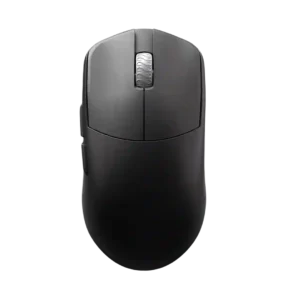
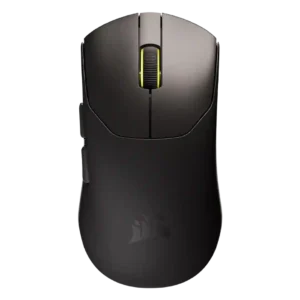
Direct connection evidence is limited, but the Nookyyy transcript states that the mouse can run over wired USB or wireless 2.4GHz. No reviewer raised a specific 2.4GHz reliability complaint.
Wireless connectivity relies on a 2.4 GHz dongle, with one review clearly identifying that as the primary wireless mode.
One review directly highlights the sensor’s 50G acceleration capability, positioning it as high-end on paper.
Tracking precision is described as excellent across several reviews: ProSettings saw no anomalies at 8000 Hz, Tom's Guide found movements predictable and stable, Nookyyy cited superior tracking performance, and Wasabi reported consistently good tracking on mouse pads.
Reviews describe the Sabre V2 Pro as accurate and precise in actual play, especially for fast cursor movement and steady tracking in games.
The weight and shape are repeatedly described as controlled and stable. ProSettings praised the pinched middle for finer control, Boardzy called the weight balance on point, Wasabi found it planted and stable, and another reviewer felt locked in immediately.
Battery life is a mixed strength. Reviewers cite up to roughly 70-80 hours around 1K polling, but several note that higher polling rates drain the mouse faster and can require charging every few days.
Battery life is acceptable at 1,000 Hz but often criticized as mediocre to poor once reviewers move beyond marketing claims or use higher polling rates.
Bluetooth is not supported, and multiple reviews frame that omission as a meaningful tradeoff for the extreme weight target.
Build quality is generally strong, with several reviews calling the shell rigid, solid, or premium. One YouTube review reported a small side creak, so the overall picture is high quality with a possible unit-level QC caveat.
Build quality is divisive but generally solid for the weight: many reviews call it sturdy, while others still note flex or a flimsy impression.
Button customization is supported through the software/web interface. Reviews mention online button configuration, full key rebinding, bottom DPI-button programmability, and button mapping.
Button remapping is available through the Web Hub, giving the mouse basic but useful customization for its limited control set.
Button responsiveness is a major positive. Reviewers repeatedly describe the clicks as light, spammable, fast, responsive, or precise, although one review felt its particular switch implementation lacked character.
Button response is strong in normal gameplay, with reviewers noting reliable click registration and easy rapid clicking.
Cable flexibility is a weak point. Tom's Guide and multiple YouTube reviews describe the included USB-C cable as stiff or draggy enough to interfere with wired use.
Cable flexibility is a recurring negative, with reviewers repeatedly describing the included charging cable as stiff and poorly matched to such a light mouse.
Charging convenience is mixed. The mouse can be used while plugged in and one reviewer liked the larger USB-C port fit, but Tom's Guide found the charging cable awkward and another reviewer avoided it because of stiffness.
Claw grip support is one of the clearest strengths. Multiple reviewers with claw or aggressive claw grips found the shape comfortable, controlled, and well suited to relaxed or regular claw positions.
Claw-grip comfort is mixed: some shape-focused reviews think it suits claw well, while at least one large-hand reviewer had to adapt to it.
The click-latency evidence comes from Nookyyy's specification section, which lists 0 ms click latency. Other reviews also describe the clicks as fast and responsive, but only Nookyyy provides a direct value.
Click latency is the clearest technical weakness in the review set, with technical reviewers explicitly flagging it as unusually high for a competitive mouse.
Noise evidence is limited and mixed. ProSettings said the wheel gets louder when scrolling quickly, while another reviewer found the side-click sound loud and unpleasant.
Click noise varies by reviewer and component, with some calling the mouse louder and others describing the buttons as relatively quiet.
Connection stability is supported mainly by performance testing language. ProSettings saw no anomalies even at 8000 Hz, and Wasabi reported the sensor/wireless use working properly during review.
One review explicitly reports stable wireless behavior even at longer range, supporting dependable connection stability.
Cross-platform support is partial. Nookyyy says the mouse works with most USB 2.0-and-newer systems, but also notes that customization is not yet supported on macOS.
Cross-platform use is helped by the browser-based setup flow, but at least one review notes that firmware updating is restricted to Windows.
Debounce customization is well supported through the configuration tools. Reviewers mention adjustable debounce time, and one software walkthrough shows debounce time set to 0 ms by default.
Debounce customization is missing in the current software, and one technical review specifically flags that lack of control as a drawback.
DPI range is strong on paper and configurable in software. Reviews identify the PAW3950/30,000 CPI or 30,000 DPI capability and mention DPI adjustment in the web interface.
The mouse offers a very high advertised DPI ceiling, with reviews repeatedly highlighting the 33,000 DPI sensor and flexible sensitivity presets.
Durability evidence is favorable but not long-term definitive. Reviews cite durable design, strong build, no decay after weeks of use, and one reviewer felt it would hold out longer; one coating-wear caveat remains.
Corsair ecosystem integration is weak because this mouse uses Web Hub instead of iCUE, creating friction for users with other Corsair devices.
Ergonomics are praised across grip styles. Reviewers describe a comfortable symmetrical design, support for different grips, hand-rest comfort, and finger placement that helps the mouse feel controlled.
Ergonomics are generally good for a lightweight competitive mouse, but not every reviewer found it naturally comfortable, especially with larger hands.
Fingertip grip is only conditionally recommended. Several reviewers suggest the smaller Maya or another large-fingertip option unless the user has medium-to-large hands or specifically wants a larger mouse.
Fingertip grip support is a relative strength, especially for users who prefer smaller mice or more nimble control.
Firmware reliability is positive in the limited evidence available. Hard-Gamer notes firmware updates are handled online, and another reviewer says an early battery-indicator issue was quickly fixed by firmware.
FPS suitability is strong. Reviews discuss Valorant, Fortnite, competitive gaming, and aim-trainer performance, with the mouse's low weight, responsive clicks, and high polling rate supporting competitive play.
FPS gaming is the mouse’s clearest use case, with multiple reviewers framing it as an especially strong fit for competitive shooters.
Glide smoothness is a consistent highlight. Reviewers repeatedly praise the stock feet as smooth, fast, low-friction, or among the best they have tried, with no need to replace them immediately.
Glide is a consistent strength, though skate feel varies slightly by surface and reviewer preference.
Grip texture is generally good but not perfect. Several reviewers call the coating grippy or improved, while others mention moisture pickup, smudges, or possible wear/cleaning challenges for sweaty users.
Grip texture is a net positive, with several reviews calling the shell grippy or usable, even if some users may still prefer the included grip tape.
Handedness evidence describes an ambidextrous or symmetrical shape, though one source calls it right-handed symmetrical. The score reflects a broadly symmetrical shape rather than true left-side-button parity.
Main-click quality is repeatedly praised. Reviews describe the main clicks as implemented well, responsive, crisp, loved, or superior to competing clicks.
Primary click quality lands in a good-but-not-perfect range, with several reviews praising the main buttons even when they note mild softness or mushiness.
Lift-off distance is configurable and competitive. Reviews cite 0.7 mm support, LOD adjustment in software, and multiple lift-off options.
Long-session evidence is positive but indirect. Nookyyy emphasizes extended gaming sessions through battery life, while Wasabi calls the mouse comfortable as a daily driver for general computer use.
Long-session comfort is a notable benefit, with reviewers specifically saying the mouse feels less tiring or fatigue-free over extended play.
Macro support is supported in the software. ProSettings, Tom's Guide, and another software walkthrough mention macro recording or macro controls.
Macro support is present in software, and reviews confirm that users can create and store macros despite the mouse’s minimalist design.
Materials quality is generally good. Reviewers point to pure PTFE feet, a good-feeling plastic case, strong shell materials, and thickness that contributes to solidity.
Material quality gets specific praise in one technical review, which calls the materials excellent and easy to keep clean.
MMO suitability is limited by the very low button count, which one review directly calls out as a compromise versus heavier, more feature-rich mice.
MOBA suitability is supported by Tom's Guide testing in League of Legends, where the reviewer said the mouse worked very well in ranked matches.
Motion consistency is a strength in testing and configuration. Reviews cite no anomalies at 8000 Hz, stable predictable movement, motion-sync controls, and strong sensor consistency.
Tracking consistency is strong overall, with reviewers reporting stable tracking and no meaningful motion issues in normal use.
Onboard memory evidence is limited to the transcript's MCU/profile discussion. It supports stored profiles and CPI settings, but reviews do not deeply test onboard storage behavior.
Onboard memory is limited, with reviews repeatedly noting that only one profile can be stored on the mouse itself.
Palm grip comfort is mixed by hand size and preference. One reviewer says palm grip feels good on the larger Maya X, while others recommend different options for users wanting a very full palm or using larger hands.
Palm-grip comfort is better than the size suggests for some users, but it is not universally ideal for every hand size.
Polling-rate support is a standout feature. Every major source that discussed specs points to 8K wireless polling or broad polling-rate options, often with the 8K receiver included.
Polling-rate support is a clear strength, with multiple reviews calling out 8,000 Hz support as a standout competitive feature.
Portability is supported by the low weight and included pouch/spare-feet package. The mouse is easy to carry, though the evidence is more about accessories than travel testing.
Portability is limited by the lack of Bluetooth and the unusual dongle/cable setup, which several reviewers say makes travel or multi-device use less convenient.
Premium feel is mostly positive. Reviews call the unboxing premium, the mouse premium-feeling, exceptional, or close to its price in perceived quality.
Premium feel depends heavily on perspective: some reviewers say it feels surprisingly premium, while others think the extreme lightness makes it feel cheap.
Profile switching is only lightly supported by review text. The strongest direct evidence is the web-software mention of setting up profiles; deeper profile-switching behavior is not tested.
Profile switching is a weak spot because there is no dedicated profile button and changing profiles feels awkward or slow.
Programmable buttons are supported through software. Reviews mention full rebinding and six programmable buttons, including the main buttons, wheel click, side buttons, and DPI button.
Programmable button support exists, but the limited button count means the mouse offers only modest flexibility compared with more feature-heavy models.
RGB is essentially absent, aside from brief indicator lighting, which reviewers consistently frame as a deliberate sacrifice for lower weight.
Scroll-wheel quality is generally good. Reviewers describe it as tensioned correctly, light, tactile, distinct, and easy to click, with one dust/open-bottom caveat in ProSettings.
Scroll wheel quality is mostly positive, though opinions vary on stiffness, noise, and tactility depending on reviewer preference.
Sensor performance is consistently praised. Reviews identify the PAW/PixArt 3950 and describe stellar performance, superior tracking, perfect operation, or elite wireless sensor implementation.
Sensor performance is consistently praised, with multiple reviews calling the sensor flawless, stable, or issue-free in real use.
Shape comfort is a core strength. Most reviewers liked the larger Maya X shape, especially for medium-to-large hands and claw or relaxed claw grip, though a few preferred the smaller Maya or noted edge/size preferences.
The shape is widely seen as safe and comfortable, though its smaller size fits some hand sizes and grip styles better than others.
Side-button quality is the most uneven button area. Some reviewers found them crisp and accessible, but several reported stiffness, mushiness, or excess travel, especially on the top/front side button.
Side buttons are usable and often well placed, but several reviews also mention excess post-travel or a cheaper feel than the main clicks.
Skate durability has moderate support. Reviews mention spare feet for wear, smoothness after nearly four weeks, and stock skates that remained worth keeping, but there is no long-term months-long test.
The stock UPE/UHMWPE feet are positioned as longer-wearing than typical PTFE options, even if they trade some speed or friction characteristics.
Software stability is mixed. ProSettings and Wasabi found it working or loading fine, while Tom's Guide had slow, laggy app trouble and another review simply said the web driver gets the job done.
Software stability looks good in practice, with reviews describing the Web Hub as working reliably and applying changes without lag.
Software usability varies by implementation. Web-based setup is praised for convenience and simplicity, but Tom's Guide criticized the companion app as slow, laggy, and ugly.
Software usability is mixed but workable: reviewers like the clean, minimal Web Hub, yet often criticize browser dependence and slower mid-game adjustments.
Surface compatibility is strong. Reviewers mention use across a variety of surfaces, any mouse pad, textured pads, and consistent tracking on mouse pads.
Surface compatibility is decent overall, with support across cloth and even desk use, though glass-pad performance is rougher than cloth-pad use.
Switch durability is supported by the Omron optical switch rating evidence. Direct long-term switch testing is not provided, but the quoted rating is high.
Switch durability is supported by repeated mention of the 100 million click rating on the main switches.
Switch feel is widely praised. Most reviewers describe the Omron optical switches as crispy, springy, light, fast, or precise, although one reviewer found the feel somewhat lackluster.
Switch feel is generally good but not class-leading; some reviewers like the tactile feel, while others find the clicks a bit soft or less crisp.
Value is rated positively at around $120. Reviewers cite strong specs, included accessories, competitive pricing versus big-brand alternatives, and a premium package, while noting cheaper budget mice exist.
Value is mixed but generally favorable at $100: several reviews see strong value for the specs, while one technical review thinks rivals make a better case.
Weight is a major strength. Multiple reviewers measured or cited roughly 47-48 g and described the weight as excellent, amazing, or impressive for the larger shell.
Weight is the defining feature of the Sabre V2 Pro, with many reviews emphasizing just how extreme the 36 g design feels in hand.
Wireless latency is supported indirectly through click-latency, high polling, and responsiveness evidence. Reviews describe lightning-fast response and responsive button behavior in wireless/high-performance contexts.
Wireless latency is generally strong on paper and in testing, though one technical review also notes some instability at the highest wireless polling rates.
Wireless performance is consistently strong. Reviewers describe true 8K wireless operation, elite wireless implementation, and wireless performance that feels great or among the best.
Wireless performance is strong in practice, with reviews reporting stable gameplay, no dropouts, and accurate behavior during fast movement.