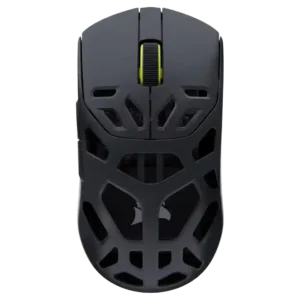
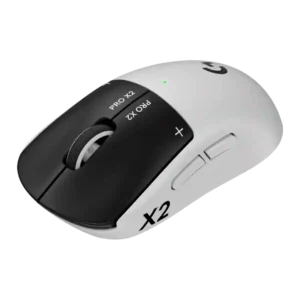
Reviews consistently identify 2.4GHz/SLIPSTREAM wireless as a core connection mode, usually through the included receiver or dongle. They describe setup as simple and position 2.4GHz as the primary gaming connection.
Reviewers consistently describe the mouse as relying on Logitech's low-latency dongle or Lightspeed wireless path rather than broad multi-device wireless. The connection is treated as gaming-focused and stable, with no Bluetooth fallback.
The supporting reviews describe acceleration handling or related motion tuning rather than a dedicated acceleration slider. Evidence centers on the sensor's 50G/70G acceleration spec and Web Hub motion controls such as motion sync, angle snapping, and ripple control.
The sensor specification is repeatedly tied to 88G acceleration and, in one review, zero smoothing, acceleration, or filtering. Reviewers frame this as part of the pro-grade tracking package rather than the main innovation.
Tracking precision is one of the clearest strengths. Reviewers describe the sensor as precise, accurate, clean during long swipes, and reliable for low-DPI aiming and quick in-game movement.
Tracking and aiming precision are repeatedly praised. Reviewers report flawless sensor behavior, pixel-perfect tracking, stable movement across speeds, and sharper practical aiming, though one reviewer preferred a smaller mouse for accuracy because of shape.
Reviewers that discuss balance frame it as a useful middle ground: light enough for quick movement, but reinforced by a sturdier magnesium shell and larger battery. The tradeoff is that it is not as featherlight as the plastic Ultralight version.
Balance is one of the clearest mixed points. Several reviewers call out front-heavy weight distribution from the new haptic hardware, while only a few treat the familiar 61g weight as easy enough to adapt to.
Battery life is repeatedly praised. Multiple reviews cite up to 120 hours at lower polling rates, while noting that 8,000Hz sharply reduces runtime but still remains usable for gaming sessions.
Battery life is generally viewed as strong. Multiple reviews cite roughly 80 to 95 hours or multi-day use, while noting that higher haptics, higher polling, or heavy clicking can reduce runtime.
Bluetooth is repeatedly mentioned as a useful addition for non-gaming or multi-device use. Reviews generally treat it as convenient, while still positioning 2.4GHz wireless as the better gaming mode.
Bluetooth support is consistently absent. Reviews that mention it treat the omission as expected for a competitive mouse or disappointing at the price, but no review indicates Bluetooth is available.
Build quality is a major strength. Reviews describe the magnesium shell as sturdy, rigid, flex-free, and tank-like, with several noting no creaking, rattling, or visible wear during testing.
Build quality is praised across reviews, with comments about a solid shell, premium construction, durable-feeling chassis, and sturdy lightweight design. The few criticisms focus more on balance, skates, or controls than core construction.
Button customization is well supported through Corsair Web Hub. Reviews mention remapping, DPI stages, assignments, and other controls, though customization is limited by the simple five-button layout.
Button customization is one of the defining strengths. Reviews emphasize adjustable actuation, haptic feedback strength, rapid trigger behavior, independent left/right tuning, remapping, and G Hub configuration.
Button responsiveness is strong where discussed. Reviewers describe crisp, spammable, well-implemented clicks with little travel and consistent registration, although side buttons receive more mixed comments.
Button responsiveness is the central performance win. Reviewers describe snappier clicks, faster response, lower measured or perceived latency, and quicker click behavior, though some stress that it will not replace skill.
Cable flexibility is a recurring weakness. Reviewers describe the included USB-C cable as thick, stiff, firm, and not suited to low-drag wired gaming, making it better for charging than regular wired play.
Charging convenience is mixed. Reviews appreciate USB-C, relatively quick charging, and long battery life that reduces charging frequency, but the stiff cable makes plugged-in use less comfortable.
Charging convenience is strong, especially for users in Logitech's ecosystem. Reviews mention long intervals between charges, USB-C top-ups, PowerPlay compatibility, and wireless charging during use.
Claw grip comfort is one of the safer fits. Reviewers repeatedly call the shape suitable or intentional for claw grip, helped by the low, familiar ambidextrous-style shell.
Claw grip feedback is mostly positive because the shape and optional grip tape can support it, although one reviewer used more claw because the G502X thumb rest was gone rather than because the shape was ideal.
Click latency is supported through comments on near-instant input, response time, and successful click registration. The evidence is positive but mostly tied to polling/input feel rather than formal measured click-latency testing.
Click latency is the mouse's headline advantage. Reviews cite Logitech's up-to-30ms claim, lower reaction-time results, very low measured click latency, and the practical feel of faster shots.
Click noise is generally favorable. Reviewers describe the switches as quieter or not too loud while still giving clear feedback, making the mouse less noisy than some gaming mice.
Click noise is generally praised for being quiet or virtually silent. Reviewers describe the haptic clicks as muted, less audible than standard switches, and pleasant for shared rooms, even if some users may miss a sharper click.
Connection stability is positive across testing. Reviewers mention stable Bluetooth for everyday use, no signal issues, no dropouts, and no performance-limiting wireless events.
Connection stability is a clear strength. Reviews report no drop-outs, lag-free Lightspeed performance, stable wireless use, and no interruption during play or testing.
Cross-platform compatibility is mainly supported by the browser-based Web Hub and Bluetooth. The clearest evidence says the Web Hub is a platform-independent alternative, with Bluetooth useful for mobile or desktop use.
Cross-platform support is mixed. G Hub support for Windows and macOS is cited, but the mouse lacks Bluetooth hot-swapping and one review notes Linux users are left out.
Debounce customization is a weakness. The only direct review evidence says debounce time is not available in the Web Hub, even though clicks still felt responsive in use.
PowerPlay compatibility is repeatedly mentioned as a convenience advantage. The mouse can work with Logitech's charging mat or puck system, though this depends on staying inside Logitech's ecosystem.
DPI range is strong on paper and repeatedly cited. Reviews mention the 33,000 DPI Marksman S sensor or detailed DPI stages, giving the mouse more range than most users are likely to need.
The DPI range is consistently described as very high, typically 100 to 44,000 DPI. Reviewers treat it as a flagship spec even when noting that most players will use much lower settings.
Durability over time is promising but not fully long-term proven. Reviews cite sturdy materials, no flex, no visible shell wear, and rugged construction, while some note possible concerns about dust or sweat entering the perforated shell.
Durability over time is uncertain. Reviewers like the solid build and the no-physical-switch concept, but several explicitly note that long-term HITS durability or quality control cannot yet be proven.
Ecosystem integration is mixed. Web Hub is praised, but several reviews note separation from iCUE or the need to close iCUE, which weakens integration for users already invested in Corsair's broader software ecosystem.
Ecosystem integration is a strength for Logitech users. Reviews connect the mouse to G Hub tuning, Lightspeed wireless, PowerPlay charging, sensitivity matching, and profile or settings sharing.
Ergonomic design is generally safe rather than deeply sculpted. Reviews describe the mouse as comfortable and usable across grip styles, but some caution that users wanting strongly contoured ergonomics may want something else.
Ergonomic design is mostly positive because the Superlight-style shell is familiar and comfortable. Criticism centers on size for smaller hands, lack of left-side symmetry in the buttons, or shape preferences.
Fingertip grip comfort is mostly positive. Multiple reviews describe it as suitable for fingertip grip, though one reviewer found fingertip use more deliberate than effortless because of the front width and shape.
Fingertip grip comfort is mixed. Some reviews include fingertip or hybrid grips in the supported range, while others say pure fingertip users or small-mouse fans may prefer another shape.
Firmware reliability is mixed and lightly evidenced. Reviews report a smooth firmware update or no hitches, but also mention wake-from-sleep DPI delay or settings behavior that needs software running.
FPS suitability is one of the product's best-supported use cases. Reviews repeatedly connect its light weight, responsive wireless performance, high polling rate, and precise sensor to shooters and competitive play.
FPS suitability is one of the strongest use cases. Reviews repeatedly tie the low-latency clicks, rapid trigger, 8K wireless, and precise tracking to shooters like Counter-Strike, Valorant, Call of Duty, and Battlefield.
Glide smoothness is strong, especially with the larger included skates. Reviews describe smooth glide, improved control, and good movement across mousepads, with only minor surface-specific caveats.
Glide smoothness is mixed. Some reviewers report effortless or butter-smooth gliding, while several mouse-focused reviewers criticize the stock skates as slower, not smooth enough, or better on glass than cloth.
Grip texture is positive overall. Reviews cite the textured magnesium finish, grip tape, stable coating, and added traction, though grip tape can visually interfere with the perforated design.
Grip texture is mixed-to-good. Several reviewers praise the matte texture or optional grip tape, while others find the shell a bit slick without tape.
Handedness support is based on the ambidextrous or symmetrical shape. The reviews support a safe ambidextrous form, but they do not show multiple handedness-specific button layouts.
Handedness options are limited. The shell is symmetrical, but the side buttons are left-side only, so left-handed users do not get a true ambidextrous control layout.
Main click quality is strong. Reviewers describe satisfying, snappy, responsive primary clicks with clear feedback and well-balanced tension, even where they prefer optical switches over mechanical ones.
Left and right click quality is strongly praised because the HITS buttons feel tactile, tunable, and unusually satisfying once powered. A few reviewers still prefer older mechanical clicks or note the sensation takes adjustment.
Lift-off distance control is supported through Web Hub settings. Reviews mention lift height or lift-off distance adjustments as part of the browser-based tuning suite.
Lift-off distance is configurable but not deeply praised. Reviews mention lift-off settings in G Hub, though one notes the lack of precise measurement and others treat it as part of broader sensitivity controls.
Long-session comfort is supported by comments on reduced fatigue, cooling, sweat management, and comfort over longer gaming sessions. The shape is safe, though not deeply contoured.
Long-session comfort is generally positive. Reviews cite comfortable extended use, long gaming sessions, and reduced fatigue, though comfort still depends on grip style and shape preference.
Macro support is supported across Web Hub reviews. Reviewers mention macro creation, recording, and editing, making the feature available despite the mouse's minimal button layout.
Macro support is available through G Hub, with several reviews mentioning recorded macros or assignable functions. The main limitation is the relatively low button count.
Materials quality is a major differentiator. Reviews repeatedly identify the magnesium alloy shell as premium, rigid, durable, and distinct, though one reviewer felt the finish was more average than expected.
Materials quality is praised through references to high-quality plastics, smooth durable chassis feel, satin or matte texture, and premium lightweight construction.
MMO suitability is weak-to-mixed. One review says the mouse can handle World of Warcraft, but several point to the low button count as a drawback for RPG/MMO-style players who need many inputs.
MOBA suitability has limited but direct support. One review specifically says the precision and responsiveness matter in FPS and MOBA titles, but most gaming evidence centers on FPS play.
MOBA suitability is positive when the game rewards fast clicks. Reviews cite MOBAs or click-heavy RTS play as places where rapid trigger and light actuation can still feel useful.
Motion consistency is strong. Reviewers describe smooth movement, consistent responsiveness, no stuttering, no delayed inputs, and only minor high-polling instability that was not noticeable in-game.
Motion consistency is supported by flawless tracking, no dropouts, stable movement plots, and consistent sensor behavior across swipes and micro-adjustments.
Onboard memory/profile retention is supported through comments about settings and profiles staying on the mouse without running software. Evidence centers on tournament and multi-PC convenience.
Onboard memory is inconsistent across reviews. Some say up to five onboard profiles or internal memory are supported, while another reports that settings did not save to the mouse without G Hub running.
Palm grip comfort is mixed. One review says palm-style contact feels familiar, while another would not necessarily recommend it as a palm grip mouse because of the shape and large holes.
Palm grip comfort is mixed-to-positive. Some reviewers say the palm is well supported or fits perfectly, while another says palm is not ideal because of the low, slim shape.
Polling-rate support is excellent. Reviews repeatedly cite 8,000Hz wired and wireless polling, with the tradeoff that higher polling consumes much more battery.
Polling rate is a flagship spec. Reviews repeatedly cite 8,000Hz wireless operation, with some noting wired mode is capped at 1,000Hz or that many players may still choose lower polling for battery or compatibility.
Portability is mixed. Bluetooth and pack-safe comments help, while the lack of a carrying case and stiff cable reduce the travel-friendly feel for a premium mouse.
Portability is helped by onboard dongle storage and a travel-ready lightweight shell. Reviewers specifically call out the stored receiver and suitability for players moving between setups.
Premium feel is mixed-positive. Many reviewers credit the magnesium shell with a premium or unique feel, but at least one found the finish underwhelming for the price.
Premium feel is strong, with reviews describing the mouse as premium, well-made, high-performing, and advanced. The same evidence also reinforces that the premium price is a major consideration.
Profile switching and profile management are supported through Web Hub. Reviews mention profile selection, different profiles, and DPI-stage/profile behavior stored on the mouse.
Profile switching is available but not always hardware-direct. Reviews mention dual profiles, per-game profiles, G Hub profile controls, and workarounds for DPI/profile switching because there is no dedicated DPI button.
Programmable buttons are supported but limited. Reviews confirm five programmable buttons or button remapping, while the physical layout remains simple and esports-focused.
Programmable buttons are supported through remapping, macros, and assignments. The main limitation is that the mouse has few physical buttons compared with more feature-rich gaming mice.
RGB features are minimal. Reviews explicitly say there is no flashy RGB or no RGB lighting, aside from small indicator LEDs for DPI or status.
RGB features are essentially absent. Reviewers repeatedly note no RGB lighting, usually framing it as a clean design or a battery-life benefit rather than a customization feature.
Scroll wheel quality is generally good. Reviewers cite clear steps, rubber grip, satisfying action, and centered operation, while a few note softer or stiffer middle-click feel.
Scroll wheel quality is mostly good but not unanimous. Some reviewers call it solid, precise, phenomenal, or marvelous, while others report looseness, mushiness, or release issues.
Sensor performance is a clear strength. Reviews praise the Marksman S sensor as excellent, flawless, responsive, accurate, and suitable for competitive gaming.
Sensor performance is highly praised. The Hero 2 sensor is described as precise, proven, exceptional, and capable of flawless tracking, with high DPI and polling specs backing it up.
Shape comfort is broadly positive. Reviewers call the shape safe, familiar, comfortable, and suited to multiple grip styles, though not especially sculpted or radical.
Shape comfort is familiar and generally safe, especially for users who already like the G Pro/Superlight shell. Reviews still flag size, boxiness, and personal shape preference as important caveats.
Side button quality is mixed. Some reviewers found them easy to distinguish and press, while others criticized mushiness, dull feedback, recessed placement, or weaker feel than the main clicks.
Side button quality is mixed. Some reviewers find the side buttons tactile and usable, while others call them traditional, mushy, or underdeveloped next to the new main clicks.
Skate durability and stock skate quality are mixed-to-weak. Some reviews like the longevity angle, but several criticize the feet for slowing, flattening, or needing replacement.
Software stability is positive where discussed. Reviews describe settings applying immediately and the browser interface working intuitively, though this is not the same as long-term software reliability testing.
Software stability is mixed. Some reviewers had no hitches or called the setup flawless, while others found settings behavior or G Hub dependence frustrating.
Software usability is strong. The Web Hub is repeatedly praised as browser-based, lightweight, clean, simple, and preferable to installing a large desktop suite.
Software usability is mostly positive, with G Hub described as clear, straightforward, easy to navigate, and useful for HITS tuning. The main criticisms are lack of web configuration and general G Hub dislike.
Surface compatibility is supported through glide and tuning comments. Reviews mention glass-pad scratchiness, surface selection, and interchangeable skates for different surfaces.
Surface compatibility is generally good for tracking, with reviewers mentioning cloth, glass, fabric, and hard plastic surfaces. The stock skates are more divisive across surfaces than the sensor itself.
Switch durability is mixed. Reviews cite 100-million-click mechanical switches, but one reviewer would prefer optical switches for reliability in a competitive-focused mouse.
Switch durability is promising but not proven. Reviewers note the lack of traditional switches and theoretical reduction in mechanical wear, but Logitech's lack of click-rate figures leaves long-term certainty open.
Switch feel is strong. Reviewers describe crisp, satisfying, snappy, and good-feeling clicks with clear tactile feedback.
Switch feel is a major strength after adjustment. Reviewers describe the haptic clicks as fantastic, tactile, convincing, clean, and customizable, while still noting they feel different from traditional switches.
Value for money is divided. Some reviewers call it worth the money or a compelling option, while others say the premium price is hard to justify or criticize it as overpriced.
Value for money is the biggest tradeoff. Reviewers often accept the premium because the tech is genuinely new, but many still call the price high or say casual players can get strong mice for less.
Weight is light but debated. At roughly 55-56g, reviewers call it lightweight, yet several note it is heavier than the plastic Ultralight and not extreme by modern standards.
Weight is generally good at about 59 to 61 grams. Reviewers treat it as lightweight for a mouse with new internal tech, though some ultralight enthusiasts would prefer something lighter.
Weight tuning is limited. Reviews mention small configuration weight changes from pucks or covers, but there is no real adjustable-weight system like traditional weight tuning.
Wireless latency is very strong in subjective testing. Reviewers cite near-instant input, no delay, immediate wireless inputs, and smooth 8,000Hz responsiveness.
Wireless latency is excellent. Reviews cite low-latency 2.4GHz/Lightspeed operation, 8K wireless polling, zero perceived latency, and extremely low measured response.
Wireless performance is strong overall. Reviews describe stable signal, strong wireless performance, 2.4GHz gaming responsiveness, and wireless mode that does not feel like a compromise.
Wireless performance is strong. Reviews point to sturdy wireless connectivity, stable Lightspeed use, no interruption, and high polling over wireless.