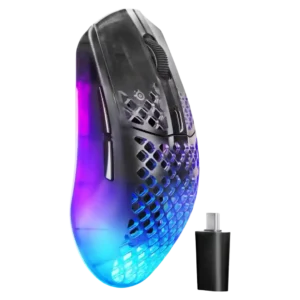
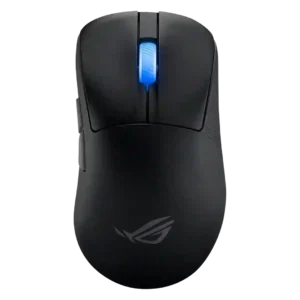
2.4 GHz connectivity is well supported through the bundled dongle or receiver, with reviewers tying it to full 4K polling and better gaming performance.
Reviews that discussed wireless modes consistently describe 2.4GHz connectivity as a core option alongside Bluetooth and wired use. The evidence supports strong coverage for 2.4GHz operation, including receiver storage, tri-mode connectivity, and pairing through the main wireless receiver.
Acceleration control is supported mainly through software-level acceleration and precision settings plus the sensor specification of 40G acceleration.
Sensor acceleration specs were consistently described as high-end, with reviewers citing 50G acceleration alongside 750 IPS speed. The evidence supports strong acceleration capability, though it is presented as sensor performance rather than a separate user-facing tuning feature.
Tracking precision is repeatedly described as accurate, one-to-one, and reliable, with several reviews tying that precision to flicks, aiming, and high-speed movement.
Tracking precision was repeatedly praised. Reviewers described near-perfect accuracy, high precision, accurate tracking, and jitter-free performance, with only one review noting high-DPI irregularity at extreme settings.
Balance feedback is mixed and limited: one reviewer found the balance spot-on, while another felt weight was biased toward the middle and rear.
Most reviewers who discussed balance found the mouse light and well balanced. One teardown-style review noted a slightly forward balance point, but the broader evidence describes the mouse as comfortable to move without obvious front or rear weight bias.
Battery life is generally strong at Bluetooth or 1,000 Hz 2.4 GHz settings, but several reviews note a sharp drop at 4,000 Hz and high RGB brightness.
Battery life is generally strong, with many reviews citing 107 hours at 2.4GHz with lighting off or strong real-world endurance. Higher polling rates and RGB reduce runtime, and one review measured lower Wi-Fi runtime with default lighting.
Bluetooth support is widely documented and valued for laptops, tablets, travel, and non-competitive use, though some advanced features require 2.4 GHz or wired mode.
Bluetooth support is widely confirmed and treated as a useful convenience feature. Reviews describe Bluetooth pairing, multi-device Bluetooth use, and longer battery life in Bluetooth mode, while noting that it is not the low-latency competitive mode.
Build quality is mostly strong, with praise for fit, finish, shell integrity, lack of flex, and improved creaking or mushiness concerns.
Build quality is mostly positive, with reviewers describing a sturdy, solid shell and little flex or creaking. A few reviewers found the build merely average or noted minor rattle, so the evidence is strong but not flawless.
Button customization is supported through freely configurable side buttons, remapping, app controls, and profile-based settings changes.
Button customization is well supported through Armoury Crate or onboard controls. Reviewers cite remapping inputs, assigning commands, programmable controls, and hardware-based adjustments for key settings.
Button responsiveness is generally strong, with reviewers describing clicky, snappy, responsive buttons and few complaints about missed inputs.
Button responsiveness is consistently praised. Reviewers cite snappy registration, lightning-quick actuation, responsive clicks, and short-travel optical buttons that support fast inputs.
Cable flexibility is supported by repeated praise for the included mesh, braided, or fabric USB-C cable and its smooth movement on a desk.
Cable flexibility is a strength overall. Several reviewers praised the paracord as flexible, tangle-free, or drag-reducing, though one reviewer found it long enough but somewhat stiff while charging.
Charging convenience is supported by USB-C charging, wired-while-charging use, quick charging comments, and included adapters or cables.
Charging and setup convenience are mixed. One review says USB-C charging is quick and painless, while another liked the adapter/booster setup but noted the connection stack could feel loose.
Claw grip comfort is one of the clearest ergonomic strengths, with multiple reviewers saying the rear flare and compact shape suit claw grip users.
Claw grip comfort is supported for many hand sizes. Reviews mention all-grip compatibility, relaxed claw comfort, and claw grip usefulness, though one detailed review cautions that fit depends on hand size.
Click latency evidence is limited but positive, with two reviews citing the 1.2 ms response figure tied to the higher-performance internals.
Click latency is a clear strength. Reviews cite latency reduction from high polling, measured low click latency, no latency issues, and low wireless click latency measurements.
Click noise is mixed: some reviewers liked the click sound or quieter scroll wheel, while others found the switches loud.
Click noise is mixed but generally acceptable. Some reviews described the switches as quiet or quieter than competitors, while another found the optical clicks loud.
Connection stability is mostly positive, with stable Bluetooth and 2.4 GHz experiences plus dongle placement or hub evidence for stronger signal.
Connection stability is strong across the reviews that tested it. Reviewers mention tri-mode connectivity, no delays, no hiccups, no dropouts, and stable Bluetooth or wireless switching.
Cross-platform compatibility is supported by Bluetooth, multi-device use, smartphone or MacBook mentions, and settings saved for use across different systems.
Cross-device use is supported mainly through Bluetooth and multi-device pairing. Reviewers cite simultaneous pairing with multiple devices, multi-device setup versatility, and the ability to pair up to three devices.
Debounce customization is weak. The available evidence says debounce was 0ms and not adjustable, and another review states there was no debounce setting in the software.
The 26,000 DPI ceiling is widely documented, with reviewers treating it as more range than most users need but useful for sensitivity flexibility.
The DPI range is one of the clearest strengths. Reviewers repeatedly cite 42,000 DPI or CPI and describe it as unusually high, although some note that most users will not need the upper end.
Durability evidence is strong, covering IP54 protection, tough shell behavior, drop or spill resistance, and general resistance to daily travel abuse.
Durability over time is supported mainly through switch behavior. One review specifically links optical switches to consistent long-term performance and reduced double-click risk.
Ecosystem integration is supported through SteelSeries GG, SteelSeries accessory integration, and coordinated setups with other SteelSeries gear.
Ecosystem integration is present through Aura Sync and the ROG Omni receiver. Reviewers cite lighting sync with compatible devices and using one receiver for multiple ROG peripherals.
Ergonomic design is praised by some for the flat symmetrical shape and small-hand fit, but one review criticizes the overall comfort compared with alternatives.
The design is clearly ergonomic and right-handed. Reviews describe the curved or ergonomic shape, often tying it to right-handed comfort and ultra-light wireless use.
Fingertip grip comfort is mixed: some reviews include fingertip users in the target audience, while others found the flared rear awkward for fingertip control.
Fingertip grip comfort is limited and hand-size dependent. One review says the light weight makes fingertip use possible with grip tape, while another does not recommend fingertip gripping the ergonomic shell.
FPS suitability is strongly supported, with repeated Counter-Strike, shooter, and competitive gaming evidence tied to low latency, tracking, and 4K polling.
FPS and esports suitability are consistently strong. Reviewers repeatedly frame the mouse around hard-core gameplay, competitive esports, FPS use, high polling, and precision aiming.
Glide smoothness is mostly positive, with PTFE feet described as smooth across mouse pads, desks, and cloth surfaces.
Glide smoothness is broadly praised. Reviewers cite PTFE feet, smooth glide, controlled movement, and good stock skates, including use on glass in some tests.
Grip texture is polarizing, with some reviewers finding the texture grippy and others saying the sides or plastic finish feel slippery.
Grip texture is the most divisive physical trait. Some reviewers liked the non-slip or textured surface and grip tape, while others found the coating slippery or not secure enough without aftermarket grips.
Handedness evidence points to a right-handed practical layout despite the symmetrical shell, because the side buttons are only on one side.
Handedness is limited. Evidence shows the mouse is comfortable for right-handers but not suited for lefties or users wanting an ambidextrous shape.
Main click quality is mostly praised for satisfying, clicky feedback, with evidence focused on left/right click feel rather than unusual customization.
Left and right click quality is generally strong, with snappy, tactile, consistent, or solid click feedback across many reviews. Some detailed reviewers still criticized slipperiness or travel on the main buttons.
Lift-off distance is repeatedly supported as an adjustable software setting, usually mentioned alongside DPI, polling, and other advanced tuning controls.
Lift-off distance support is present through software or onboard controls, but not universally flexible. Reviews mention lift-off adjustment, low/high LOD options, and 1mm/2mm LOD limits.
Long-session comfort is generally positive for smaller hands, light use, and fatigue reduction, though one reviewer reported hand cramps with the smaller shape.
Long-session comfort is strong where discussed. Reviewers cite no hand pain, low fatigue, and zero strain over prolonged play, helped by the low weight.
Macro support appears in software-focused reviews, with explicit evidence that custom macros and game profile macros can be configured.
Macro support is available through Armoury Crate. Reviews cite macro recording and saved macros in the software workflow.
Materials quality trends positive for plastics and shell construction, though one review criticizes the finish for lacking grip.
Materials quality is generally positive, with evidence for PBT buttons, bio-based nylon, rigid shell feel, and textured surfaces. Some reviewers still found the shell feel less premium than rubberized coatings.
MMO suitability is only lightly supported. One review used the mouse in Final Fantasy XIV raids and inventory management, but the review evidence does not present it as a dedicated MMO mouse.
Motion consistency is described positively through smooth aiming, reliable tracking, fluid movement, and the lack of missed tracking during gameplay.
Motion consistency is strong in gameplay, with reviewers citing smooth tracking, granular accuracy, and micro-adjustment precision. MotionSync is present but not configurable in one technical review.
Onboard memory is supported by references to storable profiles and settings saved directly to the mouse for use beyond one system.
Onboard memory/profile support is present, with reviews citing hardware-based profiles, onboard controls, and profile switching without needing to keep the software open.
Palm grip comfort is mixed to weak overall, with smaller-hand praise offset by repeated comments that larger palm-grip users may prefer the Aerox 5 or another shape.
Palm grip comfort is positive but not universal. Reviews describe comfortable palm or relaxed palm use, while hand size and the smaller ergonomic shape affect fit.
The move from 1,000 Hz to 4,000 Hz polling is a major upgrade across the reviews, improving responsiveness most clearly in competitive and high-refresh-rate play.
Polling rate is a headline strength across nearly every review. Evidence repeatedly confirms 4,000Hz wireless polling and 8,000Hz wired polling through the included booster.
Portability is mostly favorable because of durability, Bluetooth, compact size, and travel use, but one review criticizes the lack of onboard dongle storage.
Portability is supported through bundled accessories, dongle storage, and multi-device use. Reviewers mention grip tape, extra feet, and using one mouse across multiple devices or on the go.
Premium feel is supported by solid construction, low-weight feel that does not seem compromised, and descriptions of a more premium mouse experience.
Premium feel is present but not unanimous. Some reviewers found the chassis premium and the mouse solid, while others criticized coating and click feel as less premium for the price.
Profile switching evidence is narrower but clear, with game-based saved settings and automatic profile switching described in the reviews.
Profile switching is supported but placement is sometimes criticized. Reviewers cite scenario profiles, saved profiles, and button-combination profile switching, while some dislike the underside DPI/profile control.
Programmable button support is well supported through evidence for remapping, six programmable buttons, and software-controlled button behavior.
Programmable button coverage is solid for an esports mouse. Reviews cite five or six programmable buttons and programmable controls including scroll functions.
RGB support is broad, with reviews mentioning three-zone lighting, Prism controls, presets, effects, and the battery impact of brighter lighting.
RGB features are modest but useful. Reviews focus on the single scroll-wheel RGB zone, customization, battery notifications, and keeping RGB without losing the low weight.
Scroll wheel quality is generally positive, with reviewers noting responsive scrolling, tactile feedback, and in some cases quieter or grippier revisions.
Scroll wheel quality is mixed. Some reviewers praised tactile, quiet, or excellent scrolling, while others wanted clearer steps, adjustable resistance, or a more controlled encoder.
The TrueMove 26K sensor is one of the most consistently supported strengths, with reviews describing smooth tracking, no missed beats, and strong gaming performance.
Sensor performance is excellent overall. Reviewers cite an accurate high-end sensor, no tracking issue, top-tier performance, glass tracking, and no spinouts or jitter in normal testing.
Shape comfort is divisive: many reviewers liked the familiar Aerox shape, while others found the flared rear uncomfortable or polarizing.
Shape comfort is a major strength for many reviewers, especially for relaxed claw, palm, and small-to-medium ergonomic preferences. A few reviewers reported hand-size mismatch or cramps.
Side button feedback is mixed: several reviewers found them easier to reach or improved, while others found the long shape easy to hit accidentally.
Side button quality is mixed. Some reviewers loved their placement and crispness, while others found them small, stiff, high, heavy, or less accessible for larger hands.
Skate durability is only moderately supported. One review points to replaceable feet if they wear out, and another describes the stock skates as standard PTFE rather than emphasizing long-term durability.
Software stability is a weakness. Reviews describe Armoury Crate as bloated, resource-heavy, and unwieldy, even though some settings can be handled without keeping it open.
Software usability is one of the strongest repeated positives, especially SteelSeries GG, sensitivity tools, aim trainer features, live previews, and accessible customization.
Software usability is mixed. Some reviewers found configuration simple or the lighter Armoury Crate Gear easier, while others called the software slow, terrible, bloated, or in need of improvement.
Surface compatibility evidence is positive but narrower, with reviews noting smooth movement on pads and usable performance on desks or different surfaces.
Surface compatibility is very strong. Reviews describe calibration for surfaces, tracking on glass, and reliable tracking across many surfaces or mouse pads.
Switch durability is mostly supported by the 80 million click rating, with one review also noting consistent clicks after extended testing.
Switch durability is a clear strength. Multiple reviews cite the ROG Optical Micro Switches and their 100-million-click rating.
Switch feel trends positive, with tactile, crisp, clicky feedback noted by several reviewers, though the feel remains more traditional mechanical than optical.
Switch feel is divisive. Some reviewers praised crisp, consistent, punchy switches, while others described dull, mushy, hollow, or travel-heavy click feel.
Value is mixed-to-positive: reviewers often call the price competitive or reasonable, but several note strong competition around the same or lower price.
Value is mixed because the performance is high but the price is premium. Several reviewers called it expensive or pricey, while others still found the package justified or worth the money.
The 68 g weight is often praised as light and agile, though a few reviewers note it is heavier or less competitive by current ultralight standards.
Weight is a standout strength. Reviewers repeatedly cite 54g or about 1.9 ounces and praise the control and low fatigue that come from the ultra-light build.
Wireless latency is consistently favorable where tested, with low latency, no noticeable lag, and near-zero delay tied to 2.4 GHz or 4K operation.
Wireless latency is strong in the 2.4GHz mode. Reviewers cite low-latency wireless, low measured wireless click latency, high-polling responsiveness, and no obvious latency problems.
Wireless performance is a major strength, with reviews praising 4K wireless, reliable tracking, stable use, and no stutters or delays in several tests.
Wireless performance is consistently strong. Reviewers report good wireless connectivity, no drop in tracking, no hiccups, no stutters, and no dropouts during use.