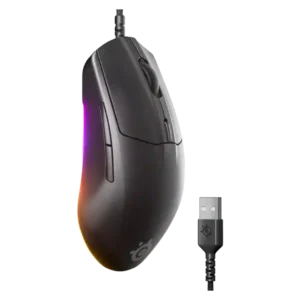
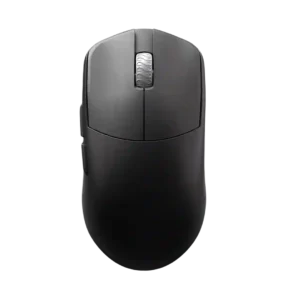
The wireless variant is repeatedly described with a 2.4GHz dongle connection; one review specifically calls that mode the preferred choice for gaming.
Direct connection evidence is limited, but the Nookyyy transcript states that the mouse can run over wired USB or wireless 2.4GHz. No reviewer raised a specific 2.4GHz reliability complaint.
Acceleration is supported through SteelSeries GG settings in one review and by the stated 35G acceleration specification in another, giving buyers some performance control and headroom.
Tracking accuracy is a clear strength: reviewers cite precise movement, confident swipes, and even a 100% aim-trainer accuracy result in testing.
Tracking precision is described as excellent across several reviews: ProSettings saw no anomalies at 8000 Hz, Tom's Guide found movements predictable and stable, Nookyyy cited superior tracking performance, and Wasabi reported consistently good tracking on mouse pads.
Wireless weight distribution receives useful notes: reviewers say the palm plate does not affect grip and the batteries sit centrally enough to reduce the dragging sensation.
The weight and shape are repeatedly described as controlled and stable. ProSettings praised the pinched middle for finer control, Boardzy called the weight balance on point, Wasabi found it planted and stable, and another reviewer felt locked in immediately.
Battery life is generally treated positively for the wireless model, with 400-hour claims and strong early-use impressions, though one reviewer notes real-world results depend on battery choice.
Battery life is a mixed strength. Reviewers cite up to roughly 70-80 hours around 1K polling, but several note that higher polling rates drain the mouse faster and can require charging every few days.
Bluetooth support is confirmed across multiple reviews and is useful for non-gaming devices, though one review notes Bluetooth lowers the polling rate.
Build quality is viewed as sturdy for the price, with reviewers praising solid construction, minimal flex, and improved build materials.
Build quality is generally strong, with several reviews calling the shell rigid, solid, or premium. One YouTube review reported a small side creak, so the overall picture is high quality with a possible unit-level QC caveat.
Customization is a consistent plus: reviewers mention button assignments, remapping, macro buttons, DPI adjustments, and assignable functions in SteelSeries GG.
Button customization is supported through the software/web interface. Reviews mention online button configuration, full key rebinding, bottom DPI-button programmability, and button mapping.
Button responsiveness is strong overall, with reviews describing rapid tapping, responsive inputs, quick actuation, and consistent long-term performance.
Button responsiveness is a major positive. Reviewers repeatedly describe the clicks as light, spammable, fast, responsive, or precise, although one review felt its particular switch implementation lacked character.
The wired cable is one of the best-supported strengths, repeatedly described as braided, flexible, low-friction, and unlikely to drag or snag during use.
Cable flexibility is a weak point. Tom's Guide and multiple YouTube reviews describe the included USB-C cable as stiff or draggy enough to interfere with wired use.
Charging convenience is mixed by variant: the wired model avoids battery concerns, while wireless reviewers criticize the lack of a USB fallback and reliance on AAA cells.
Charging convenience is mixed. The mouse can be used while plugged in and one reviewer liked the larger USB-C port fit, but Tom's Guide found the charging cable awkward and another reviewer avoided it because of stiffness.
Claw grip support is strong, with reviewers specifically saying the shape works well for claw users and feels ideal for fingertip and claw styles.
Claw grip support is one of the clearest strengths. Multiple reviewers with claw or aggressive claw grips found the shape comfortable, controlled, and well suited to relaxed or regular claw positions.
Latency is rated favorably for the wired model, with reviews citing 1.35ms to 1.5ms response and direct 1ms-style response behavior.
The click-latency evidence comes from Nookyyy's specification section, which lists 0 ms click latency. Other reviews also describe the clicks as fast and responsive, but only Nookyyy provides a direct value.
Click noise is only directly covered in one review, which says the switches are clicky without being overly loud or heavy.
Noise evidence is limited and mixed. ProSettings said the wheel gets louder when scrolling quickly, while another reviewer found the side-click sound loud and unpleasant.
Connection stability is split: wired performance is described as stable, while wireless use shows occasional delay or longer-distance connectivity issues.
Connection stability is supported mainly by performance testing language. ProSettings saw no anomalies even at 8000 Hz, and Wasabi reported the sensor/wireless use working properly during review.
Cross-platform evidence is strongest for the wireless model and software support, with reviewers citing laptops, tablets, phones, consoles, Windows, and macOS compatibility.
Cross-platform support is partial. Nookyyy says the mouse works with most USB 2.0-and-newer systems, but also notes that customization is not yet supported on macOS.
Debounce customization is well supported through the configuration tools. Reviewers mention adjustable debounce time, and one software walkthrough shows debounce time set to 0 ms by default.
DPI range is adequate for the wired model and stronger on wireless; reviewers say 8,500 DPI is enough for budget gaming while wireless reaches 18,000 DPI.
DPI range is strong on paper and configurable in software. Reviews identify the PAW3950/30,000 CPI or 30,000 DPI capability and mention DPI adjustment in the web interface.
Long-term durability has mostly positive switch-rating evidence, but one review documents a switch fault during teardown, so confidence is tempered.
Durability evidence is favorable but not long-term definitive. Reviews cite durable design, strong build, no decay after weeks of use, and one reviewer felt it would hold out longer; one coating-wear caveat remains.
Ecosystem integration centers on SteelSeries GG and Prism, which reviewers use for RGB, DPI, polling, Bluetooth smoothing, and general accessory configuration.
Ergonomics are generally positive for a simple budget mouse, with reviewers praising the familiar design and comfort during use.
Ergonomics are praised across grip styles. Reviewers describe a comfortable symmetrical design, support for different grips, hand-rest comfort, and finger placement that helps the mouse feel controlled.
Fingertip comfort is well supported, with two reviews identifying fingertip grip as one of the best fits for the Rival 3 Gen 2 shape.
Fingertip grip is only conditionally recommended. Several reviewers suggest the smaller Maya or another large-fingertip option unless the user has medium-to-large hands or specifically wants a larger mouse.
Firmware reliability is positive in the limited evidence available. Hard-Gamer notes firmware updates are handled online, and another reviewer says an early battery-indicator issue was quickly fixed by firmware.
FPS suitability is a major strength for its price, with reviewers testing Call of Duty, CS2, Valorant, Halo, and aim trainers with confident results.
FPS suitability is strong. Reviews discuss Valorant, Fortnite, competitive gaming, and aim-trainer performance, with the mouse's low weight, responsive clicks, and high polling rate supporting competitive play.
Glide smoothness is consistently praised thanks to PTFE feet that reduce friction and move cleanly across mats, desks, and mousepads.
Glide smoothness is a consistent highlight. Reviewers repeatedly praise the stock feet as smooth, fast, low-friction, or among the best they have tried, with no need to replace them immediately.
Grip texture is mostly positive, especially the matte surface and textured plastic, though one reviewer wanted deeper side grooves.
Grip texture is generally good but not perfect. Several reviewers call the coating grippy or improved, while others mention moisture pickup, smudges, or possible wear/cleaning challenges for sweaty users.
Handedness is mixed: some reviews describe an ambidextrous or symmetrical design, while another says the Gen 2 is optimized for right-handed use.
Handedness evidence describes an ambidextrous or symmetrical shape, though one source calls it right-handed symmetrical. The score reflects a broadly symmetrical shape rather than true left-side-button parity.
Primary click quality is strong, with reviewers describing the left and right clicks as firm, responsive, satisfying, and balanced.
Main-click quality is repeatedly praised. Reviews describe the main clicks as implemented well, responsive, crisp, loved, or superior to competing clicks.
Lift-off distance is configurable and competitive. Reviews cite 0.7 mm support, LOD adjustment in software, and multiple lift-off options.
Long-session comfort is a strength for the wired model, with reviewers citing workday comfort, prolonged-use comfort, and reduced wrist fatigue.
Long-session evidence is positive but indirect. Nookyyy emphasizes extended gaming sessions through battery life, while Wasabi calls the mouse comfortable as a daily driver for general computer use.
Macro support is directly supported by one review, which says the side buttons can be macroed through SteelSeries GG.
Macro support is supported in the software. ProSettings, Tom's Guide, and another software walkthrough mention macro recording or macro controls.
Materials are budget-minded but respectable, with matte ABS plastic, a thick textured shell, and improved build materials mentioned directly.
Materials quality is generally good. Reviewers point to pure PTFE feet, a good-feeling plastic case, strong shell materials, and thickness that contributes to solidity.
MOBA suitability is supported by Tom's Guide testing in League of Legends, where the reviewer said the mouse worked very well in ranked matches.
Motion consistency is praised in gaming tests, with recoil control, natural aim tracking, predictable responses, and no missed inputs cited.
Motion consistency is a strength in testing and configuration. Reviews cite no anomalies at 8000 Hz, stable predictable movement, motion-sync controls, and strong sensor consistency.
Onboard memory is directly supported by one review, which says profiles can be saved to the mouse for use across systems.
Onboard memory evidence is limited to the transcript's MCU/profile discussion. It supports stored profiles and CPI settings, but reviews do not deeply test onboard storage behavior.
Palm grip comfort is a weak point: reviewers say the mouse lacks enough body fill or may feel small for palm-grip users.
Palm grip comfort is mixed by hand size and preference. One reviewer says palm grip feels good on the larger Maya X, while others recommend different options for users wanting a very full palm or using larger hands.
Polling rate is standard rather than cutting edge; most reviews cite 1000Hz as acceptable or typical, with one calling it low but acceptable for budget gaming.
Polling-rate support is a standout feature. Every major source that discussed specs points to 8K wireless polling or broad polling-rate options, often with the 8K receiver included.
Portability is mostly a wireless-model strength, helped by small size, Bluetooth, dongle storage, and laptop or travel use cases.
Portability is supported by the low weight and included pouch/spare-feet package. The mouse is easy to carry, though the evidence is more about accessories than travel testing.
Premium feel is limited: reviewers repeatedly frame the Rival 3 Gen 2 as budget-friendly and less refined than more expensive SteelSeries or esports mice.
Premium feel is mostly positive. Reviews call the unboxing premium, the mouse premium-feeling, exceptional, or close to its price in perceived quality.
Profile switching is supported through DPI cues, remappable profile controls, and saved profiles that can travel across systems.
Profile switching is only lightly supported by review text. The strongest direct evidence is the web-software mention of setting up profiles; deeper profile-switching behavior is not tested.
Programmable buttons are clearly supported by the six-button layout, assignable functions, remapping, and side buttons that can be macroed.
Programmable buttons are supported through software. Reviews mention full rebinding and six programmable buttons, including the main buttons, wheel click, side buttons, and DPI button.
RGB is good on the wired model, with addressable underglow and software customization, while the wireless model has little or no persistent lighting.
Scroll wheel quality is only directly covered by IGN, which calls it simple but well suited for scrolling and in-game use.
Scroll-wheel quality is generally good. Reviewers describe it as tensioned correctly, light, tactile, distinct, and easy to click, with one dust/open-bottom caveat in ProSettings.
Sensor performance is consistently competent for the price, with reviewers reporting smooth tracking, no missed inputs, and only modest practical limits versus premium mice.
Sensor performance is consistently praised. Reviews identify the PAW/PixArt 3950 and describe stellar performance, superior tracking, perfect operation, or elite wireless sensor implementation.
Shape comfort is mostly good for smaller or average hands and claw/fingertip styles, but less ideal for those wanting a more sculpted or palm-filling shape.
Shape comfort is a core strength. Most reviewers liked the larger Maya X shape, especially for medium-to-large hands and claw or relaxed claw grip, though a few preferred the smaller Maya or noted edge/size preferences.
Side buttons are mixed: some reviewers praise access and responsiveness, while others call them thin, less distinct, or less premium.
Side-button quality is the most uneven button area. Some reviewers found them crisp and accessible, but several reported stiffness, mushiness, or excess travel, especially on the top/front side button.
Skate durability is only lightly evidenced; one teardown-focused review notes removal divots that help protect the adhesive feet from damage.
Skate durability has moderate support. Reviews mention spare feet for wear, smoothness after nearly four weeks, and stock skates that remained worth keeping, but there is no long-term months-long test.
Software stability is acceptable: reviews say SteelSeries GG is not resource-heavy and functions at its core, with one noting seamless profile use across systems.
Software stability is mixed. ProSettings and Wasabi found it working or loading fine, while Tom's Guide had slow, laggy app trouble and another review simply said the web driver gets the job done.
Software usability is mixed: SteelSeries GG offers useful settings and friendly controls in some reviews, but others call it cluttered or hard to navigate.
Software usability varies by implementation. Web-based setup is praised for convenience and simplicity, but Tom's Guide criticized the companion app as slow, laggy, and ugly.
Surface compatibility is supported mainly by WIRED, which says the feet glide across both desks and mousepads.
Surface compatibility is strong. Reviewers mention use across a variety of surfaces, any mouse pad, textured pads, and consistent tracking on mouse pads.
Switch durability is backed by multiple 60-million-click ratings, though one review's teardown issue keeps the assessment from being flawless.
Switch durability is supported by the Omron optical switch rating evidence. Direct long-term switch testing is not provided, but the quoted rating is high.
Switch feel is a strength, with reviewers describing the clicks as firm, crisp, clicky, solid, balanced, and satisfying.
Switch feel is widely praised. Most reviewers describe the Omron optical switches as crispy, springy, light, fast, or precise, although one reviewer found the feel somewhat lackluster.
Value is one of the strongest themes: reviewers consistently frame the Rival 3 Gen 2 as a capable, inexpensive gaming mouse with performance above its price.
Value is rated positively at around $120. Reviewers cite strong specs, included accessories, competitive pricing versus big-brand alternatives, and a premium package, while noting cheaper budget mice exist.
Weight is favorable for the wired model at roughly 77 to 80 grams, while wireless weight rises noticeably with AAA batteries.
Weight is a major strength. Multiple reviewers measured or cited roughly 47-48 g and described the weight as excellent, amazing, or impressive for the larger shell.
Weight tuning applies to the wireless version, where using one AAA battery can reduce weight at the cost of battery life.
Wireless latency is generally acceptable for budget gaming, with reviews citing 1000Hz wireless polling, no missed inputs, and a 1.9ms response figure.
Wireless latency is supported indirectly through click-latency, high polling, and responsiveness evidence. Reviews describe lightning-fast response and responsive button behavior in wireless/high-performance contexts.
Wireless performance is positive overall, with reviewers saying it plays much like the wired version and remains nimble, fast, and solid in gaming.
Wireless performance is consistently strong. Reviewers describe true 8K wireless operation, elite wireless implementation, and wireless performance that feels great or among the best.