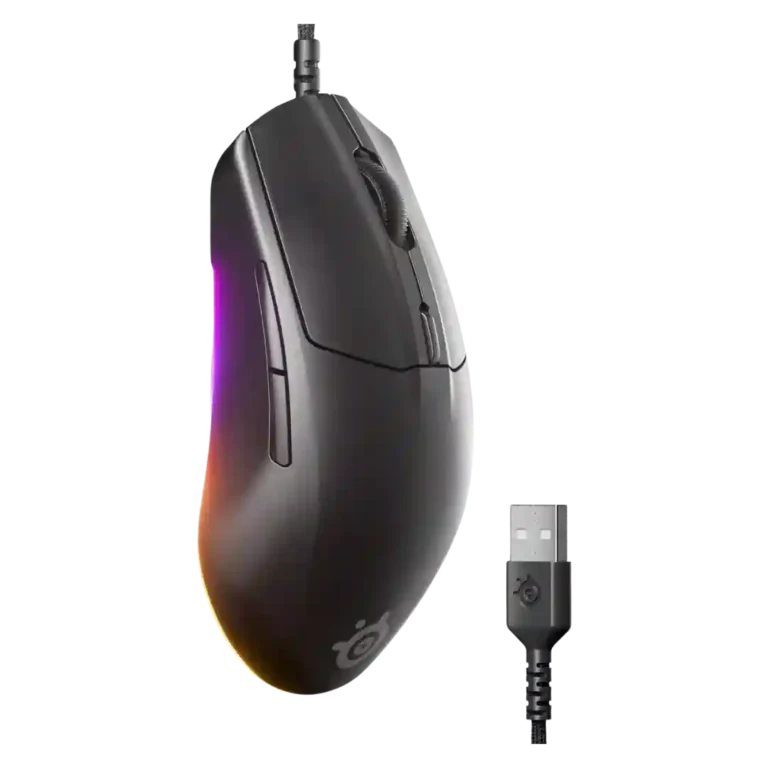
- Better: budget wired alternative PCMag considered the Rival 3 Gen 2 a good budget option but not as strong as the HyperX Pulsefire Haste 2.
SteelSeries Rival 3 Gen 2 Wired Review
Bottom Line
Choose the Rival 3 Gen 2 Wired for a light, low-cost gaming mouse with smooth glide, solid clicks, RGB, and dependable FPS control. Skip it for palm grip, wireless use, premium contouring, or flagship polling specs.
Best for budget-focused PC gamers who want a wired mouse that feels light, tracks accurately, glides smoothly, and keeps enough customization for FPS and everyday play. It is especially suitable for claw and fingertip grip users.
Not for buyers who need wireless/Bluetooth connectivity, a palm-filling ergonomic shell, MMO-style button count, or the highest polling-rate and DPI specs. It is also not ideal for users who dislike companion software clutter.
The SteelSeries Rival 3 Gen 2 Wired lands as a strong budget gaming mouse because reviewers repeatedly praise its 77g weight, smooth braided/paracord-style cable, PTFE glide, responsive clicks, and reliable FPS performance. Its 8,500 DPI sensor and 1,000Hz polling rate are not flagship specs, but the evidence says they are enough for most competitive-leaning players who are not chasing pro-level margins. The tradeoff is comfort and refinement: claw and fingertip users fare best, while palm grip users and buyers who want a deeply contoured, premium-feeling shell may feel the budget design. SteelSeries GG adds useful customization and RGB control, though reviewers also call the software cluttered or unintuitive in places.
Compared in Reviews
Products reviewers directly compared with this model, grouped into quick takeaways.
- Better: high polling rate tracking IGN noticed higher-polling premium mice can improve tracking, but still found the Rival 3 adequate for serious ranked play.
- Worse: aim trainer performance GamingTrend found the wired Rival 3 Gen 2 produced better Aim Trainer marks than the Aerox 3 in its test run.
Feature Scorecards
Pros
-
The wired setup is praised for stable, consistent use without wireless drops or battery-related interruptions.
-
Value for money is one of the strongest themes, with reviewers repeatedly calling it a budget mouse that performs above its price.
-
Glide performance is consistently positive thanks to PTFE feet that move smoothly across mousepads, desks, and general surfaces.
-
Reviewers consistently found aim and tracking dependable, including clean flicks, confident shots, and precise movement control.
-
The upgraded braided/paracord-style cable is one of the wired model's best-reviewed improvements because it avoids drag and desk friction.
-
Primary click quality is a strength, with reviewers calling the left and right clicks firm, responsive, balanced, and good for rapid tapping.
-
Onboard memory is supported for saving game-specific profiles directly to the mouse.
-
Surface compatibility is strong, with reviewers noting smooth movement across both desks and mousepads.
-
FPS suitability is strong for the price, with reviewers testing it in shooters and finding flicks, recoil control, and ranked-play basics dependable.
-
Motion consistency is strong, with reviewers describing predictable responses, natural recoil control, and stable aim tracking.
-
Click and input latency are treated as strong for a budget wired mouse, with cited response times around 1ms to 1.35ms.
-
Inputs and click actions are repeatedly described as responsive, with direct movement translation and no meaningful delay in normal use.
-
Switch feel is a highlight, with firm, bouncy, crisp, and balanced feedback across reviews.
-
Long-session comfort is good for the right grip style, helped by light weight, prolonged-use comfort, and reduced wrist fatigue.
-
The shape works especially well for claw grip users, with multiple reviews calling claw use comfortable or ideal.
-
Fingertip users are strongly served by the low-profile shape, with reviewers finding fingertip and claw grips comfortable.
-
At 77 grams, the wired Rival 3 is light enough for quick movement without requiring an extreme ultralight design.
-
The six-button layout gives the wired Rival 3 enough programmable control for everyday gaming without becoming complex.
-
The wired Rival 3 is repeatedly described as ergonomic or improved in shape, especially for users who do not need a high palm-filling hump.
-
Build quality is a clear strength for the price, with reviewers describing a solid shell and no creaking or flexibility.
-
Button customization is well covered through SteelSeries GG, including remapping, side button customization, and different software-assigned functions.
-
Click noise is controlled: the switches are clicky and tactile without being described as overly loud or heavy.
-
Macro support is available through SteelSeries GG for the side buttons, giving the budget mouse useful extra flexibility.
-
The scroll wheel is simple but effective, with distinct notches, smooth scrolling, and a usable wheel click.
-
Materials are budget-conscious but well received, especially the matte ABS plastic shell and thick, subtly textured surface.
-
Switch durability is backed by repeated 60-million-click/actuation ratings and comments about consistent performance.
-
RGB is a clear wired-model advantage, with base underglow and software-customizable zones adding tasteful visual flair.
-
Sensor performance is strong for budget play, with reviewers finding the TrueMove/Core optical sensor responsive despite lower flagship specs.
-
Durability evidence centers on solid construction, 60-million-click switch ratings, and consistent long-term click performance.
-
Grip texture is generally positive, with matte/textured plastic helping control, though one reviewer wanted deeper side grooves.
-
SteelSeries GG exposes acceleration-related settings alongside DPI, angle snapping, and button assignment controls.
-
Software support is directly stated for Windows 10 and macOS 11 or higher, giving the wired model basic cross-platform configuration coverage.
-
The mouse uses a symmetrical, ambidextrous-style shell, but side-button placement means its practical handedness support is not fully neutral.
-
Portability is decent due to the compact size, but the wired connection keeps this from being a top travel-first mouse.
-
Profile switching is possible through software remapping, though there is no default dedicated button for it.
-
The wired model's 8,500 DPI ceiling is lower than premium mice but repeatedly judged enough for budget gaming and practical use.
-
The 1,000Hz polling rate is standard and acceptable for budget gaming, though reviewers note higher-end mice go beyond it.
-
Shape comfort is broadly good for claw and fingertip users, though reviewers found it less hand-filling and less contoured than premium mice.
-
Software stability is acceptable, with reviewers saying it is not resource-heavy and functions at its core despite clutter.
-
Software usability is mixed-to-positive: SteelSeries GG is powerful and clear for basics but criticized for clutter and navigation.
-
Side button quality is mixed: some reviews found them accessible and useful, while others said they felt thin, less distinct, or less premium.
Cons
-
Premium feel is mixed: the mouse feels sturdy and capable, but reviewers note cheaper side buttons and less high-end flair than pricier models.
-
Palm grip is a weak fit because the low, smaller body leaves space under the hand and can feel too small.
-
The wired Rival 3 does not provide 2.4GHz connectivity; reviewers describe that functionality as belonging to the wireless model, not the wired one.
-
Bluetooth is not part of the wired Rival 3 experience; the evidence frames wireless features as absent from this version.
Compared With Category Average
Compared with other Gaming Mouse, this product is above average in handedness options, RGB features, cable flexibility, below average in 2.4GHz connectivity, Bluetooth support, palm grip comfort.
| Attribute | This product | Category average | Difference |
|---|---|---|---|
| 2.4GHz connectivity | 1.0 | 4.3 | -3.3 |
| Bluetooth support | 1.0 | 3.3 | -2.3 |
| palm grip comfort | 2.2 | 3.9 | -1.7 |
| handedness options | 4.0 | 2.8 | +1.2 |
| RGB features | 4.1 | 3.1 | +1.0 |
| cable flexibility | 4.5 | 3.6 | +0.9 |
| value for money | 4.6 | 3.7 | +0.8 |
| premium feel | 3.4 | 4.1 | -0.8 |
FAQ
Is the SteelSeries Rival 3 Gen 2 Wired good for FPS games?
Yes. Reviewers tested it in games such as Counter-Strike 2, Valorant, Call of Duty, and Aim Trainer scenarios and found its aim, recoil control, and tracking dependable for budget competitive play.
Is 8,500 DPI enough on the wired Rival 3 Gen 2?
For most users, yes. Reviewers repeatedly say the wired model's 8,500 DPI ceiling is lower than premium mice but still more than enough for regular gaming.
What grip style works best with this mouse?
The strongest fit is claw and fingertip grip. Multiple reviews say palm grip users may find the body too small or too low-profile.
Does the wired Rival 3 Gen 2 have RGB?
Yes. Reviewers mention base/underglow RGB on the wired model, with customization available through SteelSeries GG.
How good is the cable?
The cable is one of the more praised upgrades. Reviewers describe the braided or paracord-style cable as smooth, low-friction, and unlikely to drag during use.
Is SteelSeries GG required?
The mouse works as a basic wired mouse without deep setup, but SteelSeries GG is used for DPI, polling rate, button assignments, profiles, and RGB customization. Reviews find it useful but sometimes cluttered.
Does it support wireless or Bluetooth?
No. The wired Rival 3 Gen 2 is tethered to a PC, and reviews frame 2.4GHz and Bluetooth as features of the separate wireless version.
Consider This Instead
If you want better 2.4GHz connectivity
Choose Razer DeathAdder V4 Pro. It scores 5.0 vs 1.0 for 2.4GHz connectivity, with a 4.0 overall score.
If you want better Bluetooth support
Choose Razer Basilisk V3 Pro 35K. It scores 5.0 vs 1.0 for Bluetooth support, with a 4.5 overall score.
If you want better palm grip comfort
Choose Turtle Beach Kone II Air. It scores 4.8 vs 2.2 for palm grip comfort, with a 4.3 overall score.
If you want better premium feel
Choose Logitech G Pro X2 Superstrike. It scores 4.7 vs 3.4 for premium feel, with a 4.0 overall score.
Overall Top Gaming Mouse Alternatives
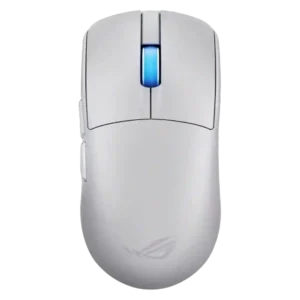
Best for a 47g, high-performance 8K wireless mouse with excellent shape, skates, clicks, and web controls. Skip it if stiff side buttons, shorter high-polling battery life, or app/cable quirks would...
Pros: Accuracy and tracking precision, sensor performance
Cons: cable flexibility
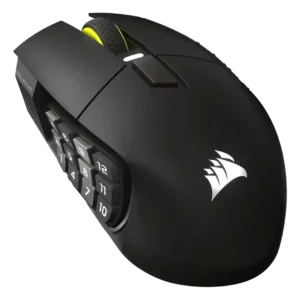
Choose it if you want a comfortable, feature-rich wireless mouse for mixed gaming and productivity. Skip it if you need ultralight FPS speed, left-handed support, or better value than discounted...
Pros: programmable buttons, Bluetooth support
Cons: handedness options, firmware reliability
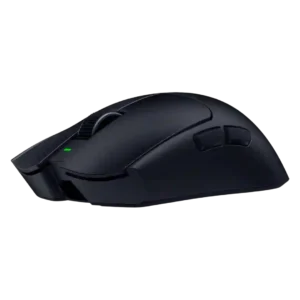
Good if you want an ultra-light esports mouse with 8K wireless, precise tracking, and web setup. Skip it if you need MMO buttons, onboard memory, large-hand palm support, or the...
Pros: polling rate, click latency
Cons: onboard memory, tilt gesture controls
Good if you want ergonomic wireless gaming with hot-swappable batteries and strong tuning. Skip it if price, dock clutter, or short 8K battery life matters most.
Pros: switch durability, DPI range
Cons: grip texture, portability