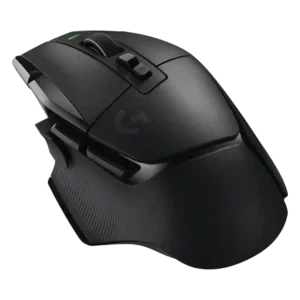
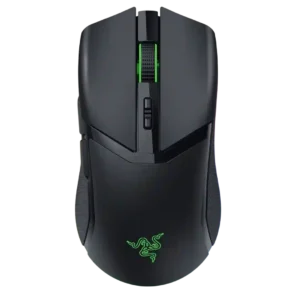
The reviews that mention the receiver describe 2.4GHz operation through the included wireless dongle and report solid PC connection behavior.
2.4GHz support is consistently present through the HyperSpeed or included dongle setup, with reviewers treating it as the main low-latency gaming mode rather than a secondary convenience.
Sensor-focused comments consistently point to clean movement handling, with reviewers calling out zero acceleration, no jitter, and no unwanted filtering or smoothing.
Acceleration handling is supported by repeated 70G sensor specifications and performance claims, with no review describing user-adjustable acceleration tuning beyond the sensor capability itself.
Tracking precision is treated as a strength: reviewers cite exact hand tracking, 1:1 tracking, and submicron movement tracking.
Tracking precision is one of the product's strongest areas: reviewers repeatedly described accurate, smooth, or flawless tracking, including fine movement and competitive play.
Balance and weight distribution are mixed: one review praised control, while several others called the mouse back-heavy or noted unusual rear-biased weight distribution.
Battery life is one of the clearest strengths, with multiple reviews citing 140-hour expectations or testing and another review still calling battery life solid.
Battery life is generally solid, especially with RGB reduced or disabled, but several reviewers warned that RGB and higher polling modes can cut runtime sharply.
The only direct Bluetooth evidence says the mouse does not include Bluetooth connectivity, so this scores as a missing feature rather than a strength.
Bluetooth support is well documented and useful for travel, productivity, and non-gaming use, though reviewers commonly reserved the 2.4GHz mode for lower latency gaming.
Build impressions are split: one review found loose-feeling construction, while others reported robust build quality, no drop-test damage, and sturdy assembly.
Build quality is consistently positive, with reviewers describing the shell as solid, sturdy, well made, or free of creaks and rattles.
Customization is well supported through remappable buttons, swappable or repositionable controls, DPI adjustment, and G Hub assignment options.
Button customization is a clear strength through Synapse, with reviewers noting remapping, DPI controls, lighting controls, macros, and profile-related functions.
Button responsiveness is generally positive, with reviewers reporting reliable buttons, responsive clicks, and satisfying response during use.
Button responsiveness is mostly strong, with optical switches, immediate clicks, and responsive feel praised, though one reviewer disliked the DPI button feel.
Cable flexibility has limited evidence, but the one direct review describes the included rubber cable as soft and supple.
Cable impressions are mixed: some reviewers found the cable flexible or low-pushback, while others found it stiff enough to create pull.
Charging convenience scores well because reviewers repeatedly highlight USB-C charging, included USB-C cabling, and easy charging between sessions.
Charging is convenient because the mouse can charge over USB-C during use and also supports optional wireless charging accessories, but those accessories usually cost extra.
Claw grip has limited but direct support from one review that found claw use felt good.
Claw grip comfort is a major fit advantage. Multiple reviewers specifically found the small symmetrical shell well suited to claw grip users.
Click latency is scored highly from repeated claims of instant click registration, faster response rate, optical actuation, and reduced click latency.
Click latency is rated highly where directly discussed, with optical switches and low-latency behavior noted by reviewers.
Click noise is mixed: one review criticized cheap, echoey click sound, while another described the switches as producing a satisfying click sound.
Click noise is present and somewhat subjective: reviewers described the clicks as pronounced, loud, muted, or pleasant depending on the source.
Connection stability is strong where directly discussed, with reviews reporting no lag, no dropped connections, and no issues with the 2.4GHz connection.
Connection stability is strong in the 2.4GHz mode, with reviewers reporting no obvious latency or connectivity problems in normal use.
Cross-platform or multi-machine use is mixed: onboard profiles help across machines, but one review reported a MacBook Air detection failure.
Cross-platform flexibility is supported by Bluetooth and wired/wireless modes, with reviewers mentioning laptops, tablets, smartphones, and multiple devices.
Charging-mat and PowerPlay evidence supports dock-style compatibility, with multiple reviews mentioning PowerPlay or wireless charging mat support.
Dock compatibility is well supported, but it depends on optional Razer accessories such as Mouse Dock Pro, Wireless Charging Puck, or HyperPolling hardware.
DPI support is consistently strong, with reviews citing on-the-fly DPI adjustment and maximum ranges around 25,600 DPI.
The DPI range is consistently described as high-end, with repeated references to the Focus Pro 30K sensor and its 30,000 DPI maximum.
Durability evidence is positive but not extensive, with one review reporting no drop-test damage and switch design intended to reduce mechanical wear.
Durability over time is mixed: switch life is rated highly, but several reviewers warned that the built-in rubber side grips may wear down.
Ecosystem integration is a recurring advantage through shared Lightspeed receivers, Logitech keyboard pairing, and syncable lighting or audio profiles.
Ecosystem integration is strong for users already in Razer's setup, especially through Synapse, Chroma lighting, HyperSpeed multi-device pairing, and shared dongle support.
The ergonomic design is generally praised through references to thumb support, ergonomic contours, and grip-style adaptability.
Ergonomic design is favorable for users who fit the smaller symmetrical shape, but some reviewers preferred larger ergonomic alternatives for desktop or productivity comfort.
Fingertip comfort has limited direct evidence, but the available review says fingertip grip felt good.
Fingertip grip comfort is a clear fit category, with several reviewers saying the shell works well for fingertip use and small-to-medium hand control.
FPS suitability is divided: several reviewers enjoyed aim control and low latency, while others found the weight and extra buttons less ideal for FPS players.
FPS suitability is mixed-positive: sensor, switches, and low latency are strong, but weight and size kept several reviewers from calling it ideal for hardcore esports.
Glide is mostly positive, with reviewers citing PTFE feet, smooth movement on mats, and slick desk movement, though one review called stock skates merely fine.
Glide smoothness is consistently praised thanks to PTFE feet and smooth movement across desks or mouse mats.
Grip texture is a strength where mentioned, with reviewers noting textured rubber grips, grippy side lines, and rubberized thumb areas.
Grip texture is divisive. Many reviewers praised the rubberized sides for control, while others disliked the built-in rubber grips or expected wear.
Handedness options are weak because the direct evidence describes the mouse as made for right-handed users.
Handedness options are limited. The body is symmetrical, but side-button placement and reviewer comments point to a right-handed bias rather than true ambidextrous support.
Main click quality is mixed: reviews praised easy rapid clicking and reduced pre-travel, while broader click impressions included some premium-feel reservations.
Left and right click quality is generally strong, with Razer optical switches praised for crisp feel, although some reviewers preferred other switch implementations.
Lift-off distance and calibration are supported through low measured distance, asymmetric cut-off, surface calibration, or lift-off adjustment references.
Long-session comfort is strong, with reviewers citing no hand fatigue, little hand adjustment, and comfortable hold during longer use.
Long-session comfort depends on hand size. Reviewers with the right fit found it comfortable or fatigue-free, while larger-hand reviewers found it cramped or cumbersome.
Macro support is clearly present through G Hub, with reviews describing program-specific macros and assigning macros to customizable buttons.
Macro support is well supported through Synapse and onboard profiles, with reviewers explicitly mentioning macro assignment or macro recording.
Materials quality is mixed: soft-touch plastic and low fingerprinting are praised, while glossy areas and untextured smooth plastic draw criticism.
Materials quality is strong overall, with matte plastic, rubberized grips, and solid-feeling construction described positively, though rubber wear remains a concern.
MMO suitability is one of the better-supported use cases because several reviews highlight many buttons and MMO-focused control flexibility.
MMO suitability is weak. Reviewers repeatedly suggested it lacks enough inputs for MMO or RPG-style players who need many commands.
MOBA suitability has limited direct support, but one review says MOBA players should have no trouble because the extra buttons remain unobtrusive.
MOBA suitability is below average to mixed because the mouse is capable for general gaming but reviewers said it lacks the inputs or specialization for button-heavy genres.
Motion consistency is supported by direct testing that found no jittering or phantom movements.
Motion consistency is strong where described, with reviewers praising smooth, consistent motion, quick stops, Motion Sync, and reliable transitions across surfaces.
Onboard memory is consistently supported by repeated mentions of five onboard profiles and settings saved to onboard profiles.
Onboard memory is a real benefit, with repeated support for five stored profiles and settings that can remain on the mouse without constant software use.
Palm grip comfort is generally positive because reviewers repeatedly associate the shape with palm grip comfort, though reach issues remain for some hands.
Palm grip comfort is the most size-dependent grip type. Some users with smaller hands were comfortable, while larger-hand reviewers found palm use cramped or unsuitable.
Polling-rate evidence is limited and mixed: 1000Hz is considered enough by one reviewer, but also behind newer higher-polling competitors.
Polling rate support is strong but accessory-dependent: 1,000Hz works out of the box, while 4,000Hz or 8,000Hz requires optional Razer hardware.
Portability is helped by onboard dongle storage, magnetic storage covers, and reviews that call the mouse a good portable option.
Portability is a strong use case due to the compact size, Bluetooth option, laptop suitability, and onboard dongle storage.
Premium feel is mixed: some reviewers mention stylish finish, but others criticize plastic feel, glossy wear, and high-end expectations not fully met.
Premium feel is supported by strong build comments, refined finish, RGB presentation, and reviewers describing the mouse as high-end or premium.
Profile switching is a strength, with reviews describing easy switching, five profile support, and built-in profiles.
Profile switching is well supported through onboard profiles and physical profile controls, though some reviewers considered the underside button placement odd.
Programmable button support is one of the most repeated strengths, with reviews citing 11 to 13 programmable controls and many extra buttons.
Programmable buttons are consistently supported, although reviewers disagreed on whether the advertised count feels practical in real use.
RGB is a mixed feature because it exists mainly on the Plus variant, costs extra, and can reduce battery life or add weight.
RGB is one of the standout features, with underglow, scroll wheel lighting, Chroma zones, smart dimming, and customization repeatedly praised.
Scroll wheel quality is highly polarized: reviewers praise free-scroll usefulness and hyperfast scrolling, but several criticize ratcheted feel, sound, or looseness.
Scroll wheel quality is mostly solid, with reviewers praising wobble-free or tactile feel, but it lacks tilt and customizable scroll-wheel features.
Sensor performance is consistently positive through Hero 25K references, strong tracking, and zero smoothing or acceleration claims.
Sensor performance is a standout strength. Reviewers repeatedly cite the Focus Pro 30K sensor as high-end, accurate, and competitive.
Shape comfort is broadly positive, especially for larger hands and thumb-rest users, though a few comparisons and reach issues keep it from being perfect.
Shape comfort is positive for small-to-medium hands and users who like compact symmetrical mice, but reviewers with larger hands were less satisfied.
Side button quality is mixed because reviewers like the modular sniper button but repeatedly mention reach problems and accidental fat-fingering.
Side button quality is generally good, with several reviewers praising access, resistance, and click feel, though the lack of right-side buttons limits ambidextrous use.
Software stability is a weakness in the evidence, with reviews describing G Hub behavior going haywire or the mouse not being recognized.
Software stability is mixed to weak. Reviewers found Synapse useful, but several called it bloaty, unpleasant, less stable, or inconsistent between modes.
Software usability is mixed: G Hub offers DPI, macros, and profiles, but several reviewers could not access it, could not customize fully, or called it bad.
Software usability is good but not universally loved. Synapse provides deep control over buttons, lighting, DPI, polling, profiles, and calibration, but some reviewers disliked the app experience.
Surface compatibility is modestly positive, with reviewers reporting acceptable or smooth movement on desks and mouse mats.
Surface compatibility is a major strength, with reviewers repeatedly mentioning glass support, mouse-mat calibration, and reliable tracking across surfaces.
Switch durability is supported by optical-mechanical switch design claims, reduced wear, double-click prevention, and wear-and-tear resilience.
Switch durability is a strong point, with many reviewers citing Razer optical switches and 90-million-click durability claims.
Switch feel is mostly positive for crispness and responsiveness, though one review found the clicks not especially tactile.
Switch feel is mostly positive, with reviewers describing tactile, precise, satisfying, or good-feeling optical switches, though some noted heavier or less poppy feel.
Value is mixed and price-sensitive: some reviews found acceptable sale pricing, while others called MSRP pricey or a worse deal against newer rivals.
Value for money is divided. Some reviewers found the feature set worth the premium, while others saw the price and paid accessories as major drawbacks.
Weight is a recurring caveat: reviewers note reductions from older versions, but also repeatedly call it heavy or not especially light by current standards.
Weight is the biggest recurring tradeoff: 77g is lighter than many feature-heavy mice, but heavy compared with modern ultralight esports mice.
Weight tuning is weak because the direct evidence says this version lacks additional weights.
Weight tuning is very limited. The only direct adjustment noted was a small 2g saving from removing the underside cover, with no true weight-tuning system.
Wireless latency is strong where tested or discussed, with reviewers reporting no spikes, low-latency Lightspeed, and wired-like response.
Wireless latency is strong in 2.4GHz mode, with many reviewers reporting imperceptible lag, while Bluetooth is repeatedly treated as slower or less gaming-focused.
Wireless performance is consistently strong, with reviews citing excellent wireless behavior, instant response, fast connectivity, and Logitech wireless confidence.
Wireless performance is strong overall through HyperSpeed, 2.4GHz, Bluetooth, and wired modes, though best performance requires using the gaming dongle mode.