Compare SteelSeries Aerox 3 Wireless vs ROG Harpe Ace Extreme
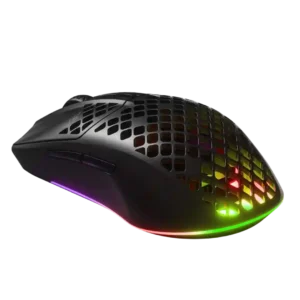
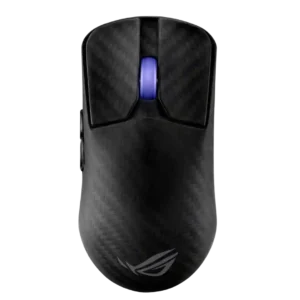
Reviews describe 2.4GHz wireless as a core low-latency connection mode, with several noting it works well during active use, while some reported dongle or wake/connectivity issues.
Reviews consistently identify 2.4GHz wireless as the main performance connection, often tied to the Omni receiver or polling-rate booster. The mode is treated as the best route for high polling and gaming responsiveness.
Software exposes acceleration-related controls, including acceleration and angle-snapping options, though these were treated as configurable rather than essential.
Sensor acceleration handling is documented through repeated 50G acceleration specifications. The reviews support strong acceleration capability, though they do not describe a separate user-facing acceleration tuning feature.
Reviewers praised the Aerox 3 Wireless for precise tracking and high-precision aim, with the TrueMove implementation described as accurate and exact in gameplay.
Tracking accuracy is one of the strongest areas: reviewers describe the sensor as accurate, precise, consistent, and difficult to disrupt across testing and gameplay.
Balance evidence is limited but positive, with one reviewer saying the weight felt well balanced.
Balance is described positively where tested, with reviewers noting solid balance and excellent weight distribution that does not tilt when lifted.
Battery life is praised for useful endurance and quick charging, but multiple reviews say real-world 2.4GHz/RGB use falls short of the highest advertised Bluetooth figures.
Battery life is usable but not class-leading. Several reviews cite 70-hour 2.4GHz figures at 1,000Hz, while high polling and RGB reduce runtime substantially.
Bluetooth is consistently treated as a useful secondary connection option for laptops, travel, or casual use, though some reviewers prefer 2.4GHz for gaming responsiveness.
Bluetooth is repeatedly confirmed as present alongside 2.4GHz and wired modes. Reviewers treat it as a convenience mode rather than the main gaming connection.
Build quality was broadly positive but not perfect, with praise for rigidity and passing tests alongside some concerns about bottom flex.
Build quality is a major strength in most reviews, especially the stiff carbon-fiber top shell, tight buttons, and lack of creaking or flex. A few critiques focus on the nylon/plastic lower section rather than structural weakness.
Button customization is supported through the custom buttons, CPI/sensitivity control, and SteelSeries software for presets and button behavior.
Button and performance customization are well supported through Armoury Crate Gear, Armoury Crate, and hardware controls. Reviewers cite remapping, DPI, polling, lift-off, lighting, and related adjustments.
Button responsiveness was praised in the positive reviews, with reviewers describing tactile buttons, satisfying clicks, and short travel.
Button responsiveness is generally strong, with many reviews praising precise, brisk, instant, or consistent actuation. One review reports a left-click pre-travel defect, so the evidence is strong but not perfectly uniform.
The included cable was often described favorably, with braided, light, flexible, or generally good characteristics for charging or wired use.
Cable impressions are mixed. Several reviews call the paracord-style cable flexible or lightweight, while others say it is stiff or not especially good.
Charging convenience was a strong point, with repeated praise for USB-C charging, fast charging, use while wired, and compatibility with common USB-C chargers.
Charging is handled through USB-C and wired operation. Reviews describe it as functional and convenient enough, though wired mode can have polling-rate limits depending on setup.
Claw grip comfort is one of the better-supported grip areas, with reviewers repeatedly saying the shape suits claw grip or that claw felt natural.
Claw grip support is broadly positive, especially for medium to large hands. Several reviewers identify claw as a natural fit, though smaller hands may find the mouse long or awkward.
Click latency was rated favorably where measured or discussed, with reviewers citing true 1-to-1 tracking and very low click latency.
Click latency is presented as very low, helped by optical switches and high polling modes. Measurements and subjective comments support fast response, with little reason to worry about delay.
Click noise was treated positively in the scored reviews, with quieter main buttons and quiet scroll-wheel movement mentioned.
Click noise is mixed. Some reviewers find the clicks pleasant or not annoying, while others describe the switches or side buttons as loud.
Connection stability was inconsistent across reviews, ranging from automatic pairing and no trouble to frequent disconnects or random dropout issues.
Connection stability is mostly praised through stable wireless and strong receiver performance, but one review reports wireless disconnects during gameplay, making this a generally strong but not flawless area.
Cross-platform or cross-device usefulness is supported by multi-device use, cross-device compatibility, and Bluetooth connectivity to many devices.
Debounce support is mixed in a narrow way: optical switches allow very low debounce behavior, but multiple reviews note no user-adjustable debounce setting.
Dock compatibility is weak because one reviewer specifically noted that a charging dock or wireless charging feature would have been welcome.
The mouse offers a wide sensitivity range, with reviewers referencing 18,000 CPI or 18,000 DPI and configurable DPI/CPI settings through software or the top button.
The DPI/CPI ceiling is repeatedly cited at 42,000, with several reviews also discussing fine adjustment steps. The range is clearly flagship-level.
Durability over time was mixed: one reviewer expected long life, another worried about flex, and a long-term user reported two years of daily use.
Durability evidence centers on structural integrity, carbon-fiber strength, and 100-million-click optical switches. Long-term field wear is not deeply tested, but the stated and observed durability signals are strong.
Ecosystem integration is lightly supported through SteelSeries GG being described as the software layer that completes the mouse setup.
Ecosystem integration appears through the Omni receiver, shared ASUS dongle support, Armoury software, and ROG peripherals. Reviewers mention the benefit, though some question how many users will need it.
Ergonomic design is supported by one review that specifically praised the smaller, more ergonomic design for comfort.
Ergonomics are shape-dependent. The mouse is often comfortable for larger hands and safe grip styles, but some reviewers find the hump, length, or button height awkward.
Fingertip grip comfort is supported by several reviews that describe the shape as suitable for fingertip or lighter grip styles.
Fingertip comfort is supported for some hands, but not universally. Larger hands or certain grip styles fare better; smaller-hand reviewers sometimes find the mouse too long.
Firmware reliability was a weakness in the evidence, with one review reporting problematic firmware updating.
Firmware reliability is mixed because at least one reviewer received updates quickly but also saw sporadic 8K wireless shutoff behavior. The evidence points to active support with some remaining rough edges.
FPS suitability is supported by reviewers discussing sniper play, twitch shooters, Warzone, and high-precision shooting.
FPS suitability is strong. Reviews repeatedly position the mouse around fast shooters, esports, low weight, fast inputs, and accurate tracking.
Glide smoothness was mostly praised for easy movement across pads and surfaces, but one reviewer found the glide uneven.
Glide is a clear strength. PTFE and glass feet are described as smooth, fast, and low-friction, although glass feet may require adjustment.
Grip texture was viewed positively where discussed, with reviewers describing a grainy or micro-textured surface that improved grip.
Grip texture is mixed. Carbon fiber is often grippy or secure, but the nylon/plastic sides can feel slippery to some reviewers, making included grip tape useful.
Handedness is limited: the mouse has an ambidextrous-style shape but reviewers noted right-handed use only or no lefty support because of side-button placement.
The shape is symmetrical, but handedness is limited by side-button placement. Reviews support basic ambidextrous hand feel while noting practical right-hand bias.
Main click quality was mixed: some reviewers liked the clickiness and tactile feel, while others noted resistance, wobble, or unstable trigger feel.
Left and right click quality receives strong praise in many reviews for tightness, tactility, and minimal wobble. A few units or reviewers report pre-travel, squishiness, or a defect, so results are not unanimous.
Lift-off behavior was mixed: one review complained of jumpy movement when lifting, while another praised the low lift-off distance.
Lift-off distance is well covered through software and hardware controls. Reviews mention LOD adjustment, low/high settings, and surface calibration.
Long-session comfort was positive in the scored reviews, with reviewers saying it remained comfortable for hours or longer gaming sessions.
Long-session comfort depends on hand size and grip. Some reviews mention prolonged comfort, while others cite fatigue, palm irritation, or awkward shape details.
Macro support is present but lightly discussed, with reviewers mentioning simple macros and key rebinding macros in the software.
Materials were generally viewed as solid, with reviewers citing textured bodies, ABS plastic, IP54 protection, and high-quality feel.
Materials quality is one of the defining strengths. Reviews repeatedly highlight the carbon-fiber shell, premium construction, and stronger/lighter material story.
One reviewer reported no tracking, spinout, or latency issues in use, supporting a positive motion-consistency score.
Motion consistency is supported by consistent sensor tracking, Motion Sync, stable polling, and smooth wireless behavior. One source notes Motion Sync is not user-configurable.
Only limited direct evidence supports onboard profile behavior, with reviewers focusing more on software configuration than stored profiles.
Onboard memory is supported by reviews noting saved profiles and the ability to configure settings once, then use the mouse without keeping software open.
Palm grip support exists but is narrower than claw or fingertip support, with reviewers noting palm-style shaping and possible comfort for smaller hands.
Palm grip comfort is mixed. Some larger-hand reviewers can palm or relaxed-palm it, while others say the mouse is short, irritating, or less suitable for palm use.
Polling-rate support is treated as a gaming-strength feature, with reviewers pointing to 1000Hz operation while noting settings can be adjusted in software.
Polling-rate support is a standout feature, with repeated 8,000Hz references over wireless and, in some reviews, wired mode with the booster. Higher polling trades off heavily with battery life.
Portability is a strong fit for laptop or on-the-go users because reviews describe the mouse as travel-friendly, slim, and useful away from a desk.
Portability is strong because many reviews mention the carrying case, travel case, or accessory storage. The missing onboard dongle slot is offset by the included case.
Premium feel is supported by one positive review that said the mouse felt premium despite plastic construction.
Premium feel is strong in packaging, carbon fiber, accessories, and presentation. Some reviewers still feel the price makes the premium treatment hard to justify.
Profile-related evidence is limited and mostly tied to software settings and configuration rather than frequent hardware-level profile switching.
Profile switching is supported through onboard profiles and hardware combinations. Reviews cite up to five stored profiles and mouse-based profile changes.
The mouse provides limited but useful programmable control, with reviewers pointing to side buttons, six switches/buttons, and configurable secondary buttons.
Programmable controls are supported, but quantity is modest. Reviewers cite five to seven programmable inputs depending on whether scroll directions are counted.
RGB was frequently praised or at least recognized as a visible design feature, with reviewers mentioning bottom trim, diffusers, internal lighting, and software control.
RGB is limited to the scroll wheel. Reviews confirm lighting is present and configurable, but repeatedly frame it as basic or restrained rather than elaborate.
Scroll wheel feedback varied: one review found firmer scrolling useful, another called it disappointing, and another called it excellent and quiet.
Scroll wheel quality is mixed-to-good. Several reviews praise defined steps and tactility, while others find it stiff, small, recessed, or unremarkable.
Sensor feedback was mostly positive, with many reviews citing the TrueMove Air or PixArt-based sensor as accurate and responsive; one review noted jumpy movement on lift-off.
Sensor performance is consistently excellent. Reviews cite the AimPoint Pro/PAW3950-class sensor, high DPI, accuracy, responsiveness, and reliable performance.
Shape comfort was generally favorable for users who match the shape, especially smaller hands and claw-oriented use, though not every reviewer found it ideal.
Shape comfort is divisive. The safe symmetrical shape works for many, especially larger hands, but multiple reviewers find it too long, awkward, or not ideal for their grip.
Side button quality was one of the weaker areas, with multiple reviewers calling the side buttons less precise, slim, low, awkward, or difficult to use.
Side button quality is one of the most divided areas. Some reviews praise tactility and implementation, while others find the buttons too small, too far forward, loud, or less accessible.
Skate feedback was mixed: one review expected durable feet, another disliked performance, and another noted PTFE glide skates.
Skate durability evidence is limited and cautious. One review warns glass feet can wear quickly, so smoothness is clearer than long-term skate durability.
Software stability was mixed, with one review reporting hangs and another finding the driver suite acceptable.
Software stability is inconsistent. Reviewers appreciate lighter Armoury Crate Gear, but report pop-ups, installation confusion, download problems, and troubleshooting.
Software usability was generally adequate to strong, with reviewers citing useful customization, easy navigation, and SteelSeries GG/Engine controls.
Software usability is mixed. The lighter Gear app is simpler and useful, but several reviewers still call the software overkill, annoying, complicated, or frustrating.
Surface compatibility was supported by reviews saying the mouse glided across many surfaces or along most surfaces.
Surface compatibility is strong, with reviews citing hard, soft, glass, cloth, wood, and calibration support. The sensor is repeatedly described as reliable across surfaces.
Switch durability is supported by references to Golden Micro or 80-million-click switches, including dust and water resistance claims.
Switch durability is strongly supported by repeated 100-million-click optical switch ratings. This is one of the clearest durability claims in the reviews.
Switch feel was generally positive in the scored reviews, with descriptions of tactile feedback, satisfying clicks, firm crisp action, and strong switch technology.
Switch feel is generally strong, with reviewers praising tactile, crisp, clicky, and consistent feedback. A minority find the clicks heavier, squishier, or not best-in-class.
Value depends heavily on price: reviewers praised discounted pricing or affordability, but the value case is less certain at higher launch prices.
Value for money is the largest weakness. Nearly every review treats the mouse as expensive or niche, with some calling it hard to justify despite strong performance.
Low weight is one of the strongest points, with reviewers repeatedly citing 66g to 68g weight and describing the mouse as ultra-light or lightweight.
Weight is a core strength. Reviews repeatedly cite 46-48g figures and emphasize the sub-50g feel, especially for a non-perforated carbon-fiber mouse.
Wireless latency was mostly acceptable over 2.4GHz, with low-lag or latency-free claims, while Bluetooth was repeatedly framed as less precise or more casual.
Wireless latency is generally praised as very low through high polling, optical switches, and solid receiver performance. Some reviewers caution that 8K benefits are small.
Wireless performance was mixed but often strong in active use: several reviewers reported no lag or tracking issues, while one review flagged connectivity problems.
Wireless performance is broadly strong, with praise for stable, responsive 2.4GHz operation and high polling. One review reports disconnects, but most evidence is positive.