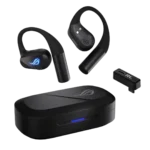
Asus ROG Cetra Open Feature Scores
Explore all 57 feature scores for Asus ROG Cetra Open, organized into pros and cons.
Scores by Feature
Summary
57 reviewed features-
Very positive 4.5-5.018 (32%)
-
Positive 3.5-4.421 (37%)
-
Neutral 2.5-3.411 (19%)
-
Negative 1.5-2.45 (9%)
-
Very negative below 1.52 (4%)
Pros
Sort
-
Low-latency gaming is one of the clearest strengths. The 2.4GHz dongle repeatedly delivers near-wired responsiveness and excellent sync for shooters, rhythm games, handhelds, and console play.
-
Situational awareness is nearly universally praised. Reviewers can hear conversations, doorbells, traffic, children, and room activity without removing the earbuds.
-
Physical fit is highly secure for most users. The hooks stay put during running, workouts, and active movement, though a few ear shapes struggle with fit.
-
Comfort is the product’s strongest consensus advantage. Most reviewers can wear the buds for hours without ear-canal pressure, though a minority experience cartilage pain or poor fit depending on ear shape.
-
Charging is a strong part of the package, especially the USB-C passthrough on the dongle and quick top-ups. One defective unit failed to charge, but most reviewers praise the convenience and speed.
-
Battery life is usually strong, often lasting through long gaming sessions and in some tests approaching the advertised figures. Heavy use of RGB, Immersion Mode, Phantom Bass, or the mic can cut runtime substantially.
-
Low weight is consistently praised and helps the earbuds disappear during long sessions despite their visibly chunky shape.
-
Glasses compatibility is consistently excellent, with thin hooks and low pressure working well alongside frames. One expert also found the fit comfortable with hats and sunglasses.
-
Noise suppression works well in many tests, keeping speech understandable while reducing fans, background media, and ambient chatter.
-
Sound quality is good for many gaming-focused users, especially for dialogue and positional cues, but it is not a universal win. Some reviewers hear clean, detailed audio while others describe the presentation as thin, compressed, or harsh.
-
The 2.4GHz USB-C dongle is central to the appeal, delivering excellent low-latency gaming and useful passthrough charging. A few units show disconnects or awkward port blocking, so reliability is not universal.
-
The EQ is highly useful and often materially improves the sound. Several reviewers say tuning or Phantom Bass turns a mediocre out-of-box presentation into something much better.
-
Multipoint is excellent when it works, with fast switching and useful dual-device behavior. Several reviews, however, criticize unpredictable switching or the lack of simultaneous audio in certain setups.
-
Game-audio separation is consistently strong. Reviewers can distinguish footsteps, dialogue, and competing sounds clearly enough for competitive play.
-
Mids are usually a strength, with clear dialogue, vocals, and footsteps. A few reviewers hear lower-mid thinness, but speech intelligibility remains strong.
-
Positional performance is strong for games, especially footsteps and directional cues. A few tests find rear localization or Dolby Atmos rendering less convincing.
-
USB-C implementation is excellent where discussed, particularly the case-friendly dongle plug and passthrough charging that keeps handhelds or phones powered.
-
The open design generally creates a spacious presentation, with several reviewers praising the wide soundstage and stereo image.
-
IPX5 earbud protection is viewed as well suited to workouts, sweat, and light rain, supporting the product’s gaming-and-fitness crossover use.
-
The earbuds themselves are generally seen as solid or premium, but impressions are less consistent around the plastics. Several reviewers think the materials feel good, while others say parts of the package feel cheaper than the price suggests.
-
Physical buttons are easy to find and tactile, but the default multi-press scheme is contentious. Four presses for volume and three presses for mute or assistant functions feel unnecessarily cumbersome to several reviewers.
-
Overall opinion is polarized but leans positive for the right niche. Fans love the comfort, awareness, and gaming responsiveness, while critics are pushed away by price, sound compromises, or software instability.
-
Mic quality is mixed but generally usable. Many reviewers find voice chat clear and good for earbuds, while several customers report thin, robotic, or poor-sounding voice transmission.
-
Bluetooth works well for ordinary listening in several reviews, but reliability is inconsistent. Some owners report slow pairing, disconnects, or worse sound than the 2.4GHz dongle.
-
RGB controls are extensive and easy to personalize, with effects, brightness, and colors available. Some reviewers enjoy the style, while others see lighting as garish or unnecessary battery drain.
-
Leakage is better controlled than some open-ear designs, though nearby people may hear faint audio in quiet rooms or at higher volumes.
-
The dongle works across a wide range of PCs, handhelds, phones, and consoles, but platform-specific quirks appear on Steam Deck, Mac, and PS5 in some reviews.
-
Presets and Phantom Bass can improve the listening experience, but results vary. Some users call Phantom Bass essential, while others find presets subtle or dislike the default communication profile.
-
Wear detection is a useful convenience, automatically stopping playback when the earbuds are removed.
-
The open design provides a very natural ability to hear your own voice during chat, which one reviewer particularly appreciated.
-
One video describes the controls as responsive and intuitive, giving them a very positive usability assessment.
-
The open-ear effect was judged more natural and effective for hearing surroundings than typical electronic transparency modes.
-
The included charging cable received a positive mention and was viewed as a useful part of the package.
-
The ear-hook design applies little pressure for at least one reviewer, helping the buds stay comfortable during long sessions.
-
The rounded arm allows useful rotation around the ear, making it easier to dial in a comfortable position.
-
AAC and SBC are considered adequate for the gaming-focused use case, though one expert would have preferred higher-bandwidth codec options.
-
Default tuning was described as reasonably clean and usable, though one reviewer still preferred the flatter EQ setting.
-
Android use is generally workable, though one test still found the volume curve aggressive. The earbuds remain usable on Android without the sharper low-volume problem being quite as severe as on iOS.
-
The built-in microphones are considered decent for an earbud design, especially for casual chat rather than broadcast-quality recording.
Cons
Sort
-
Passive isolation is essentially nonexistent by design. That is useful for awareness, but it makes noisy environments and fully immersive gaming poor fits.
-
Reliability is the biggest technical concern. Multiple customer reviews report disconnects, one-sided audio, distortion, failed updates, beeping, or erratic behavior, although some users find later firmware dramatically improves performance.
-
Portability is a recurring weakness because the charging case is unusually large and thick. Several reviewers say it is barely pocketable or not pocket-friendly at all.
-
Price is the most consistent purchasing objection. Even positive reviewers often call the $230 class price steep, and several experts say cheaper gaming earbuds or headsets offer better overall value.
-
At high levels, clarity can break down with sharp treble or bass distortion. The earbuds have plenty of headroom, but pushing them hard is not their best use.
-
One customer received a unit that appeared used or refurbished, with misaligned protective films and a dead earbud.
-
Immersion Mode only softens steady background noise and is nowhere near full ANC. A few users notice a small benefit, but most reviewers treat noise reduction as secondary to the open-ear design.
-
Treble is another polarizing area. Some reviewers praise crisp detail, but many hear excessive brightness, sibilance, or piercing highs at louder levels.
-
Xbox support is absent, which one reviewer flags as a concrete platform limitation even while noting the broader USB-C ecosystem constraint.
-
Setup experiences vary sharply. Some users get simple plug-and-play operation, while others encounter hidden apps, multiple utilities, web-only controls, or convoluted firmware update steps.
-
Manual voice-assistant activation via a triple press was viewed as redundant and not a good use of the control scheme.
-
The styling splits opinion. Some like the flashy gaming look and RGB accents, while others call the buds chunky, angular, oversized, or unattractive.
-
ASUS acknowledged a reported Steam Deck issue and said it was being investigated, but did not promise a fix.
-
Bass is the most divisive part of the tuning. Phantom Bass can add useful punch, but many reviewers still hear weak sub-bass or thin impact compared with sealed earbuds, while a smaller group finds the low end surprisingly satisfying.
-
The dongle and charging cable are useful additions, while the reflective neck strap is more mixed because some find it stiff or uncomfortable.
-
The case draws mixed reactions. Some owners like its quality and dongle storage, but many reviewers criticize its bulky size, plasticky feel, or missing premium touches.
-
The earbuds get very loud, but the volume curve is uneven. Several reviewers complain that even low settings are too loud, while others appreciate the strong headroom.
-
Gear Link is polarizing: several reviewers love the browser/mobile flexibility and deep controls, while others find it buggy, hidden, web-dependent, or awkward during firmware setup.