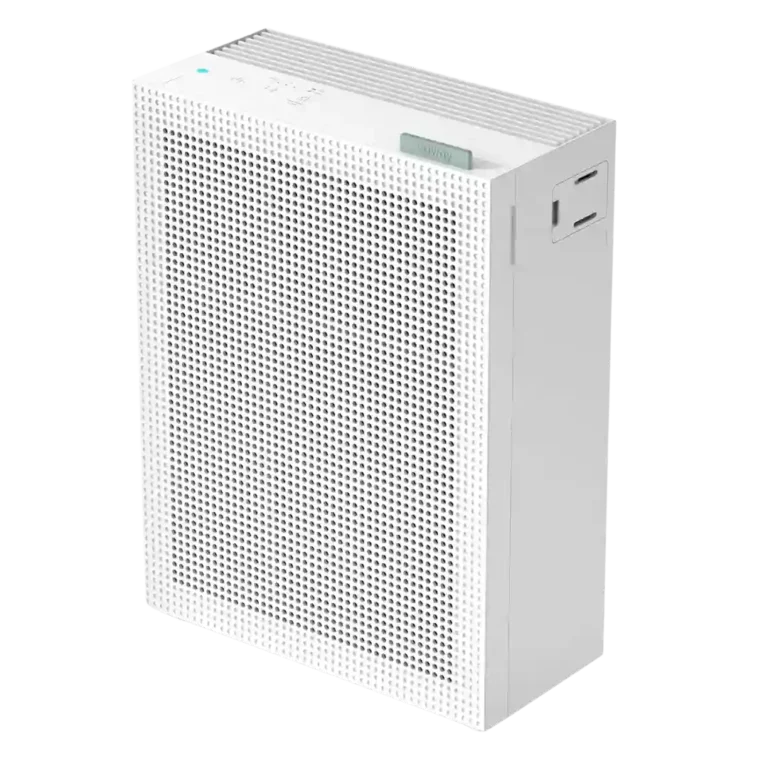
Coway Airmega 150 Air Purifier Review
Bottom Line
Choose the Coway Airmega 150 for small rooms if you want quiet operation, simple controls, easy filter care, and low running costs. Skip it for larger rooms, strong odor/VOC problems, or app, timer, and child-lock needs.
Best for people who want a quiet, attractive, easy-maintenance purifier for bedrooms, small offices, or modest living spaces. It especially suits users who prefer simple controls over app setup.
Not for larger rooms, heavy smoke or odor/VOC problems, or buyers who want app control, scheduling, child lock, voice assistants, or stronger low-speed air changes.
Reviewers portray the Coway Airmega 150 as a polished small-room purifier with real strengths in quiet operation, simple setup, easy pre-filter access, and low ownership costs. Test evidence is favorable for particle cleaning, especially in smaller spaces, with several reviews praising fast or excellent air-quality improvement. The tradeoff is that its style and convenience are stronger than its odor/VOC capability and low-speed cleaning power. Multiple reviewers criticize the carbon fabric or lack of pelletized carbon, and several note missing app, timer, child-lock, or fuller smart controls. It fits best as a simple, attractive everyday purifier rather than a high-output or smart-home centerpiece.
Feature Scorecards
Summary
45 reviewed features- Very positive 4.5-5.0 31% 14 features
- Positive 3.5-4.4 40% 18 features
- Neutral 2.5-3.4 18% 8 features
- Negative 1.5-2.4 11% 5 features
- Very negative below 1.5 0% 0 features
Pros
-
Maintenance ease was a major strength across reviews, especially the slide-out washable pre-filter and simple setup or cleaning access.
-
Reviewers treated ozone-free operation positively, noting the lack of ionizer or ozone-producing features.
-
Pre-filter quality was a standout strength, especially the easy slide-out design and its role protecting inner filters.
-
Auto mode was generally praised for reacting to changing air quality and adjusting fan speed without much user input.
-
Energy efficiency was consistently praised, with reviewers emphasizing low energy use and low long-term running costs.
-
Power consumption was a clear strength, with multiple reviewers praising very low running cost or energy draw.
-
The washable pre-filter was widely praised for being easy to remove, rinse, clean, or reuse.
-
HEPA filtration was strongly praised as a key reason for particle-removal performance and pollutant reduction.
-
The True HEPA filter was praised as high-quality and central to the unit’s strong particle performance.
-
One review framed the HEPA stage as extra family protection and suitable for allergy sufferers.
-
A reviewer’s home use found it highly effective against airborne dust as part of its particle-removal performance.
-
A reviewer found it highly effective against pollen in home use, supporting a strong pollen-removal score.
-
One review explicitly described the unit as reliable for bedrooms and living rooms.
-
Sleep suitability was praised where silent mode and low noise made night use comfortable.
-
The three-stage, separate-filter setup was praised for practical filtration and for avoiding bonded filters.
-
Portability was generally positive because of low weight and ease of moving, though not every review agreed on handle convenience.
-
Design was one of the strongest areas, with reviewers repeatedly calling it stylish, modern, compact, muted, or decor-friendly.
-
Reviewers liked the compact footprint, small-room fit, and easy placement, even when coverage limitations remained.
-
Filter life was viewed positively, with reviewers citing roughly 12-month HEPA life or especially long filter life versus peers.
-
Particle-removal effectiveness was good in lab-style testing, with one average timed result and one very fast AQI/PM2.5 improvement.
-
Noise was usually praised at low settings, but high-speed loudness created mixed scores in some reviews.
-
Value for money was generally positive because of low running costs, decent performance, and simple usability, despite performance tradeoffs.
-
Particle-cleaning performance ranged from average to excellent depending on room, speed, and test method, with strongest results in smaller rooms.
-
Indicator lights were generally useful for air quality and filter reminders, though the system stays simple rather than data-rich.
-
Real-time monitoring was useful and responsive for everyday feedback, though one review cautioned about slower spike detection.
-
Filter replacement cost was mixed but mostly favorable, with several reviewers calling costs reasonable or cheap and one calling cost a drawback.
-
Build quality drew mixed reactions, from thin and plasticky in one review to solid, sturdy, and premium in others.
-
Room coverage was context-dependent: reviewers liked it for bedrooms and smaller rooms, but warned against larger spaces at quieter speeds.
-
The color/LED display was useful for at-a-glance status, but reviewers wanted more detail such as an actual PM2.5 readout.
-
Sensor impressions were mixed: sensitivity adjustment and adequate response were praised, but some reviewers warned it can be slow or need cleaning.
-
CADR feedback was mixed: the CADR-to-power ratio was praised, but low smoke CADR and reduced real-world speed were noted.
-
PM2.5 feedback was split between praise for a PM2.5 dust sensor and criticism that the unit does not show the actual PM2.5 value.
Cons
-
Odor reduction was the most mixed performance area, with weak carbon criticism offset by a few reports of cleared smells.
-
Fan speed options were acceptable for simple use, but reviewers wanted more than three speeds for better quiet-performance balance.
-
VOC reduction was mixed: carbon/VOC claims and use cases were noted, but several reviewers criticized the weak impregnated carbon approach.
-
Filter availability was mixed: third-party pellet-carbon options exist, but one reviewer disliked Coway’s bundled replacement approach.
-
Smart features were limited; some liked the simplicity, but most smart-home extras were absent.
-
Low-speed air changes were a limitation; one reviewer said it could not provide multiple air changes in larger spaces.
-
Handle design was a weakness because one reviewer found room-to-room movement inconvenient despite compact size.
-
Smoke removal was limited by the low Smoke CADR, making it better suited to personal or small-room use.
-
Reviewers repeatedly criticized the U.S. carbon stage as weaker than pelletized carbon, though one noted pellet-based third-party or regional options.
-
Scheduling was a drawback because reviewers wanted a timer or app routines and noted the buttons could not be locked or scheduled.
-
App connectivity was consistently absent and often treated as a drawback for remote control, monitoring, timers, or routines.
-
One reviewer directly disliked the lack of a child-lock button.
-
Voice assistant compatibility was absent, and one reviewer specifically noted no connection to Google Assistant, Siri, or Alexa.
Compared With Category Average
Compared with other Air Purifiers, this product is above average in reliability, below average in smoke removal, scheduling options, child lock.
Summary
8 compared features- Above average 0.4+ pts higher 13% 1 feature
- Same as average within 0.3 pts 0% 0 features
- Below average 0.4+ pts lower 88% 7 features
| Attribute | This product | Category average | Difference |
|---|---|---|---|
| smoke removal | 2.5 | 4.3 | -1.8 |
| scheduling options | 2.3 | 3.9 | -1.7 |
| child lock | 2.0 | 3.7 | -1.7 |
| voice assistant compatibility | 2.0 | 3.6 | -1.6 |
| air changes per hour | 2.5 | 4.0 | -1.5 |
| activated carbon filter | 2.3 | 3.8 | -1.5 |
| reliability | 4.5 | 3.0 | +1.5 |
| app connectivity | 2.1 | 3.2 | -1.1 |
FAQ
Is the Coway Airmega 150 good for small rooms?
Yes. Reviewers most often framed it as a strong fit for bedrooms, small offices, apartments, and other modest spaces, while warning against relying on it for larger rooms at quiet fan speeds.
How well does it clean particles?
Particle-cleaning evidence is generally positive. Some tests called its results excellent or faster than peers, while HouseFresh-style testing found the result acceptable but not outstanding for the price.
Is it quiet enough for bedrooms?
Mostly yes. Multiple reviewers praised low-speed or silent-mode noise, though a few noted that the highest fan speed can become loud.
Does it remove odors and VOCs well?
Odor and VOC performance is the main weakness. Several reviewers criticized the carbon fabric approach and said pelletized carbon would improve odor neutralization.
Does it have app control or smart-home features?
No app control is supported in the reviews, and reviewers repeatedly noted missing smart extras such as app routines, remote monitoring, voice assistant support, timers, and child lock.
Is maintenance easy?
Yes. Reviewers consistently praised the removable washable pre-filter, simple setup, and filter indicators, with the slide-out pre-filter standing out as a practical design win.
Sample Expert Reviews We Analyzed
These are a few of the reviews included in our analysis.

Video Reviews
Article Reviews
- Review score
- 4.4
- Review score
- 4.4
Compared in Reviews
Products reviewers directly compared with this model, grouped into quick takeaways.
- Better: smart features The reviewer recommended the Levoit Vital 200S instead for shoppers who want more smart features.
- Better: odor neutralization The reviewer said the Airmega 150 trails the Levoit Vital 200S for neutralizing cooking odors.
- Better: air purification performance The reviewer expected more performance after comparing the Airmega 150 with the Levoit Vital 200S.
- Worse: design and appearance The reviewer felt the Airmega 150 looks more design-forward than plain white devices such as the Levoit Core 300S.
- Worse: noise level The Airmega 150 was quieter than the Levoit Vital 100S at maximum speed.
Consider This Instead
If you want better app connectivity
Choose Levoit Vital 100S. It scores 4.7 vs 2.1 for app connectivity, with a 4.4 overall score.
If you want better scheduling options
Choose Levoit Vital 200S. It scores 4.7 vs 2.3 for scheduling options, with a 4.3 overall score.
If you want better odor reduction
Choose Winix 5510. It scores 4.7 vs 3.2 for odor reduction, with a 4.0 overall score.
If you want better voice assistant compatibility
Choose Blueair Blue Pure 311i Max. It scores 5.0 vs 2.0 for voice assistant compatibility, with a 3.9 overall score.
Top Air Purifiers to Consider
Choose the H7124 if you want a quiet smart purifier for odors, dust, pets, and app control. Skip it if you need foolproof Wi-Fi, wall-facing intake, UV light, or strong...
Pros: particle removal effectiveness, pollen removal
Cons: UV-C light effectiveness, air dryness
Choose this if you want strong odor, dust, smoke, and pet-air cleanup with washable filters. Skip it if turbo noise, Wi-Fi setup, or a high upfront price will bother you.
Pros: filter replacement cost, allergen reduction
Cons: Wi-Fi reliability
Best for quiet, smart large-room cleaning and strong odor control. Skip it if $99 filters, true-HEPA wording, or occasional sensor/fan reliability complaints are dealbreakers.
Pros: air purification performance, allergen reduction
Cons: reliability, filter replacement cost
Best for large rooms, strong particle cleanup, quiet everyday running, and easy rolling. Skip it if you need app control, compact placement, automatic restart after outages, or low filter costs.
Pros: ozone-free operation, particle removal effectiveness
Cons: filter replacement cost, app connectivity