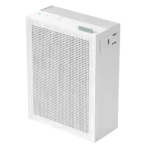
Coway Airmega 150 Feature Scores
Explore all 45 feature scores for Coway Airmega 150, organized into pros and cons.
Scores by Feature
Summary
45 reviewed features-
Very positive 4.5-5.014 (31%)
-
Positive 3.5-4.418 (40%)
-
Neutral 2.5-3.48 (18%)
-
Negative 1.5-2.45 (11%)
Pros
Sort
-
Maintenance ease was a major strength across reviews, especially the slide-out washable pre-filter and simple setup or cleaning access.
-
Design was one of the strongest areas, with reviewers repeatedly calling it stylish, modern, compact, muted, or decor-friendly.
-
Energy efficiency was consistently praised, with reviewers emphasizing low energy use and low long-term running costs.
-
Power consumption was a clear strength, with multiple reviewers praising very low running cost or energy draw.
-
Auto mode was generally praised for reacting to changing air quality and adjusting fan speed without much user input.
-
Pre-filter quality was a standout strength, especially the easy slide-out design and its role protecting inner filters.
-
Noise was usually praised at low settings, but high-speed loudness created mixed scores in some reviews.
-
The washable pre-filter was widely praised for being easy to remove, rinse, clean, or reuse.
-
Value for money was generally positive because of low running costs, decent performance, and simple usability, despite performance tradeoffs.
-
Reviewers liked the compact footprint, small-room fit, and easy placement, even when coverage limitations remained.
-
HEPA filtration was strongly praised as a key reason for particle-removal performance and pollutant reduction.
-
The True HEPA filter was praised as high-quality and central to the unit’s strong particle performance.
-
Particle-cleaning performance ranged from average to excellent depending on room, speed, and test method, with strongest results in smaller rooms.
-
Filter life was viewed positively, with reviewers citing roughly 12-month HEPA life or especially long filter life versus peers.
-
The three-stage, separate-filter setup was praised for practical filtration and for avoiding bonded filters.
-
Real-time monitoring was useful and responsive for everyday feedback, though one review cautioned about slower spike detection.
-
Indicator lights were generally useful for air quality and filter reminders, though the system stays simple rather than data-rich.
-
Reviewers treated ozone-free operation positively, noting the lack of ionizer or ozone-producing features.
-
Build quality drew mixed reactions, from thin and plasticky in one review to solid, sturdy, and premium in others.
-
Room coverage was context-dependent: reviewers liked it for bedrooms and smaller rooms, but warned against larger spaces at quieter speeds.
-
Filter replacement cost was mixed but mostly favorable, with several reviewers calling costs reasonable or cheap and one calling cost a drawback.
-
Portability was generally positive because of low weight and ease of moving, though not every review agreed on handle convenience.
-
Sensor impressions were mixed: sensitivity adjustment and adequate response were praised, but some reviewers warned it can be slow or need cleaning.
-
Particle-removal effectiveness was good in lab-style testing, with one average timed result and one very fast AQI/PM2.5 improvement.
-
The color/LED display was useful for at-a-glance status, but reviewers wanted more detail such as an actual PM2.5 readout.
-
One review framed the HEPA stage as extra family protection and suitable for allergy sufferers.
-
A reviewer’s home use found it highly effective against airborne dust as part of its particle-removal performance.
-
A reviewer found it highly effective against pollen in home use, supporting a strong pollen-removal score.
-
One review explicitly described the unit as reliable for bedrooms and living rooms.
-
Sleep suitability was praised where silent mode and low noise made night use comfortable.
-
CADR feedback was mixed: the CADR-to-power ratio was praised, but low smoke CADR and reduced real-world speed were noted.
-
PM2.5 feedback was split between praise for a PM2.5 dust sensor and criticism that the unit does not show the actual PM2.5 value.
Cons
Sort
-
App connectivity was consistently absent and often treated as a drawback for remote control, monitoring, timers, or routines.
-
Reviewers repeatedly criticized the U.S. carbon stage as weaker than pelletized carbon, though one noted pellet-based third-party or regional options.
-
Scheduling was a drawback because reviewers wanted a timer or app routines and noted the buttons could not be locked or scheduled.
-
One reviewer directly disliked the lack of a child-lock button.
-
Voice assistant compatibility was absent, and one reviewer specifically noted no connection to Google Assistant, Siri, or Alexa.
-
Smart features were limited; some liked the simplicity, but most smart-home extras were absent.
-
Low-speed air changes were a limitation; one reviewer said it could not provide multiple air changes in larger spaces.
-
Handle design was a weakness because one reviewer found room-to-room movement inconvenient despite compact size.
-
Smoke removal was limited by the low Smoke CADR, making it better suited to personal or small-room use.
-
Filter availability was mixed: third-party pellet-carbon options exist, but one reviewer disliked Coway’s bundled replacement approach.
-
VOC reduction was mixed: carbon/VOC claims and use cases were noted, but several reviewers criticized the weak impregnated carbon approach.
-
Fan speed options were acceptable for simple use, but reviewers wanted more than three speeds for better quiet-performance balance.
-
Odor reduction was the most mixed performance area, with weak carbon criticism offset by a few reports of cleared smells.