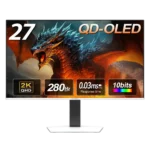
InnoCN GA27S1Q Feature Scores
Explore all 49 feature scores for InnoCN GA27S1Q, organized into pros and cons.
Scores by Feature
Summary
49 reviewed features-
Very positive 4.5-5.031 (63%)
-
Positive 3.5-4.410 (20%)
-
Neutral 2.5-3.44 (8%)
-
Negative 1.5-2.43 (6%)
-
Very negative below 1.51 (2%)
Pros
Sort
-
Color coverage is consistently excellent, with vibrant reds and greens and measured gamut results that meet or beat the advertised claims.
-
Picture quality is the headline attraction: deep blacks, vivid color, sharp motion, and high contrast make games and HDR media look striking.
-
The stand is a major strength, offering height, tilt, swivel, and pivot adjustments with sturdy construction and a desk-friendly base.
-
The combination of 280Hz refresh, near-instant response, and clean motion makes this a highly capable competitive gaming monitor.
-
OLED-care controls are unusually comprehensive, including pixel shift, static-icon and taskbar detection, screen saving, and panel cleaning. Some protections cannot be fully disabled, but the breadth of safeguards is widely praised.
-
Black levels are a standout, staying truly dark instead of washing into gray and preserving detail in shadow-heavy scenes.
-
Near-infinite OLED contrast gives highlights extra punch and makes games and HDR scenes look dramatically more dimensional.
-
Response performance is consistently excellent, with measured results near the top of the OLED monitors one reviewer had tested.
-
Overall sentiment is strongly positive, with most reviewers recommending it as an affordable route into fast QD-OLED gaming. The main dissent centers on whether its street price is low enough versus better-known brands.
-
The clean white finish, slim bezels, and restrained styling look modern and distinctive. Rear RGB is less convincing, and the stand shape drew one mild criticism.
-
Most reviewers see the monitor as an exceptional OLED value around $380 to $450, especially for its speed and image quality. One reviewer argued that $400 is too close to mainstream-brand alternatives and preferred it nearer $300.
-
Fast movement stays clean and sharp, with reviewers repeatedly praising the smoothness in both esports and cinematic games.
-
The QD-OLED panel is the monitor’s defining strength, delivering richer color, deeper blacks, and a more striking image than typical IPS or VA screens.
-
The image and clean white design feel more premium than the price suggests, with little about the monitor immediately revealing its budget positioning.
-
The 280Hz refresh rate feels exceptionally fluid and is more than fast enough for most competitive players.
-
Dual HDMI 2.1 inputs make it easy to connect a gaming PC and modern console while retaining high-refresh 1440p support.
-
Assembly is quick and tool-free, with the stand snapping into place and ports positioned for easy access.
-
Two DisplayPort inputs are unusually generous for the price and are useful for multi-PC or desktop-heavy setups.
-
PC gaming is an excellent fit thanks to the fast OLED response, 280Hz refresh, vivid SDR image, and extensive tuning controls.
-
Standard 100 x 100 VESA support makes moving the display to a monitor arm simple.
-
The joystick makes navigation much easier than traditional monitor buttons, and most found the menu intuitive. Its dated appearance and occasionally tedious structure keep it from being perfect.
-
Console support is strong, with 1440p, 120Hz, VRR, and low-latency options. Some Xbox and 4K-upscaling settings may need extra toggling before they work correctly.
-
The core video selection is strong with dual HDMI and dual DisplayPort, but the lack of USB-C, USB expansion, and KVM functionality keeps it from feeling fully equipped.
-
The stand and chassis feel robust, with the metal base receiving particular praise for sturdiness.
-
Motion tests showed no visible ghosting or inverse-ghosting trails, reinforcing the panel’s excellent gaming clarity.
-
Single-player games benefit from the deep blacks, vivid color, and strong contrast, giving cinematic scenes far more impact than conventional panels.
-
The monitor offers an unusually large set of presets and customization controls, especially in SDR. HDR limits those controls, and some presets look too similar.
-
Game imagery looks crisp, but text clarity is less consistent. Some reviewers found everyday text comfortable, while another saw unusually noticeable fringing and pixelation.
-
Adaptive sync works well after it is enabled, including high-refresh console output. Setup can require a little menu tinkering.
-
Low-blue-light and flicker-free options are welcome for reducing strain during long sessions.
-
Low power consumption helps the monitor run cool during use.
-
Per-pixel OLED lighting produces clean dark scenes without the halos associated with zone-based backlights.
-
Picture-in-picture support is a useful extra for displaying multiple connected sources at once.
-
The extensive OLED-care system inspired confidence about long-term use, though this optimism is based on protective features rather than years of ownership.
-
At 27 inches, the screen size pairs especially well with 1440p for a balanced desktop gaming setup.
-
A downloadable desktop app mirrors the OSD controls, letting users adjust the monitor without reaching for the rear joystick.
-
Color accuracy is strong enough for photo editing and less demanding creative work, though one reviewer found the default balance slightly cool and preferred a warmer adjustment.
-
The glossy or semi-gloss finish makes colors pop and handles reflections reasonably well in moderate lighting. Strong windows or intense room light can raise blacks, add a magenta tint, and become distracting.
-
The 1440p resolution is widely treated as a strong match for a 27-inch gaming screen. It looks sharp in games, though text can appear less dense and more fringed than on a 4K display.
-
The color performance and ergonomic stand make it useful for creative work, but text fringing and the lack of USB-C or KVM features reduce its appeal as an all-in-one office display.
-
VRR delivers smooth, tear-free play once enabled, but dark scenes and loading screens may show the flicker common to OLED displays.
Cons
Sort
-
There is no KVM switch, reinforcing that this is primarily a gaming display rather than a multi-device productivity hub.
-
There is no USB hub, a repeated omission that limits peripheral connectivity and weakens the monitor’s productivity appeal.
-
The one-year warranty is a consistent concern because many competing OLED monitors offer three years and explicit burn-in coverage.
-
The included documentation and product listing leave important settings and specifications unexplained, so buyers may need to hunt for details. One listing image even suggests USB ports the monitor does not have.
-
Cable management is weak because the stand lacks a built-in clip or routing hole, and the external power brick adds extra clutter.
-
The small speakers are generally described as acceptable for close-up or backup use, not immersive listening. One walkthrough reported no built-in speakers at all, creating some uncertainty.
-
HDR is the most divisive part of the picture. OLED contrast remains impressive, but several reviewers found the default image too dim and the presets too restricted, while one found HDR video excellent.
-
Brightness is adequate in controlled lighting but trails brighter IPS, Mini-LED, and premium OLED rivals. Highlight mode helps, yet sunlit rooms remain a weak fit.