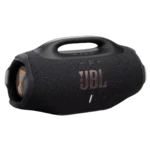
JBL Boombox 4 Feature Scores
Explore all 62 feature scores for JBL Boombox 4, organized into pros and cons.
Scores by Feature
Summary
62 reviewed features-
Very positive 4.5-5.036 (58%)
-
Positive 3.5-4.413 (21%)
-
Neutral 2.5-3.44 (6%)
-
Negative 1.5-2.46 (10%)
-
Very negative below 1.53 (5%)
Pros
Sort
-
Output is a defining strength: reviewers repeatedly describe it as exceptionally loud, with enough projection for backyards, parties, gyms, and large outdoor spaces. Several tests put it near much larger party speakers.
-
IP68 protection earns near-unanimous praise for pool, beach, rain, and outdoor use. One tester submerged the speaker and watched it continue playing, making water resistance one of its strongest practical advantages.
-
The user-replaceable battery is one of the most celebrated upgrades across the review set. Reviewers value both the ability to carry a spare and the longer product lifespan, although replacement cost and the screw-based swap process draw minor caveats.
-
Auracast is a major upgrade for building larger JBL setups, supporting stereo pairs and broad multi-speaker synchronization. Reviewers like the ease and scale of current-generation pairing, though older PartyBoost models are excluded.
-
Reviewers consistently treat the IP68 dust protection as well suited to beaches, campsites, and other outdoor environments. The sealed, rugged construction reduces concern around sand and dusty surfaces.
-
A major upgrade is how little performance drops when unplugged: several reviewers say battery operation remains almost as authoritative as AC power. Day-to-day power delivery and reconnection are also described as dependable.
-
Bass is the clearest consensus strength: reviewers describe deep extension, physical punch, and unusually strong output for a portable speaker. Bass Boost modes are more divisive, sometimes sounding boomy, resonant, or overwhelming indoors.
-
Battery endurance is a major strength, with several hands-on tests landing around 25 to 35 hours at moderate levels and some sources reporting even longer. High volume and heavy bass shorten runtime substantially, but the overall consensus remains very positive.
-
Build quality is a major strength, with rugged fabric, rubber protection, a stable base, and IP68 sealing repeatedly praised. The strongest durability caveat comes from one severe drop test that caused temporary functional problems.
-
The seven-band EQ is one of the most consistently praised software features. It gives enough control to tame bright highs, reshape bass, or make the speaker more balanced, and reviewers often recommend using it.
-
Most reviewers are strongly positive, especially for first-time buyers wanting a rugged, high-output party speaker. The main reasons for hesitation are the premium price, sheer size, high-volume tonal issues, and limited legacy connectivity.
-
Overall sound quality is rated highly across the set, with strong bass, clear vocals, and impressive scale. The consensus becomes more mixed at maximum volume, where some reviewers hear compression, harsh treble, narrowness, or distortion.
-
The JBL Portable app is broadly praised as easy, useful, and stable, with quick connection and helpful control over EQ, grouping, firmware, lights, and battery features. No recurring app-reliability complaint appears in the reviews.
-
Despite its size, the Boombox 4 is repeatedly praised for frictionless day-to-day use: quick pairing, reliable reconnection, strong battery life, physical controls, ruggedness, and the ability to move between home, outdoor, and social settings.
-
Using the large internal battery to top up a phone or other device is consistently viewed as practical, especially for camping, beach days, and long outdoor events. The feature worked as expected in hands-on testing.
-
USB-C lossless playback is widely viewed as a meaningful quality option, and LC3 support adds a modern wireless path in several reviews. The speaker is strongest for Bluetooth and USB-C rather than a wide range of legacy formats.
-
Core controls are consistently considered intuitive, tactile, and easy to reach, including volume, playback, pairing, Auracast, and bass modes. The physical layout reduces the need to open the app for common adjustments.
-
Voices are usually a strength, staying clear and intelligible even over strong bass. Podcasts and vocals were described as natural, detailed, and resistant to boxiness, though one review found vocals slightly cold.
-
Wireless stability is a strong point across the hands-on reviews, with quick reconnection, rock-solid operation, and few complaints about dropouts. Pairing and day-to-day switching are consistently described as dependable.
-
Roughly three-hour charging is repeatedly praised as a meaningful improvement over the much slower Boombox 3. Reviewers see the faster turnaround as practical for frequent use.
-
Setup is consistently easy: reviewers describe quick Bluetooth pairing, automatic connection, and little to no learning curve. The speaker works immediately without requiring complicated app configuration.
-
The Boombox 4 has enormous usable output and unusually strong battery-powered headroom. The tradeoff is that compression, thin mids, harsh treble, or distortion can appear as some units are driven very close to maximum volume.
-
Music playback is broadly energetic and engaging, especially for bass-heavy genres, parties, and workouts. The speaker also handles vocals and layered tracks well, though maximum-volume harshness can reduce refinement.
-
Connecting two source devices at once is treated as a useful, straightforward feature. Reviewers describe switching between devices as seamless or simple enough for shared DJ control.
-
The lighter redesign is noticed and appreciated, but opinions on portability depend heavily on context. Some reviewers find one-hand carrying manageable, while others call the roughly 13-pound body bulky, awkward, and best for short carries.
-
Detail is generally strong, especially in vocals, treble textures, and layered arrangements. A minority of reviewers find the mids less open or detailed than the Boombox 3 when the bass-heavy tuning is pushed.
-
The enclosure is repeatedly described as rugged, stable, and well protected with reinforced edges, rubber bumpers, sealed flaps, and tough fabric. The flatter base also helps it stay planted during high-output playback.
-
Illuminated controls, bass-mode lights, connection indicators, and battery-level feedback make status easy to read. Reviewers particularly appreciate visibility at night and simple troubleshooting cues.
-
Unlike many large party speakers, it remains enjoyable at quieter levels. Reviewers describe full sound, retained clarity, and useful relaxed-listening EQ options without needing to crank the volume.
-
The recognizable boombox silhouette is broadly liked, and several reviewers praise the camo finish or cleaner integrated design. The main visual complaint is the plastic handle, which some feel looks cheaper than the previous metal version.
-
Basic Bluetooth use is consistently straightforward, with fast pairing and quick reconnection. Reviewers describe it as an easy everyday wireless speaker rather than a finicky device.
-
High-volume behavior is the main sound-quality split. Some testers heard no true distortion even at full blast, while others reported compression, muddiness, shrill treble, sibilance, or bass-heavy distortion near the top of the range.
-
The integrated handle is usually described as sturdy, comfortable, and easy to grip, but the shift from metal to plastic divides opinion. Several reviewers also wish JBL had added shoulder-strap attachment points for longer carries.
-
Wireless range tested very well, with one review reaching about 133 feet before dropouts and another citing roughly 150 feet in ideal conditions. Reviewers characterize the connection as long-range and stable.
-
Auracast pairing is consistently described as easy and dependable in hands-on use. Reviewers successfully synchronized multiple JBL speakers and praised the minimal setup required.
-
Recycled materials help, but the replaceable battery is the sustainability feature reviewers value most. It can extend useful product life and reduce the likelihood of discarding the entire speaker when the battery ages.
-
Codec support is considered adequate to strong, with SBC and AAC commonly noted and LC3/LE Audio available in several reviews. LC3 can improve latency and wireless quality, while the overall codec list is not viewed as a major limitation.
-
Latency is generally manageable, especially with LC3/LE Audio, and one tester reported no issue for phone video. Older SBC connections can introduce more delay, so the experience depends on the source and codec.
-
The Boombox 4 produces real stereo and can create a wide, immersive image when heard from the front. Its narrow listening window limits that effect off-axis, while pairing two units can widen the field.
-
USB-C lossless audio is widely welcomed as a modern wired option, but many reviewers dislike the removal of the 3.5mm aux jack. The result is capable digital wired playback with weaker compatibility for older analog sources.
-
Physical buttons are generally tactile, direct, and responsive, with useful click feedback. A severe drop test temporarily reduced responsiveness, so the controls themselves are good but not immune to impact damage.
-
The default tuning generally favors bass and treble over the mids, which makes it exciting but not consistently neutral. Reviewers say EQ can improve the balance, while very high volume can thin the mids or sharpen the top end.
-
At normal levels, several reviewers praise the speaker’s separation, coherence, and ability to keep vocals clear over heavy bass. Others find the presentation narrower and less separated than the Boombox 3, particularly when pushed hard.
-
At discounted prices, several reviewers see strong value in the added power, battery system, and modern connectivity. At full price, others prefer cheaper PartyBox or competing speakers that offer more inputs, karaoke features, or comparable sound.
-
The speaker can float while continuing to play, and the hands-on water test made this a memorable strength. That makes it unusually reassuring for pool and lake use.
-
Value is the biggest non-sound disagreement. Some reviewers think the premium is justified by durability, battery design, and performance—especially on sale—while others call the regular price excessive compared with cheaper or more feature-rich party speakers.
-
The radiator lighting is visually fun for some reviewers, but far from universally loved. Praise focuses on subtle party personality and useful mode feedback, while critics call it hard to see, pointless, or too limited in color and brightness control.
-
For video-style listening, speech remains intelligible and strong even when high volume introduces some compression. The speaker is not positioned as a dedicated TV solution, but dialogue itself comes through clearly.
-
The backlit control strip and mode-colored radiator LEDs provide clear visual feedback without becoming a full party-light system. One reviewer specifically liked the backlit controls.
Cons
Sort
-
The absence of a built-in mic or mic input is repeatedly criticized by reviewers who want calls or karaoke. That omission stands out more because the speaker is loud and expensive enough to invite party use.
-
There is effectively no speakerphone capability because the Boombox 4 lacks a built-in microphone. Reviewers flag this as a drawback for anyone who wants hands-free calls.
-
The switch from PartyBoost to Auracast is a recurring ecosystem drawback. Owners of older JBL PartyBoost speakers generally cannot pair them with the Boombox 4, so upgrading can break an existing multi-speaker setup.
-
The lack of built-in assistant support is a clear weakness for buyers who expect Alexa, Google Assistant, or Siri from an expensive speaker. Reviewers specifically call the omission disappointing.
-
The speaker has useful app, EQ, battery, and grouping functions, but it is not a full smart speaker. Reviewers note the absence of Wi-Fi, voice assistants, and microphone-driven features as meaningful limitations for smart-home-style use.
-
The speaker itself does not normally charge through USB-C in the hands-on reviews that discuss this directly, and that limitation is criticized. USB-C remains useful for audio and charging other devices, but AC power is still required for the speaker.
-
Several reviewers warn that the Boombox 4 can be excessive in very small or quiet rooms. It can still sound good indoors, but its scale and output make larger spaces and outdoor use a more natural fit.
-
The Boombox 4 is decidedly front-facing rather than 360-degree. Reviewers say sound quality and tonal balance diminish off-axis, so placement matters if people are spread around the speaker.
-
Playtime Boost can extend runtime by reducing low-frequency output, but reviewers often dislike the resulting sound. A few find the tradeoff practical for background listening or emergency endurance, while others say it becomes hollow or loses nearly all bass.
-
One reviewer specifically disliked the move away from the earlier three-way/subwoofer arrangement, linking the new two-way design to separation problems and high-volume distortion. Other reviews often liked the stronger bass overall, but did not evaluate the missing subwoofer itself.
-
It can technically connect to a compatible TV, but one reviewer explicitly says the Boombox 4 is not designed as a TV speaker. Buyers focused on home theater should treat that capability as secondary rather than a core strength.
-
One unboxing criticizes the packaging as unnecessarily large for the small number of included accessories. No other review offers a clear opinion on packaging quality.
-
Drop durability is mixed. The heavy rubber protection looks reassuring, but one laboratory drop test caused shutdowns, reduced button responsiveness, scuffs, and scratches before the unit later recovered.