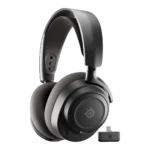
SteelSeries Arctis Nova 7 Wireless Gen 2 Feature Scores
Explore all 57 feature scores for SteelSeries Arctis Nova 7 Wireless Gen 2, organized into pros and cons.
Scores by Feature
Summary
57 reviewed features-
Very positive 4.5-5.018 (32%)
-
Positive 3.5-4.431 (54%)
-
Neutral 2.5-3.46 (11%)
-
Negative 1.5-2.42 (4%)
Pros
Sort
-
Battery life was repeatedly praised as long, often around or above 50 hours, with low-battery beeps being the main annoyance.
-
The app and GG/Sonar ecosystem were major strengths, especially mobile preset control, though a few advanced features still require desktop.
-
Comfort was one of the strongest themes, with most reviewers praising long-session wear, though glasses and very long sessions caused issues for some.
-
Charging was strongly praised for fast top-ups, USB-C, and the ability to keep playing while charging.
-
Multi-platform compatibility was one of the headset's strongest areas, especially when choosing the 7X variant.
-
Simultaneous 2.4GHz and Bluetooth was one of the most consistently praised features, enabling smooth dual-source use.
-
Reviewers generally liked the sound for gaming and everyday media, often calling it good to great, though some noted it is not as resolving as pricier competitors.
-
Weight comfort was widely praised because the headset felt light or well balanced despite being a wireless over-ear model.
-
Build quality was mostly praised for sturdy metal, solid plastics, and durability, with a minority complaint about control finish.
-
Value was generally positive, especially for comfort, battery, EQ, and connectivity, though some reviewers thought it should be cheaper or bought on sale.
-
Positional audio was consistently strong, with reviewers repeatedly hearing enemy direction and cues accurately.
-
Preset EQ profiles were generally useful and sometimes game-changing, especially for footsteps, though one reviewer was skeptical of per-game tuning.
-
Connectivity versatility was a major strength, with reviewers praising dual wireless, analog fallback, and broad device coverage.
-
EQ customization was powerful, especially desktop parametric EQ and saved profiles, but mobile custom EQ limitations were a recurring caveat.
-
Physical controls were usually praised as tactile, easy to reach, and intuitive, though one reviewer disliked cheap-feeling dials.
-
Bass was widely described as powerful and immersive, but a few reviewers found it overemphasized or thick without EQ.
-
The integrated retractable microphone was widely appreciated because it stores cleanly and avoids the hassle of detachable mics.
-
Earpads were mostly praised as soft, breathable, and high quality, though a few reviewers said they could get warm.
-
Noise reduction was praised when using ClearCast or Sonar processing, though baseline mic performance still varied.
-
Spatial audio was generally useful for immersion and positional effects, though one reviewer preferred avoiding it for competitive play.
-
Connection stability was mostly good over 2.4GHz, though a few reviewers reported limited range or Bluetooth/device-switching quirks.
-
Footstep-focused tuning and presets were praised for competitive awareness, though one reviewer said heavy bass could mask subtle cues.
-
Design impressions were mostly positive for clean, mature aesthetics, but some reviewers criticized the lack of visible Gen 2 changes or mid-range feel.
-
Wireless latency was excellent over the 2.4GHz dongle, while Bluetooth was not recommended for timing-sensitive gaming or video.
-
Game/chat balance controls were praised as handy for multiplayer, although function depends on version and platform.
-
The headband was praised for distributing pressure and helping adjust fit across head sizes.
-
Volume output was strong, with reviewers noting loud playback and enough headroom, though extreme settings could become uncomfortable.
-
Bluetooth was valued for simultaneous phone use, but reviewers noted SBC-only support, lag, pairing quirks, or power-management annoyances.
-
Midrange was praised for clear voices and dialogue, with one reviewer noting it was fairly flat but detailed.
-
Xbox compatibility was praised on the 7X version, but reviewers warned buyers that other versions do not fully support Xbox.
-
Setup and software were usually approachable, with plug-and-play use and beginner-friendly UI, though Sonar can feel complex at first.
-
Included accessories were viewed positively, especially the useful cable set and extension/adapter options.
-
Cup rotation and articulation were praised for fit, neck wear, and natural positioning.
-
USB-C was praised for charging convenience and fast charging, while the broader USB-C dongle design drew separate complaints.
-
Clamp force was generally manageable or comfortable, but glasses wearers in some reviews experienced pressure after hours.
-
Replaceable earpads had limited but positive evidence for replacement and aftermarket compatibility.
-
Replaceable ear plates were appreciated mainly for easy aesthetic customization.
-
Microphone opinions were mixed: clear enough for chat and calls, but often described as tinny, fuzzy, hissy, or not streamer-grade.
-
Call and chat intelligibility was usually fine, with voices heard clearly even when fidelity was not especially natural.
-
Sidetone was useful on the 7P version, but reviewers criticized loudness, hiss, or activation quirks.
-
A/V sync depended heavily on connection type: 2.4GHz was praised as near-latency-free, while Bluetooth could lag or drift out of sync.
-
Maximum-volume clarity was mixed, with one reviewer praising improved lack of distortion and another warning of harsh loudness.
-
Instrument and layer separation was mixed: some heard clean layering, while others said dense tracks or pricier drivers separate better.
-
Fit and seal were mixed: some praised consistent seal, while glasses-related gaps and fit instability hurt audio in other reviews.
-
Frequency-response comments were mixed, pointing to balanced or gamer-friendly tuning alongside bass emphasis, recesses, and a strong treble peak.
-
Hi-res playback evidence was limited, but 24-bit/48kHz support over the dongle was considered enough for casual audiophile use.
-
Packaging had limited positive evidence, with the package described as simple and clean.
-
Cable quality received limited but positive evidence for useful lengths, with one reviewer preferring braided sheaths.
-
Soundstage was considered decent for a closed-back headset, useful for games but sometimes enclosed for music.
Cons
Sort
-
The headset lacks ANC, and reviewers framed that as expected at the price but still a limitation versus some alternatives.
-
A reviewer reported painful feedback at maximum transparency-style settings, making that control a clear caveat.
-
The dongle was the most repeated design complaint: reviewers disliked its width, port blocking, or merely adequate range, despite functional wireless use.
-
Codec support was weak because reviewers repeatedly noted SBC-only Bluetooth and wished for better codec options.
-
Sound leakage was a weakness in the one direct review that discussed it, with audio bleeding through even with a seal.
-
Platform/version limitations mattered: Xbox compatibility depends on the 7X model, PlayStation variants lose some controls, and wired/USB behavior has caveats.
-
Passive isolation split reviewers: some found it useful for immersion, while others said voices, keyboards, and outside noise still came through.
-
Treble helped with detail and competitive cues, but several reviewers found upper treble sharp, bright, or potentially fatiguing.