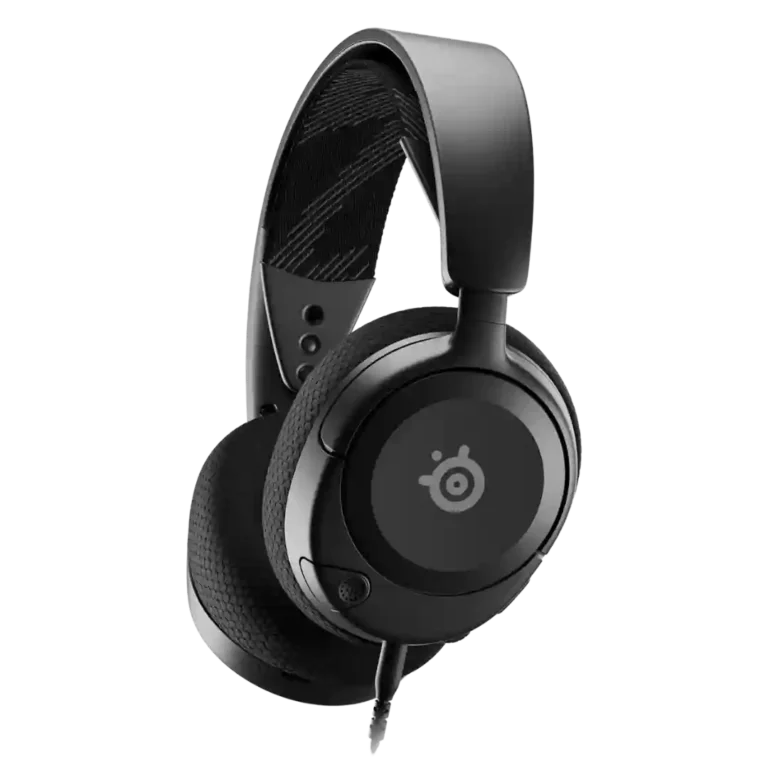
- Better: positional audio and separation The reviewer noticed the Nova 1’s positional limits after switching to the Asus ROG Kithara.
SteelSeries Arctis Nova 1 Review
Bottom Line
Choose the SteelSeries Arctis Nova 1 if you want a light, comfortable, inexpensive wired headset with broad 3.5mm compatibility. Skip it if you need wireless, USB-C, strong isolation, premium positional accuracy, or rich bass.
Best for budget-focused gamers who want a light, low-friction wired headset for PC, PlayStation, Xbox, Switch, Steam Deck, or other devices with a 3.5mm jack. It also fits users who value comfort and simple controls over advanced wireless features.
Not for buyers who need wireless or USB-C connectivity, strong active or passive noise blocking, rich music performance, or the most precise competitive positional cues. It is also less ideal for console users who want full access to Sonar-style tuning.
The SteelSeries Arctis Nova 1 earns its best marks as a simple, comfortable wired headset that keeps the essentials strong for the price. Across reviews, the most consistent positives are its light weight, easy 3.5mm setup, broad platform support, clear-enough sound, and useful retractable microphone. The tradeoff is that its analog simplicity also removes major conveniences: no wireless, no USB-C, no hardware game/chat mix, limited sidetone, and PC-only access to deeper Sonar tuning. Audio quality lands above many budget expectations, but bass, treble, separation, and positional accuracy draw mixed reactions. It is strongest as an affordable plug-and-play gaming headset, not as a premium all-purpose audio or competitive positional tool.
Compared in Reviews
Products reviewers directly compared with this model, grouped into quick takeaways.
- Worse: weight comfort The Nova 1 is contrasted as far lighter than the much heavier Audeze Maxwell 2.
- Better: budget headset value Tom’s Guide says the HyperX Cloud Stinger 2 is better and cheaper than the Nova 1.
Feature Scorecards
Pros
-
Multi-platform support is a clear strength through the 3.5mm connection, spanning PC, PlayStation, Xbox, Switch, Steam Deck, Mac, and mobile devices with jacks.
-
Where discussed, earpad removal is treated as easy and useful for replacement or maintenance.
-
Weight comfort is a consistent advantage, with many reviews highlighting the 236g-class lightweight build.
-
Xbox compatibility is a clear supported use case through the analog 3.5mm connection, with reviewers repeatedly naming Xbox among compatible platforms.
-
Setup is consistently simple because the headset works as plug-and-play analog audio and does not require software for basic use.
-
Replaceable earpads are supported where mentioned, with removable memory foam pads described as a practical durability advantage.
-
Hinge and yoke durability receive positive notes, especially where reviewers mention reinforced or split-fork construction.
-
Stability is good where discussed, with the headset fitting tightly enough not to slip around.
-
Equalizer customization is strong on PC through Sonar, with reviewers praising detailed EQ and game-tuned sound adjustments.
-
Voice capture for calls and chat is generally clear and loud enough, with multiple reviewers reporting intelligible or bright vocal pickup.
-
Reviewers consistently value the rotating earcups, especially the ability to swivel or lay flat around the neck or in a bag.
-
Preset EQ support is a PC-side Sonar strength, with presets for games and genres highlighted by reviewers.
-
Smudge resistance is only mentioned once, but that review says the black model resists fingerprints relatively well.
-
Value is one of the strongest themes, especially for buyers wanting a budget wired headset that covers the fundamentals well.
-
Spatial audio is a meaningful strength when paired with PS5, Windows, Xbox, or Sonar surround features.
-
The detachable 3.5mm cable is usually treated as a practical convenience for travel, replacement, and desktop splitter use.
-
The design is widely described as simple, sleek, muted, and low-key rather than flashy or premium.
-
Build quality is generally considered solid for the price, despite heavy plastic construction, with a few durability reservations around moving or retractable parts.
-
Comfort is one of the most repeated strengths, especially because of low weight and padding, but a minority of reviewers report heat or discomfort over time.
-
Frequency response coverage is considered good for the price, with reviewers citing the 20Hz to 22kHz range and measured response as a positive.
-
Included accessories are basic but useful, typically a 3.5mm cable and splitter or extension, with stickers mentioned in some boxes.
-
Connectivity is broad through 3.5mm analog support, but that versatility depends on devices still having a headphone jack.
-
Packaging is only lightly discussed, but one unboxing review describes protective packaging positively.
-
Controls are simple and usually easy to use, centered on a volume control and mic mute button, though some reviewers dislike the mute feedback or placement.
-
Overall sound quality is generally good for the price, with clear and balanced performance, though not premium or consistently detailed.
-
Earpad comfort is usually praised for AirWeave fabric and memory foam, although a few reviewers say the cups can get warm or feel low quality.
-
The integrated retractable microphone is a major convenience, tucking into the earcup, though one reviewer reports retraction trouble.
-
Midrange is usually serviceable to good, with comments ranging from pleasant mids to flatter or less airy vocal reproduction.
-
Fit is generally secure and adaptable, but large ears, large heads, hair type, and clamp force can affect reliability for some users.
-
Headband adjustability is a recurring strength thanks to the ski-goggle style strap, notches, and height-adjustable earcups, though one reviewer disliked hair pulling.
-
The microphone is usually seen as good for the price, with praise for clarity but some criticism of pickup level or passable quality.
-
Portability is decent because the headset is light and the earcups lay flat, even though it does not fold into a compact shape.
-
The software story is PC-dependent: Sonar can add meaningful EQ and surround tools, but several reviewers note that analog use lacks full app benefits.
-
Microphone noise reduction is mixed: ClearCast and Sonar can help, but some reviewers still report hiss, weak isolation, or background noise.
Cons
-
Treble clarity is inconsistent: some reviewers hear clear or non-abrasive highs, while others cite dips, harshness, or uneven tuning.
-
Positional accuracy is highly mixed: some reviewers pinpoint footsteps well, while others say direction, distance, or competitive cues are weak.
-
Clamp comfort is mixed: several reviewers find the fit secure and tolerable, while others report strong pressure during longer sessions.
-
Volume output is adequate for some but not outstanding, with one reviewer calling the Nova 1 among the quieter competitors.
-
Bass impressions vary sharply: some hear warm, punchy, or precise low end, while others find it restrained, dull, bloated, or overpowering.
-
Soundstage is not wide; reviewers describe it as intimate or not cramped enough to ruin gaming, but clearly limited.
-
Maximum-volume clarity is mixed, with some reports of distortion or struggle at high volumes and one report of bass holding up loudly.
-
Instrument separation and detail layering are only average; several reviewers note limited separation even when overall sound is enjoyable.
-
Android and mobile use depends on having a headphone jack or adapter, so compatibility is useful for some phones but limited for modern jackless devices.
-
Cable feedback is mixed: the included cable can be good enough, but reviewers criticize short length or proprietary-style replacement concerns.
-
Console use is easy through controllers, but reviewers note console users miss PC-only Sonar tuning and may get weaker sound customization.
-
Passive isolation is modest; reviewers repeatedly say outside noise is not blocked strongly.
-
Game/chat balance is limited on the hardware itself, though Sonar can provide ChatMix-style audio features on PC.
-
The microphone is not detachable; reviewers note SteelSeries replaced detachable mic convenience with a retractable design.
-
Sidetone and mic monitoring are weak or absent, with reviewers noting no sidetone, no monitoring, or limited mute feedback.
-
USB-C is not part of the Nova 1 package; reviewers point to USB or USB-C alternatives when discussing what it lacks.
-
Bluetooth is not included; reviewers frame the Nova 1 as a strictly wired analog headset, which avoids wireless hassles but limits wireless convenience.
-
Reviewers consistently describe ANC as absent rather than a strength; the Nova 1 is a passive, analog wired headset without active noise canceling.
-
RGB lighting is absent, which reviewers treat as part of the stripped-down, budget design.
Compared With Category Average
Compared with other Headsets, this product is above average in Xbox compatibility, Smudge resistance, below average in USB-C, Bluetooth, Detachable microphone convenience.
| Attribute | This product | Category average | Difference |
|---|---|---|---|
| USB-C | 1.2 | 4.3 | -3.1 |
| Bluetooth | 1.0 | 3.1 | -2.1 |
| Detachable microphone convenience | 2.0 | 3.9 | -1.9 |
| Sidetone adjustment quality | 1.7 | 3.3 | -1.7 |
| Xbox compatibility | 4.7 | 3.2 | +1.5 |
| Smudge resistance | 4.3 | 3.0 | +1.3 |
| Instrument separation | 3.2 | 4.3 | -1.2 |
| Positional audio accuracy | 3.4 | 4.4 | -1.0 |
FAQ
Is the SteelSeries Arctis Nova 1 comfortable for long gaming sessions?
Most reviewers found it very comfortable because it is light and uses AirWeave-style memory foam padding, but a few reported clamp pressure, heat, or fit issues during longer sessions.
Does the Arctis Nova 1 work on PS5, Xbox, Switch, and PC?
Yes, reviewers repeatedly describe broad compatibility through the 3.5mm connection, including PC, PlayStation, Xbox, Nintendo Switch, Steam Deck, Mac, and some mobile devices.
Is the Arctis Nova 1 wireless or Bluetooth?
No. Reviews describe it as an analog wired headset, so it avoids battery and pairing issues but does not provide Bluetooth or wireless convenience.
How good is the microphone?
The retractable mic is generally praised as clear and usable for gaming chat and calls, especially for the price. Some reviewers still heard background hiss, weak isolation, or too much pickup without software help.
Is the sound quality good for music and games?
Reviewers generally say the sound is good for the price and works well for gaming, but not everyone agrees on bass, treble, separation, or music detail. It is not positioned as a critical-listening headset.
Does Sonar software matter for the Nova 1?
It can matter a lot on PC because reviewers praise Sonar EQ, surround, and microphone tools. Console users do not get the same software benefits, so the headset is more basic there.
Does the Arctis Nova 1 have active noise cancellation?
No. Reviewers describe the headset as lacking active noise canceling, and passive isolation is generally modest rather than strong.
Consider This Instead
If you want better Bluetooth
Choose Razer BlackShark V3 Pro. It scores 4.7 vs 1.0 for Bluetooth, with a 4.0 overall score.
If you want better USB-C
Choose EKSA E1000 Gaming Headset. It scores 4.9 vs 1.2 for USB-C, with a 3.6 overall score.
If you want better Active noise cancellation
Choose Sony INZONE H9 II Wireless Gaming Headset. It scores 4.4 vs 1.0 for Active noise cancellation, with a 3.7 overall score.
If you want better RGB lighting customization
Choose Fractal Design Scape Headset. It scores 4.2 vs 1.0 for RGB lighting customization, with a 3.7 overall score.
Overall Top Headsets Alternatives
Good if you want top-tier wireless sound, ANC, battery swapping, and four-source mixing across a serious multi-platform setup. Skip it if $600 feels steep or you mostly play one console.
Pros: Audio-video sync accuracy, Hinge durability
Cons: aptX, Smudge resistance
Choose the Arctis Nova Pro Wireless for do-everything connectivity and a no-downtime swappable-battery system; Skip it if the premium price and only middling stock boom-mic quality are dealbreakers.
Pros: Replaceable battery, Simultaneous wireless + Bluetooth audio
Cons: aptX, LDAC
Best for clear positional gaming audio, 60+ hour battery life, and a convenient charging dock. Skip it if you need ANC, a removable mic, wired 3.5mm use, or seamless Xbox-and-PS5...
Pros: Earpad replacement ease, Wireless latency
Cons: Active noise cancellation, Carry case quality
Choose the MMX 150 Wireless for all-day comfort and long battery life; Skip if you want bass-heavy tuning without EQ or a more premium, non-plasticky build.
Pros: Battery, Multipoint connectivity reliability
Cons: Active noise cancellation effectiveness, Xbox compatibility