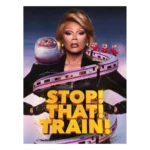
Stop! That! Train! Feature Scores
Explore all 48 feature scores for Stop! That! Train!, organized into pros and cons.
Scores by Feature
Summary
48 reviewed features-
Very positive 4.5-5.08 (17%)
-
Positive 3.5-4.417 (35%)
-
Neutral 2.5-3.410 (21%)
-
Negative 1.5-2.412 (25%)
-
Very negative below 1.51 (2%)
Pros
Sort
-
The movie’s proud queer perspective is a major strength, centering drag performers as heroes and celebrating queer joy without making them the joke.
-
Ginger Minj and Jujubee’s affectionate, synchronized rapport is widely regarded as the movie’s heart and helps the absurdity feel warm.
-
The ensemble’s commitment gives the movie most of its momentum, with performers treating even the silliest material seriously enough to make it work.
-
Colorful uniforms, polished drag looks, and theatrical styling are among the movie’s most consistently praised visual strengths.
-
Ginger Minj and Jujubee carry the picture with comic confidence, sincerity, and enough emotional grounding to hold the sketch-like material together.
-
Latrice Royale, Rachel Bloom, Chris Parnell, Matt Rogers, and several cameo players repeatedly steal scenes, although a few guest bits fall flat.
-
Its best quality is total commitment to heightened camp, though occasional sincere drama and attempted suspense do not always blend smoothly.
-
Adam Shankman generally keeps the sprawling cast and relentless gag flow under control, though the rushed production limits visual invention and polish.
-
The strongest lines use queer wordplay, double meanings, and conversational rhythm rather than relying only on familiar references.
-
Drag Race fans and viewers who enjoy broad camp are the strongest match, though several nonfans still found the humor accessible and fun.
-
As a modern disaster spoof, it captures the throw-everything-at-the-wall spirit of Airplane!-style comedy without matching the classics’ consistency.
-
The joke volume is enormous and the best bits are genuinely hilarious, but the hit rate ranges from strong to painfully low depending on the viewer.
-
The comedy mixes bawdy dialogue with cleaner wordplay, and several critics appreciated that some of its biggest laughs do not depend on explicit language.
-
Beneath the silliness, the film champions friendship, cooperation, resilience, and queer joy during a politically difficult moment.
-
At roughly 90 to 95 minutes, the film feels brisk to enthusiastic viewers but surprisingly long to critics who did not connect with the jokes.
-
The queens are presented with flattering lighting, polished hair, and spectacular makeup that gives the production a more glamorous finish.
-
The finale keeps enough laughs flowing to remain enjoyable for many viewers, but several critics found the third act rote, prolonged, or unable to stick the landing.
-
The friendship between Tess and DeeDee creates unexpected warmth, especially when hurt, loyalty, and reconciliation briefly cut through the chaos.
-
The movie wisely abandons realism and embraces cartoon logic, which suits the camp tone even when it weakens suspense.
-
The disaster-movie musical cues and retro callbacks help establish the spoof tone, with the Poseidon Adventure-style opening music receiving particular praise.
-
The R-rated humor includes innuendo, sexual props, and raunchy jokes, though some viewers found it less explicit than expected.
-
Critical response leaned positive overall, but enthusiasm varies sharply depending on tolerance for camp, Drag Race references, and rapid-fire silliness.
-
The tested friendship adds a few sincere and touching beats, but the drama stays light and secondary to the spoof machinery.
-
DeeDee and Cal’s romance is intentionally goofy and lightweight, with enough sweetness to complement the central friendship.
-
The Glamazonian Express is a fun exaggerated setting, with luxury, coach, disco, and meditation spaces that support the movie’s cartoon logic.
Cons
Sort
-
The storm, greenscreen, and exterior train shots are the most repeated complaint, ranging from knowingly campy to distractingly unfinished.
-
The digital train and landscape shots are the clearest technical weakness, often looking cheap enough to pull attention away from the comedy.
-
Constant jokes and weak effects undercut the danger, making the disaster plot more of a comic framework than a genuinely tense ride.
-
The bright interiors occasionally pop, but flat digital photography, washed-out lighting, and uninspired framing make the movie look less cinematic than its premise deserves.
-
Parents should expect an adult comedy rather than family viewing because of sexual material, language, drug references, and brief nudity.
-
Fans may enjoy repeat communal screenings and quote-alongs, but inconsistent jokes, dated references, and rough effects limit broader replay value.
-
One strongly negative critic felt the disputed, cheap-looking effects made the theatrical ticket feel insulting, while most others focused less on price.
-
The queer drag-centered perspective feels fresh, but the plot structure and many gags borrow heavily from established disaster spoofs.
-
The film is deliberately lightweight and offers little thematic complexity beyond friendship, cooperation, and queer celebration.
-
This is an adult-oriented spoof rather than a children’s comedy, with an R rating, sexual jokes, language, drug material, and brief nudity.
-
The exterior imagery and animated-looking environments were criticized as visually crude and lacking artistic polish.
-
The runaway-train set pieces have goofy movement and spectacle, but the thin storm effects keep the danger from feeling exciting.
-
The train setting adds a playful variation, but the story remains an openly familiar patchwork of Airplane!, disaster-movie, and Mean Girls conventions.
-
A simple runaway-train setup gives the comedy useful structure, though some critics found the multiple subplots unnecessarily convoluted.
-
The costumes, saturated interiors, and retro camp attitude are appealing, but cheap exteriors and flat photography create a visibly uneven presentation.
-
The friendship and runaway-train objective provide a functional spine, but the movie can still feel like loosely connected sketches and cameos.
-
Some cutaways and visual punchlines are sharply timed, while the competing subplots and repeated gags make other stretches feel jumbled.
-
Tess and DeeDee receive a workable friendship arc, but most characters remain broad comic types and the emotional throughline can feel thin.
-
The script delivers clever queer wordplay and a dense supply of gags, but repetition, weak runners, and thin character work keep it uneven.
-
The opening half usually moves at an effective joke-a-minute clip, while repeated bits, side plots, and the final stretch can make the movie feel longer than it is.
-
The musical numbers are lively and fun for some viewers, while others found the disco songs forgettable or visually constrained.
-
For viewers receptive to proudly stupid camp, the film is an energetic good time; others found the same nonstop approach exhausting or disposable.
-
The colorful train interiors and class contrasts are appealing, although the rushed, low-budget production becomes obvious outside the main sets.