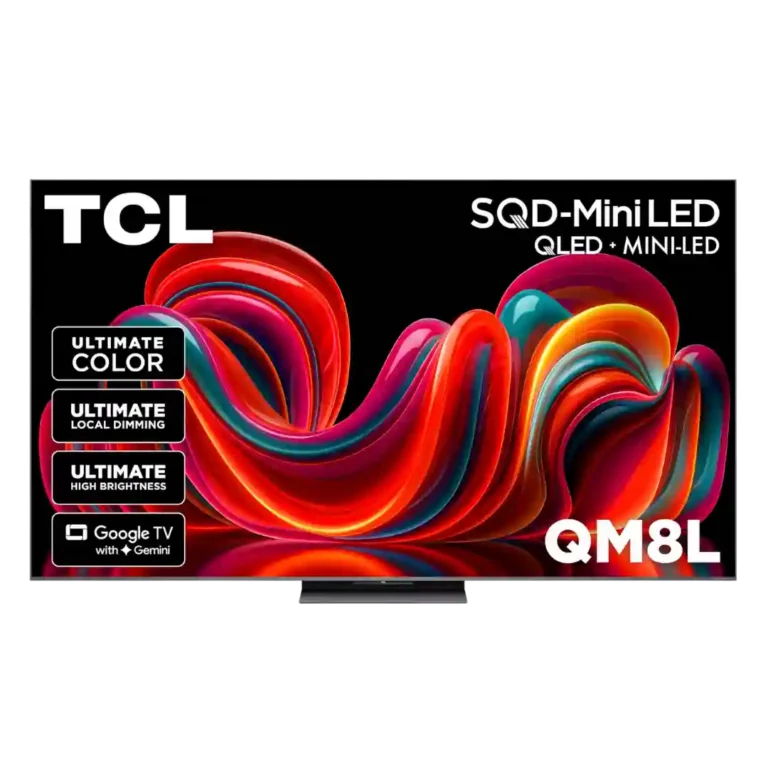
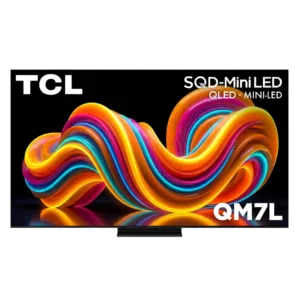
Choose the QM8L for a big, brilliantly bright TV with vivid HDR, deep mini-LED blacks, low input lag, and four HDMI 2.1 ports. Skip it if you need OLED-clean motion, reflection-free viewing, or the best value before discounts.
Best for
Best for large, bright living rooms, HDR fans, sports viewers, and console or PC gamers who want four full-bandwidth HDMI 2.1 inputs and flagship-like impact without flagship pricing.
Not for
Not ideal for competitive gamers sensitive to motion blur, viewers seated far off-axis, rooms with direct window reflections, or buyers prioritizing perfect OLED blacks and reference dark-room accuracy.
Verdict
The TCL QM8L is a premium mini-LED TV whose extreme brightness, rich SQD color, deep blacks, and tightly controlled local dimming make HDR, sports, and daytime viewing look spectacular. Four full-bandwidth HDMI 2.1 ports, very low input lag, 4K/144Hz support, and a useful Game Bar also make it unusually flexible for multi-device gaming. Built-in audio is fuller than average, Google TV runs quickly, and the backlit remote is excellent. The tradeoffs are meaningful: out-of-box color and tone mapping vary by mode, direct reflections remain visible, and motion performance ranges from smooth in ordinary use to noticeably blurry in stricter gaming tests. Launch pricing is also difficult to justify while discounted TCL predecessors remain available. Overall, it delivers near-flagship impact at a lower price, especially for large bright rooms, but OLED remains the safer choice for perfect blacks, cleaner motion, and reference dark-room accuracy.
The QM8L produces a sharp, vibrant, high-impact picture that repeatedly drew flagship and OLED-adjacent comparisons. Fine detail, bright highlights, and deep dark areas give movies, sports, and games strong depth.
HDR is spectacularly punchy, combining intense highlights, deep blacks, rich color, and strong detail. Dolby Vision material is particularly impressive when the appropriate picture mode is selected.
HDR highlights reach extraordinary levels, producing brilliant sparks, sunlight, reflections, and explosions. The panel has enough headroom to make premium HDR content look genuinely dramatic.
Detail enhancement is subtle and effective rather than harsh. The processor adds texture and clarity while generally avoiding an overly processed appearance.
TCL’s SQD Mini-LED system meaningfully improves color richness and overall picture quality, bringing premium panel performance to a less expensive tier.
low-resolution content handling: 5.0, based on 1 review
Even 720p material can look surprisingly good, with useful cleanup and detail enhancement that makes older content more watchable on a large 4K screen.
Google TV is attractive, familiar, and effective at bringing apps and content together. It runs smoothly enough that most owners will not need a separate streamer.
SQD color is a major attraction, delivering exceptionally rich, bright hues without usually looking cartoonish. The expanded color remains vivid even as luminance climbs.
Extreme brightness is the QM8L’s defining strength, with measured peaks among the highest in its class. Highlights pop intensely and the screen remains commanding in bright rooms.
Black levels are unusually deep for an LCD TV, often approaching OLED-like darkness in normal scenes. Dark backgrounds stay convincing while preserving bright highlights.
Older HD and cable sources look cleaner, sharper, and more detailed than expected without excessive artificial sharpening. TCL’s processing now approaches the better upscalers in the category.
Wide-gamut coverage approaches premium RGB LED and OLED competitors, with especially strong P3 performance. Claims of complete BT.2020 coverage were not consistently matched in measurements.
The QM8L offers vivid HDR, low lag, multiple full-bandwidth ports, and high refresh rates for an excellent mainstream gaming experience. Competitive players may be bothered by its slower motion response.
The backlit silver remote is comfortable, substantial, and unusually useful. Dedicated controls make it one of the most consistently praised accessories.
The nearly borderless face and restrained metallic finish create a clean premium look. The thicker rear profile is less elegant than ultra-slim flagships but unobtrusive from the front.
local dimming performance: 4.6, based on 8 reviews
The dense local-dimming system controls bright and dark zones with impressive precision. Its backlight management is among the strongest available outside much costlier flagship models.
Performance often approaches much more expensive flagships, making the QM8L a compelling premium value. Its launch price is still steep, and discounted previous-generation TCL models can be the smarter purchase until prices fall.
The TV can hold very high brightness for real viewing rather than only producing brief test-pattern spikes. Performance may settle below its initial peak, but remains exceptionally strong.
Blooming is usually subtle or nearly invisible in ordinary viewing, including around subtitles and bright objects. Torture tests and a few difficult dark scenes can still expose faint halos.
All four premium inputs can handle 4K/144Hz, making the TV unusually flexible for multiple consoles and PCs. One source wished the ceiling reached 165Hz.
Most long-term and first-impression testing was smooth and bug-free. One extended test found occasional brief wireless-audio dropouts, so accessory stability is not flawless.
Physical assembly is generally simple and the stand goes together easily. Google TV setup was smooth for most, although one tester encountered repeated account and network-transfer failures.
Built-in audio is fuller and more capable than typical flat-panel sound, with clear mids and enough presence for everyday viewing. Movie enthusiasts will still gain scale and impact from an external system.
Low interpolation settings can smooth motion without immediately creating a soap-opera effect. Pushing the controls higher introduces more artificial-looking movement and artifacts.
Virtual spatial processing adds a noticeable sense of height and width. It is effective for casual immersion but does not replace a real surround setup.
Low-power settings can reduce electricity use without making startup noticeably bothersome, and eco controls are available within normal picture modes.
Off-axis performance is better than many VA-panel TVs and remains solid across a typical sofa. Color and contrast still fade at sharper angles, so centered seating remains best.
Rear woofers add useful mid-bass and more weight than most televisions. They cannot reproduce true subwoofer depth, so cinematic low-end still requires an add-on.
Motion is the most divisive area. Many found sports, movies, and casual gaming smooth, while stricter testing exposed blur and weaker performance with fast-moving content.
Dark-scene detail is generally strong, with textures and contours remaining visible near black. A few sources found patchiness, flicker, or lost detail in especially difficult scenes.
The television generally looks and feels premium, though plastic elements—especially the stand on some sizes—keep it from matching the heft of costlier flagships.
Accuracy varies noticeably by mode and unit. Movie or Filmmaker settings can look natural and calibrate beautifully, while Standard and some HDR settings may run overly bright, cool, or saturated.
Voice interaction feels natural and responsive, but answers and streaming destinations are not always reliable. It is useful, though not dependable enough to replace manual search.
Bright output makes the picture easy to see in daylight, yet coating performance varies by comparison. Rooms with windows directly opposite the screen may still need curtains.
Low-frame-rate movies can look choppy until the judder controls are adjusted. Moderate settings help, but aggressive smoothing may introduce skipped frames or unnatural motion.
The glossy screen visibly reflects windows and direct lights. Extreme brightness helps overcome ambient light, but it cannot erase mirror-like reflections in dark scenes.
Atmos compatibility is present, but the lack of built-in up-firing speakers was viewed as a step backward for buyers hoping for convincing overhead effects without accessories.
Google TV can collect substantial account and usage data unless settings are adjusted. Location, advertising identifiers, app permissions, and the microphone deserve a privacy review during setup.
Tone mapping can deviate substantially from reference targets, with midtones and highlights sometimes rendered too bright. Lower peak-brightness settings improve tracking but sacrifice some impact.
Pixel response is relatively slow for a premium gaming display, producing more blur than OLEDs and stronger gaming-focused competitors.
Compared With Category Average
Compared with other TVs, this product is above average in remote layout, daytime viewing performance, sustained brightness, near average in black levels, color accuracy, below average in response time, motion clarity, size options.
Summary
65 compared features
Above average0.4+ pts higher
28(43%)
Same as averagewithin 0.3 pts
24(37%)
Below average0.4+ pts lower
13(20%)
Largest category differences
Attribute
This product
Category average
Difference
response time
1.0
4.3
-3.3
motion clarity
1.0
4.1
-3.1
size options
2.0
4.3
-2.3
remote layout
5.0
2.9
+2.1
judder handling
2.7
4.5
-1.8
daytime viewing performance
5.0
3.5
+1.5
sustained brightness
4.5
3.0
+1.5
sound quality
4.1
3.1
+1.0
Consider This Instead
If you want better motion clarity
Choose LG C6. It scores 5.0 vs 1.0 for motion clarity, with a 4.1 overall score.
Products reviewers directly compared with this model, grouped into quick takeaways.
QM8K
Cheaper: launch valueThe newer set is hard to justify while its predecessor sells for roughly half as much.
Better: current valueThe discounted predecessor remains the easier value recommendation until the new model falls further in price.
X11L
Better: flagship picture performanceIt falls short of the flagship but gets close enough to make the savings compelling.
More expensive: overall flagship performanceIt keeps most of the flagship experience for half the same-size price.
Amazon Fire TV Omni QLED
Alternative: Alexa voice integrationAlexa households may prefer the Fire TV alternative despite its lower brightness and gaming limits.
FAQ
Is the TCL QM8L good for bright rooms?
Yes. Its exceptionally high brightness keeps sports, television, and HDR highlights vivid in daylight, although direct reflections from windows can still be visible.
Does it have OLED-like black levels?
It gets unusually close for a mini-LED TV, with deep blacks and excellent local dimming. OLED remains cleaner in the hardest dark scenes and eliminates blooming entirely.
Is the QM8L a good gaming TV?
For most players, yes: input lag is very low, all four HDMI 2.1 ports support 4K/144Hz, and VRR and FreeSync are included. Competitive players may notice slower pixel response and motion blur.
Will I need a soundbar?
The built-in speakers are fuller than average, with clear dialogue and useful mid-bass. A soundbar or external system is still worthwhile for deeper bass and a more convincing cinematic soundstage.
Which picture mode is best?
Movie and Filmmaker modes generally provide the most natural image, though results vary by unit and format. Standard mode is brighter and punchier but can be less accurate.
Should I wait for a sale?
Waiting is sensible unless you need the TV now. Several sources found the launch price difficult to justify while discounted QM8K and QM9K models remain available.
What sizes are available?
The North American range focuses on large screens: 65, 75, 85, and 98 inches. Buyers needing a smaller television will need to consider another series.
Sample Expert Reviews We Analyzed
These are a few of the reviews included in our analysis.

Best for excellent OLED gaming, deep blacks, and a polished smart platform. Skip it at full launch pricing if the cheaper B5 remains available, or if you need strong bright-room...
Choose the C6 for outstanding OLED picture quality, four-port gaming support, and fast webOS. Skip it at full launch price if a discounted C5 is available, or if bright-room reflections...
Choose the QM7L for bright-room HDR, vivid color, low input lag, and big-screen value. Skip it if you are sensitive to motion smearing, need wide seating angles, or expect OLED-like...