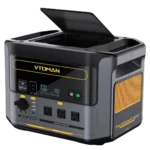
VTOMAN FlashSpeed 1000 Feature Scores
Explore all 71 feature scores for VTOMAN FlashSpeed 1000, organized into pros and cons.
Scores by Feature
Summary
71 reviewed features-
Very positive 4.5-5.043 (61%)
-
Positive 3.5-4.413 (18%)
-
Neutral 2.5-3.47 (10%)
-
Negative 1.5-2.48 (11%)
Pros
Sort
-
Across camping, workshop, van-life, and home-backup use, reviewers are strongly positive about its practical performance and versatility.
-
Wall charging is one of the clearest strengths: most tests reached full in roughly 70–75 minutes, with only one longer result around 95 minutes.
-
The top compartment is a standout convenience, keeping charging leads and small accessories with the station instead of in a separate bag.
-
The 1,548Wh add-on battery lifts total capacity to 2,376Wh and is repeatedly described as a major improvement for long trips and outages.
-
Value is a major strength, especially at frequent sale prices; the feature set, fast charging, and expandability often undercut better-known rivals.
-
Real-world tests with tools, kitchen appliances, office gear, freezers, and electronics were overwhelmingly successful, though overloaded heating devices can run at reduced power.
-
UPS mode worked reliably with computers, storage arrays, refrigerators, and other essentials, with no interruption reported in hands-on tests.
-
The wide rear light is bright and genuinely useful for camping, roadside work, outages, and emergency signaling.
-
The casing, handles, and flat top feel rugged and work-ready; reviewers repeatedly describe the unit as sturdy, robust, and able to take ordinary knocks.
-
Three AC outlets, multiple USB ports, and several 12V connections provide an unusually versatile mix for electronics, tools, and appliances.
-
It is well suited to short outages, keeping routers, computers, lights, refrigerators, and other essentials operating for several hours.
-
The matte black-and-gray shell generally looks modern, tidy, and professional, although the stacked expansion setup can look messy.
-
Connected computers and appliances stayed on when mains power was removed, confirming a fast, dependable switchover.
-
Clean sine-wave power remained stable under load and during UPS testing, a meaningful benefit for sensitive equipment.
-
Front-facing ports, dedicated output buttons, and straightforward status information make everyday operation uncomplicated.
-
Double boxes and thick fitted foam protected the heavy station well during shipping.
-
Runtime is strong for laptops, lighting, routers, and modest camp loads, while heaters and cooking appliances drain the 828Wh battery quickly.
-
The 12-port layout handles many small and medium devices together, although multiple near-1,000W appliances exceed the station’s practical limits.
-
The screen presents battery percentage, active outputs, wattage, and runtime information clearly when lighting conditions are favorable.
-
It can run kettles, heaters, cooking appliances, and even some air conditioners, but the 1,000W continuous limit often means using one demanding load at a time.
-
Optional jump-start cables, expansion batteries, solar panels, and a trolley broaden its usefulness for road trips, workshops, and extended backup.
-
With 200–400W panels and strong sun, recharge times around five to six hours are realistic; a 110W panel is far slower.
-
The pure sine inverter handled difficult appliance tests impressively, sometimes sustaining resistive loads above the nominal 1,000W rating.
-
Chunky handles make transport manageable, but opinions differ because the roughly 32–40-pound body is still heavy and bulky.
-
Large side vents and active fans cool the station effectively under demanding loads, though the fans can become audible.
-
Keeping nearly every input and output on the front makes the station easy to use in vans, workshops, and tight storage spaces.
-
The inverter handled startup spikes and resistive loads well above 1,000W, including kettles, heaters, refrigeration, and cooking equipment.
-
The plastics and structural surfaces feel solid and substantial rather than cheap, with a flat top sturdy enough for tools or occasional seating.
-
Large molded or non-slip handles make the heavy station safer and easier to lift.
-
The station can recharge from AC while continuing to power connected devices, which is useful before trips and during backup use.
-
The protection system is praised for controlling charging, temperature, voltage, and connected loads while guarding against common electrical faults.
-
Long-cycle LiFePO4 cells and active battery management make the station a credible long-term power investment.
-
Technical testing found strong inverter efficiency near full load, while low-power devices consumed very little energy.
-
The 828Wh base battery is enough for camping electronics and short backup jobs, but several reviewers found it modest for the unit’s size and weight.
-
Most units include useful AC, vehicle, and USB cables, but two reviewers received boxes missing the expected car charging lead.
-
The 1,000W continuous output covers most electronics and many appliances, but buyers with sustained loads above that level need a larger model.
-
LiFePO4 cells are a major advantage, combining greater safety with a much longer expected service life than conventional lithium-ion packs.
-
The controls are simple enough that first-time users needed little help from the manual before charging devices.
-
The station can grow into a broader battery-and-solar system, letting owners start with the base unit and add capacity later.
-
A hands-on test reached the full 300W solar limit immediately, confirming the rated input is achievable.
-
Solar input returned to full power quickly after shading, showing responsive tracking as sunlight changed.
-
Stable pure sine AC output is considered safe and appropriate for computers, chargers, and other sensitive electronics.
-
Solar compatibility turns the station into a practical off-grid system for camps, vans, and extended outages.
-
Standby draw is extremely low when outputs are off, so the stored battery should remain ready for long periods.
-
The two 100W USB-C ports are widely appreciated, though some buyers may wish there were more of them.
-
Three grounded AC outlets give the station more plug-in flexibility than many similarly sized models.
-
Around 3,000 full cycles to 80% capacity gives the battery reassuring long-term durability for regular use.
-
The rugged housing appears able to withstand normal transport and minor impacts without concern.
-
The available panels and multi-connector leads work with several battery standards, giving buyers flexibility beyond a single proprietary setup.
-
Each USB-C port can deliver up to 100W, making the station well suited to fast-charging laptops, tablets, and phones.
-
Measured usable energy was respectable rather than exceptional, with one AC test reporting about 76% of the 828Wh rating.
-
Most units show time remaining, which users find very helpful, but one reviewer reported only a battery percentage with no hours-left estimate.
-
When one review unit arrived without the expected car cable, VTOMAN sent a replacement after being contacted.
-
At discounted pricing, the station-and-panel package is considered a compelling portable solar setup.
-
The manual is readable, but one reviewer disliked that it could not fit neatly inside the built-in storage compartment.
-
Performance claims were generally matched in testing, but conflicting documentation about the car charging cable created confusion.
Cons
Sort
-
The lack of an app is a recurring drawback, especially when the display is hard to read or the unit is installed out of reach.
-
Charging flexibility is uneven: the fixed 700W AC rate cannot be reduced, and one technical test advised avoiding a particular 12V barrel input.
-
At roughly 32–40 pounds, the station is consistently viewed as heavy for an 828Wh model, even when the handles make lifting easier.
-
The base station lacks the outdoor weather protection some buyers expect from camping-focused equipment.
-
There is no Wi-Fi connection, so owners cannot monitor or adjust the station remotely.
-
There is no Qi charging pad on top, an omission that stands out against some similarly priced competitors.
-
Solar connectivity can require adapters or awkward placement, and one bundled lead was criticized for being too short.
-
The broad, tall enclosure is larger than expected for an 828Wh station, even though the flat top adds useful workspace.
-
Despite its 828Wh capacity, the body occupies more trunk or storage space than some higher-capacity rivals.
-
Charging from a vehicle works, but it is slow—typically taking most of a long drive or roughly 7–8 hours.
-
Noise varies sharply by workload: ordinary use is often quiet, but fast AC charging and sudden heavy loads can trigger very loud fans.
-
The four USB-A ports are useful, but only one supports faster 18W charging, which feels dated beside the stronger USB-C setup.
-
The two-year warranty offers basic coverage, but one reviewer wanted a longer term.
-
Outdoor visibility is inconsistent: some found the display bright and clear, while several others called it dim, reflective, or nearly unreadable in sunlight.
-
The station and expansion battery stack neatly, though the top compartment’s stiff latch can be frustrating to open.