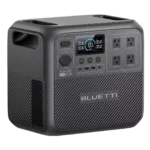
Bluetti Elite 200 V2 Feature Scores
Explore all 111 feature scores for Bluetti Elite 200 V2, organized into pros and cons.
Scores by Feature
Summary
111 reviewed features-
Very positive 4.5-5.067 (60%)
-
Positive 3.5-4.422 (20%)
-
Neutral 2.5-3.47 (6%)
-
Negative 1.5-2.412 (11%)
-
Very negative below 1.53 (3%)
Pros
Sort
-
This is exceptionally compact for a 2kWh, 2.6kW station, fitting easily into vans, vehicles, workshops, and tight home storage spots.
-
Wall charging is a standout strength, with reviewers repeatedly reaching roughly 80% in about an hour and full capacity soon after.
-
The 2,600W inverter confidently runs refrigerators, microwaves, heaters, tools, air fryers, and other demanding appliances.
-
The 2,600W continuous output delivers unusually serious appliance and tool capability from such a compact station.
-
It is highly effective for essential backup, keeping refrigerators, networking, computers, pumps, and selected household circuits running during outages.
-
The roughly 2kWh capacity supports long appliance runtimes, multi-day device charging, and meaningful emergency backup without becoming a huge cabinet.
-
The station is unusually quiet at light and heavy loads, making it suitable for bedrooms, offices, campsites, and recording environments.
-
Satisfaction is overwhelmingly high thanks to strong power, efficiency, compactness, and value, despite a small number of serious failures and feature omissions.
-
The dense chassis, solid controls, and sturdy handles consistently feel premium and ready for regular transport.
-
Multiple outlets and strong inverter headroom let users run several appliances, tools, and electronics at the same time.
-
Real-world runtimes are strong for refrigerators, computers, tools, and camping gear, though heavy heating loads still drain 2kWh quickly.
-
The 6,000-cycle rating is repeatedly highlighted as exceptional and a major reason to view the unit as a long-term purchase.
-
Exceptionally high discharge efficiency is one of the product's defining strengths, delivering more usable energy than many similarly sized rivals.
-
Simple buttons, labeled ports, and an informative display make everyday operation approachable even for nontechnical owners.
-
Months of heavy use are mostly reassuring, but scattered dead-on-arrival and early-failure reports prevent a perfect reliability record.
-
Discounted pricing is widely considered excellent for this level of capacity, output, cycle life, and build, though full-price value is less compelling.
-
Most reviewers expect the battery to last well over a decade, though isolated early failures keep the outlook from being flawless.
-
The inverter is exceptionally efficient, stable, and capable, often matching grid-like behavior under demanding loads.
-
UPS performance is a major strength, keeping home-office, server, gaming, and essential-appliance setups operating through power interruptions.
-
Solar charging can be very fast with adequate panels and sun, though clouds, panel limits, and occasional faults produce wide variation.
-
Up to 1,000W of solar input is strong for this capacity and can restore a full charge in a few good-sun hours.
-
The non-proprietary XT60 input works with a broad range of standard third-party panels, a major practical advantage.
-
The two integrated handles are strong, secure, and well placed for solo or two-person lifting.
-
Cooling stays effective and remarkably quiet, with the case remaining controlled even during sustained high-output testing.
-
The thick shell and rigid construction tolerate travel and routine knocks well, with only scattered concerns about long-term component failures.
-
Wi-Fi and Bluetooth monitoring let owners check battery, load, and shutdown status without standing beside the unit.
-
The universal XT60-based input and support for AC, solar, car, and combined charging give users flexible, non-proprietary options.
-
The information-rich screen is generally excellent, though isolated failures and low outdoor brightness prevent universal praise.
-
The station stays stable through mixed and high loads, with protection operating correctly when testers deliberately exceeded its limits.
-
Front-mounted, clearly spaced outputs remain easy to reach when the station is tucked beside a wall or under a desk.
-
The two 100W USB-C ports are widely praised for charging laptops and other high-demand devices without using the AC inverter.
-
The five-year coverage is reassuring and replacements sometimes go smoothly, but difficult claims weaken confidence for a minority of buyers.
-
As a solar generator it is highly capable and efficient, but poor weather or charging faults can still undermine fully off-grid plans.
-
The BMS inspires confidence through temperature, voltage, and charging protection, with strong cold-weather stability in real use.
-
Combining AC and DC sources cuts downtime dramatically and can bring the battery to 80% in under an hour.
-
Sensitive electronics and heavy appliances received clean, consistent power without flicker, instability, or unexpected resets in testing.
-
The station reliably powers connected devices while recharging, making it practical as a continuously connected backup source.
-
Idle draw is usually exceptionally low, supporting long-running refrigerators and UPS use, though a few tests found unexplained overnight drain.
-
Measured usable energy is close to the rated capacity in strong tests, helping the station deliver predictable runtimes.
-
The supplied heavy-gauge AC cable feels appropriate for rapid charging and avoids the clutter of an external power brick.
-
The LiFePO4 pack earns strong confidence for safety, longevity, and dependable daily use.
-
Thick ABS, solid buttons, reinforced handles, and sturdy ports give the unit a premium, durable feel.
-
Its compact shape and dual handles make vehicle-based transport practical, but the weight rules out long carries and hiking.
-
Most users can plug in and start immediately, although app setup and unusual charging behavior caused occasional frustration.
-
The app is useful for monitoring and settings, but opinions split between intuitive convenience and complaints about dated design, glitches, or missing depth.
-
Live input, output, battery, and runtime data are highly useful, although one faulty unit reported incorrect readings.
-
Most charging tests are exceptionally fast, although a few owners encountered units that charged slowly or not at all.
-
Standard cigarette-lighter charging is painfully slow, while the optional alternator charger makes vehicle charging far more practical.
-
Front-facing ports and clear controls are convenient in tight spaces, though a few button combinations and app-only settings are less intuitive.
-
The station continued powering devices reliably below freezing with little apparent capacity loss, making it unusually capable for winter use.
-
Automatic output recovery and solar wake-up were praised for restoring connected equipment without manual intervention.
-
Reviewers strongly favor the automotive-grade LFP cells for their stability, safety, and long service life.
-
The clean, professional, understated design looks at home in a workshop, vehicle, office, or living space.
-
Reviewers found the rugged casing and reinforced construction reassuring for transport, job sites, and outdoor use.
-
Clean, stable power safely supports computers, servers, cameras, and other sensitive electronics.
-
The pure sine wave inverter behaves like household power and is well suited to delicate electronics and motor-driven appliances.
-
Readouts are clear indoors and often easy to understand at a glance, but direct sunlight can make the screen difficult to see.
-
Many buyers describe responsive replacements and helpful follow-up, but several unresolved failures and slow cases show inconsistent service.
-
The fast switchover kept computers, servers, and other connected gear running through outages in most tests, though one owner experienced a brief reboot.
-
The app and display make it easy to see consumption patterns, live wattage, and longer-term usage information.
-
Remote output control is convenient, but some functions require the app and a few owners wanted more direct or reliable control.
-
Power Lifting and surge behavior handle demanding resistive loads well, although one failed unit could not meet expectations.
-
Most units arrived securely protected, though a few buyers received damaged boxes or scuffed hardware.
-
The mix of AC, USB-C, USB-A, and 12V outputs suits most everyday gear, despite limited high-current DC and RV options.
-
Bluetooth pairing is usually quick and stable, although a few owners reported reconnection quirks or trouble getting the app to discover the unit.
-
Long-term and harsh-weather tests showed steady battery behavior under repeated use and demanding loads.
-
Owners found it genuinely useful for adding emergency range to electric vehicles and supporting charging needs away from the grid.
-
The built-in MPPT controller made good use of available solar input and supported efficient off-grid recharging.
-
The live time-remaining estimate helps users decide which appliances to keep running and when to recharge.
-
The regulated car-style outlet works well for coolers and other basic DC gear, though its 10-amp ceiling limits more demanding van accessories.
-
Deliberate overload tests shut the system down safely and allowed a straightforward reset afterward.
-
Essential AC and solar cables are often included, but bundles vary and several reviewers wanted car cables, bags, or panels in the box.
-
Firmware tools add useful refinements, but update prompts and unclear version behavior occasionally create uncertainty.
-
Four AC sockets satisfy most US users, but UK reviewers found two restrictive and some buyers still wanted more outlets.
-
When paired with a suitable generator, the fast AC input replenishes the station quickly and reduces generator run time.
-
The boxy footprint is easy to stow and uses space efficiently in vehicles, campers, offices, and workshops.
-
Solar and alternator-charging accessories broaden the system's usefulness, although the ecosystem is less polished and some add-ons cost extra.
-
It can support selected household circuits and essential loads, but lacks the output and expansion needed for true whole-home backup.
-
The fire-resistant, shock-resistant shell feels built to protect the dense internal components in mobile use.
-
The supplied manual and labeling were clear enough to get one owner running without confusion.
-
Using solar and stored electricity can reduce generator fuel use and lower the cost of keeping essential devices running off-grid.
-
The broad stated temperature range and successful cold-weather use suit varied climates better than many portable batteries.
-
Silent charging mode meaningfully reduces fan activity when recharge speed is less important.
-
Automotive-grade cells and extensive battery testing provide reassuring safety credentials for indoor and mobile use.
-
The included splitter arrangement supports multiple panel strings and flexible solar-array layouts.
-
A manual transfer-switch test successfully powered selected home circuits, demonstrating practical essential-circuit backup.
-
Output efficiency is excellent, but wall-to-battery input losses vary enough that round-trip results are less uniformly impressive.
-
Standby retention is generally excellent, including in cold vans, but one test found poor behavior after extended storage conditions.
-
Automatic sleep can reduce idle use, but overly aggressive behavior or settings caused frustration for some owners.
Cons
Sort
-
The missing work light is a common frustration, especially because carrying and connecting this heavy unit in darkness requires both hands.
-
Capacity cannot be expanded with external batteries, a recurring drawback for buyers planning larger or longer-running systems.
-
The absence of a true 30-amp output is one of the clearest limitations, especially for RV owners and higher-draw DC setups.
-
There is no waterproof rating, so reviewers consistently advise keeping the station sheltered from rain, snow, and splashes.
-
Several owners reported units that would not turn on or resume charging, making startup failure a serious minority concern.
-
Several owners disliked mandatory account creation, permissions, and cloud-oriented setup for features they expected to control locally.
-
The sparse DC side is a weak point: reviewers wanted higher-current options beyond the single 12V car socket.
-
There are no built-in wheels, leaving owners to use a trolley or second person for longer moves.
-
The dense 53-to-55-pound build is the most repeated drawback; manageable for short lifts, but unpleasant to carry far.
-
There is no dedicated RV receptacle, so RV users need an adapter and must remain within the unit's standard AC limits.
-
A couple of owners reported strong chemical or burning smells, including one case paired with abnormal heat.
-
The missing wireless charging pad disappoints some returning Bluetti users, though others consider it an unnecessary extra.
-
A small number of owners reported abrupt percentage drops or inconsistent state-of-charge readings, undermining trust in the gauge.
-
One dissatisfied owner said real-world performance did not match the advertised claims.
-
Bluetti's branded panel bundles are viewed as expensive, with third-party panels often delivering better value.
-
The unit has no formal dust protection, so dusty campsites and job sites require extra care.
-
Most testing showed controlled temperatures, but rare reports of excessive heat and burning odor raise a meaningful caution.
-
Dual handles help, but the dense 53-pound body remains awkward and sometimes requires a second person or trolley.
-
The USB-A ports cover basic legacy devices, but their modest charging speed feels dated beside the stronger USB-C outputs.
-
Connections range from effortless to frustrating; Bluetooth is generally easier, while account, Wi-Fi, and device-saving issues trouble some users.
-
Replacement support worked well for some failures, but other owners faced slow resolutions or limited repair options.
-
Wi-Fi enables useful remote access, but setup and reliability vary, with some owners finding pairing unintuitive or inconsistent.