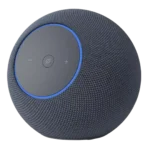
Echo Studio (2nd Gen) Feature Scores
Explore all 59 feature scores for Echo Studio (2nd Gen), organized into pros and cons.
Scores by Feature
Summary
59 reviewed features-
Very positive 4.5-5.013 (22%)
-
Positive 3.5-4.415 (25%)
-
Neutral 2.5-3.419 (32%)
-
Negative 1.5-2.410 (17%)
-
Very negative below 1.52 (3%)
Pros
Sort
-
Setup is one of the strongest consensus positives: many owners are playing music within minutes, and pre-linked Amazon accounts make it nearly plug-and-play. A few multi-speaker or TV configurations need extra manual work.
-
Detail retrieval is a standout audio strength. Across genres, listeners repeatedly pick out clean textures, instrument separation, and small musical details that cheaper Echo speakers tend to blur.
-
The compact spherical redesign is widely admired for looking cleaner, more modern, and easier to place than the old cylinder. A minority dislike the ball shape, larger horizontal footprint, or fabric finish.
-
Dolby Atmos and spatial processing can make music and movies feel much larger than the cabinet, especially with supported content or multiple speakers. The effect is convincing rather than true discrete surround from one unit.
-
The compact cabinet is particularly well suited to bedrooms, offices, apartments, and modest living rooms. In larger spaces a single unit can feel undersized, making a stereo pair more satisfying.
-
Vocals are generally crisp and easy to follow, especially for podcasts, acoustic material, and many pop tracks. A smaller group found voices recessed or less natural than on competing speakers.
-
The angled front buttons are easy to reach and clearer than the old Studio's controls, while top tapping adds quick playback actions. The basic physical layout is simple even for people who mostly use voice.
-
Overall sound is clear, detailed, and expansive enough to make this Amazon's strongest current Echo for many listeners. The main split is with original-Studio owners, who often hear less bass, scale, and authority from the smaller redesign.
-
The built-in hub, Matter, Thread, Zigbee, temperature sensing, presence detection, and routines make this much more than a music speaker. Most smart-home functions work well, though some sensors and integrations still show software gaps.
-
Multi-directional drivers spread sound effectively through open spaces, giving more even coverage away from the speaker's front. Owners replacing conventional bookshelf setups particularly appreciate the broader room coverage.
-
The enclosure generally feels solid, stable, and premium, with fabric and a weighted base that suit a living-room speaker. There are isolated complaints about uneven fabric or cheaper-feeling materials.
-
Response speed is often quick, particularly in expert testing and with the newer processor. Some owners still report multi-second delays, sluggish Alexa+ behavior, or commands that do not execute promptly.
-
Lossless, Dolby Atmos, Sony 360 Reality Audio, and high-resolution streaming support add real flexibility for compatible services. Spatial formats sound especially good when the source material is properly mixed.
-
Wi-Fi streaming is generally stable and straightforward, with several owners reporting uninterrupted playback and easy reconnection. Isolated network-specific dropouts keep it from being universally trouble-free.
-
Packaging is consistently presented as sturdy and premium, with the speaker and power accessories arriving well protected. The unboxing experience matches the product's higher-end positioning.
-
The threaded base is a useful placement option for buyers who want a stand or wall-mount solution. Owners specifically appreciate being able to use standard 1/4-inch mounting hardware.
-
Multi-speaker setups can be smooth once configured, including stereo and Home Theater groups. Reliability is uneven, though, with pairing failures and regrouping problems appearing alongside seamless experiences.
-
At its best, the Studio presents music and TV audio as a full, coherent wall of sound rather than a tiny point source. Bass limitations and some compressed or muddy mixes can weaken that sense of cohesion.
-
Alexa and Alexa+ are central strengths when they work well, with natural follow-up conversations and broad smart-home control. Experiences vary from fast and intuitive to slow, inaccurate, or not fully ready.
-
Physical microphone muting and prominent privacy controls are reassuring touches. The app also exposes voice-recording and microphone settings without burying them.
-
The smaller, lighter body is easier to place than the old Studio and less visually imposing. Its reduced weight is a practical win for a speaker meant to stay on a shelf or stand.
-
An Echo Sub can add the low-end weight the smaller Studio sometimes lacks, and some owners call the combination transformative. Others ran into weak integration, pairing trouble, or questioned the extra cost.
-
The speaker's self-powered design removes the need for a separate amplifier. That makes it easy to use as a standalone room speaker without extra audio hardware.
-
One owner specifically praises how well the speaker rejects background noise while still hearing voice commands. That is encouraging, though direct commentary on this trait is limited.
-
Extended playback produces little heat and avoids battery-management overhead. The plug-in design gives the speaker consistent power during long listening sessions.
-
When used with Fire TV Home Theater, the Fire TV remote can control the grouped speakers as one system. That simplifies everyday volume and playback control.
-
A single unit creates useful width and separation, but it does not replace true left-right stereo. Pairing two speakers produces a noticeably broader and more convincing image.
-
Continuous wall power gives consistent performance for long sessions, but reliability is not flawless. At least one owner reports restart and power-related behavior that interrupts normal use.
Cons
Sort
-
The loss of the 3.5mm and other wired audio inputs is one of the most consistent complaints. Buyers who want legacy or direct-source connections are pushed entirely toward wireless playback.
-
TV connection stability is one of the rougher areas. Some systems work cleanly, but many owners report failed Fire TV links, update loops, disconnects, or compatibility quirks that undermine Home Theater use.
-
Tap controls are notably inconsistent. Several owners report missed play/pause gestures, accidental activations, or music stopping when they touch the controls.
-
Spotify reliability is a clear weak spot in the small set of comments that address it. Owners report playback stopping, disconnecting, or working only intermittently.
-
Full-price value is the product's biggest recurring objection. Sound and smart-home features can justify the cost for committed Alexa users, but many buyers recommend waiting for a sale or keeping an older Studio.
-
There is no battery, so this is strictly a plug-in home speaker. That stationary design is a real limitation for anyone expecting portable Bluetooth use.
-
Removing the optical input is repeatedly treated as a downgrade from the original Studio. It limits direct connections to older TVs and audio gear.
-
Compatibility with older Echo setups is not seamless in every case. Owners report pairing or grouping behavior that makes the new Studio feel less interchangeable with previous generations than expected.
-
Bluetooth pairing can be quick and stable, but reliability is inconsistent across units. Some owners describe repeated disconnects or having to reconnect manually.
-
One owner reports unwanted promotional interruptions after adding the Studio, turning an otherwise simple assistant interaction into an annoyance.
-
Long-term sustainability receives little attention, but one owner specifically dislikes replacing aging Echo hardware and the resulting electronic waste. That concern stands largely alone in this set.
-
The compact hardware runs out of dynamic headroom sooner than the original Studio. DSP and compression keep the speaker controlled, but some material loses punch and requires frequent volume changes.
-
Bluetooth audio works, but support is limited to the basic SBC codec. That is functional for casual playback rather than a premium wireless-audio implementation.
-
Bluetooth is easy and fast on some setups, but it is not consistently dependable. Playback quality and connection behavior are less polished than the speaker's Wi-Fi experience.
-
The braided cable looks and feels premium, but cable design is not universally practical. One owner strongly criticizes the short proprietary lead, while another simply wishes it were longer.
-
The Alexa app can make setup and device management easy, but software polish is uneven. Bugs, awkward device filtering, and early Home Theater issues show that the companion experience still needs refinement.
-
Lip sync over Home Theater can require adjustment, and one test noticed an initial delay. Built-in tuning can correct it, but the experience is not always perfect out of the box.
-
TV dialogue can need a little tuning before it sounds fully clear. One owner found a Fire TV dialogue setting solved an initially muddy presentation.
-
The microphone system is capable of strong far-field pickup, including over loud music, but owner experiences are mixed. Some units hear exceptionally well while others are judged weaker than older Echo devices.
-
Mids and highs are often clean and balanced, yet tuning is inconsistent across genres and placements. Some owners hear a mid-heavy, muddy, or overly bright balance until the EQ is adjusted.
-
It can get genuinely loud and fill a typical room, but maximum output is a recurring step down from the original Studio. Larger spaces often benefit from using a pair.
-
The front light ring gives useful visual feedback for listening, mute, volume, and alerts. Visibility is more mixed from the side or in bright rooms, where some owners miss the older top-mounted ring.
-
The app's EQ can meaningfully improve bass and tame bright or mid-heavy tuning, and some owners found the speaker much better after adjustment. Others feel the simple controls cannot fully correct the sound.
-
At modest levels the Studio can sound balanced and apartment-friendly, but low-volume bass is less convincing on some tracks. One owner also found the lowest usable volume still too loud for bedside listening.
-
Music can sound rich, clear, and immersive across many genres, but performance is strongly content-dependent. Bass-heavy or dense rock mixes expose the smaller hardware more readily than vocals, acoustic music, and well-mixed spatial tracks.
-
The speaker usually stays clean at louder levels, with several tests noting little or no obvious distortion. A few owners heard rattling, roughness, or compression when pushed hard.
-
Stereo and multi-room connections can noticeably improve width and fullness when they stay linked. Group dropouts, low-volume secondary speakers, and re-pairing hassles remain recurring frustrations.
-
Bass is the most divisive part of the sound: it can be deep and punchy for such a small cabinet, yet it is repeatedly lighter than the original Studio. Placement, EQ, genre, and listening distance all change the impression.
-
Far-field pickup often hears commands across a room or over loud music, but accuracy is inconsistent. A meaningful group has to repeat requests or finds the new model less attentive than older Echos.
-
Alexa Home Theater can deliver a surprisingly immersive, room-filling TV experience once it is working. Setup and compatibility are the tradeoff: some users see effortless pairing, while others cannot get supported Fire TV hardware to link reliably.
-
The overall package earns strong praise for compact design, smart-home breadth, and capable sound, but satisfaction is far from unanimous. Original-Studio comparisons, software bugs, and price pull the experience down for a sizable group.