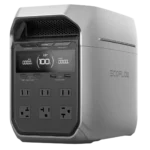
EcoFlow Delta 3 Plus Review Feature Scores
Explore all 126 feature scores for EcoFlow Delta 3 Plus Review, organized into pros and cons.
Scores by Feature
Summary
126 reviewed features-
Very positive 4.5-5.082 (65%)
-
Positive 3.5-4.417 (13%)
-
Neutral 2.5-3.410 (8%)
-
Negative 1.5-2.49 (7%)
-
Very negative below 1.58 (6%)
Pros
Sort
-
The XT60i inputs work with a wide range of EcoFlow and third-party panels, including larger fixed panels, which makes solar setups easier to customize.
-
Wall charging consistently finishes in about 55–75 minutes, and the rate can be reduced when quieter operation or battery care matters more.
-
The station is highly effective for refrigerators, internet gear, lights, TVs, CPAP machines, and office equipment during outages. It is not a substitute for a large split-phase whole-home system.
-
Capacity can grow from 1,024Wh to as much as 5kWh using several EcoFlow battery families, making the station unusually flexible.
-
At roughly 27–31 pounds, the station is easy to move between a home, vehicle, campsite, or work area and is far more portable than larger backup systems.
-
Fast recharge is one of the clearest strengths, with many tests and owners reaching full charge in roughly an hour.
-
The 1,800W inverter is repeatedly praised for running refrigerators, heaters, kitchen appliances, tools, and office equipment without strain. It is best viewed as strong mid-range power rather than whole-home capacity.
-
The broad consensus is highly positive: fast charging, strong output, quiet operation, a capable app, and flexible expansion make it a favorite midsize station. Fan control, idle draw, and a cluster of reliability failures prevent an unqualified recommendation.
-
The narrow, roughly desktop-tower-sized body fits well in vehicles, closets, RVs, and crowded workspaces.
-
Two 500W MPPT inputs provide up to 1,000W of solar charging, unusually high for a compact 1kWh station.
-
The under-10ms transfer works well for computers, networking equipment, refrigerators, printers, and home offices, with connected devices staying online during outages.
-
The enclosure feels robust, premium, and well assembled, with many owners praising the sturdy construction.
-
Most units are exceptionally quiet, even under meaningful loads, making indoor and campsite use comfortable. A recurring minority report rhythmic or loud fan behavior.
-
Runtime is strong for networking gear, refrigerators, CPAP machines, and camping electronics, with many owners reporting hours of useful backup. Heavy loads and high inverter idle draw shorten endurance quickly.
-
Physical operation is simple, while advanced app settings offer depth for owners who want more control.
-
The station can charge while continuing to power connected devices, and both AC and solar pass-through performed reliably in testing.
-
Extra batteries, alternator charging, solar, and Smart Generator support let the system grow from a simple portable station into a larger backup setup.
-
Sale prices around $599–$650 make the station highly competitive for its charging speed, ports, UPS function, and expansion options. Value drops if the buyer will never use the Plus-only features.
-
The large front display is bright, crisp, and information-rich without feeling cluttered.
-
Computers, networking equipment, appliances, and workshop tools continued operating smoothly without dips or interruptions.
-
Dual solar inputs can recharge the station very quickly under a strong array, but a few off-grid users reported slow charging or failure to restart after depletion.
-
The station can run many 1,500–1,800W appliances and some higher-wattage resistive loads through X-Boost. Continuous heavy-duty use is less convincing because of cooling concerns reported by several reviewers.
-
The 4,000-cycle rating is a major strength and supports many years of regular charging before capacity falls to 80%.
-
Long-life LFP cells and adjustable charge limits make the station attractive for daily UPS or solar-buffer use.
-
The sleek silver-and-dark finish, clean display, and compact proportions look modern enough for visible indoor use.
-
The inverter earns strong marks for clean power, solid efficiency, quiet operation, and the ability to sustain its rated load.
-
Users can switch output groups, adjust charging, set battery limits, and manage generator or alternator behavior from the app.
-
Six AC outlets, high-power USB-C, USB-A, 12V, and DC barrel outputs cover a broad range of home, camping, and worksite devices.
-
Six AC outlets are unusually generous for this size and let users connect several household devices at once.
-
AC and solar can be combined, and the two DC inputs allow flexible mixes of solar, vehicle, or battery sources.
-
Measured transfer times near 8–10ms met the specification and prevented visible interruptions on sensitive electronics.
-
Owners value the LFP pack for thermal stability, long cycle life, and greater peace of mind than older lead-acid or NMC alternatives.
-
Plastics, handles, port covers, and controls generally feel substantial and durable rather than cheap.
-
The app is one of the product’s biggest strengths, offering deep controls, schedules, Storm Guard, charge limits, and remote monitoring. Network issues, missing automations, and occasional lag keep the experience from being universally excellent.
-
Battery level, watts in and out, and time remaining are easy to read, although tiny button labels around the display draw criticism.
-
Most users can unpack, connect, and begin using the station or app within minutes.
-
Multiple phones, laptops, monitors, networking devices, and appliances can run together as long as the combined draw stays within the inverter limit.
-
Wi-Fi enables remote monitoring, control, firmware updates, and smart routines from outside Bluetooth range.
-
Historical graphs, electricity-rate settings, and live draw data help owners understand consumption and use stored solar more strategically.
-
Front-facing, rotated AC outlets reduce plug interference and are much easier to use than older rear-outlet EcoFlow designs.
-
Construction is consistently described as sturdy and premium, with several owners specifically praising durability. The reliability failures reported elsewhere appear to involve internal electronics rather than the outer build.
-
The app clearly shows battery level, charging rate, output draw, temperatures, and estimated runtime from anywhere the station has internet access.
-
The station packs substantial output into a small footprint and can tuck behind furniture or into fitted travel bags.
-
Both USB-C ports can deliver close to 140W simultaneously, making them excellent for modern laptops and other high-draw devices.
-
The protected battery pack and sturdy casing add confidence for outdoor use, but the complete station should still be sheltered.
-
Both solar controllers reached their 500W caps in testing and handled varied DC sources well, though the 60V ceiling limits some series-panel arrangements.
-
The five-year warranty is valuable and replacements were often approved, though packaging, shipping, and refurbished-unit offers caused frustration.
-
Recharge efficiency is generally strong, with measured results around the high-80% to low-90% range.
-
Most users consider the weight manageable for short carries, although it becomes tiring over distance and is too heavy for backpacking.
-
Bluetooth provides dependable local control when no Wi-Fi network is available, especially useful at campsites and on the road.
-
The display and app provide clear live readings for total and per-port power flow.
-
Real-world tests with washing machines, pressure washers, refrigerators, air fryers, and other appliances showed confident load handling.
-
Its compact shape stores easily on shelves, behind furniture, or in vehicle cargo areas.
-
Backward battery compatibility and Smart Generator or alternator options are major advantages, though a single shared expansion port prevents some combinations.
-
Many owners barely hear the unit at low loads, but several reviewers found the fans cycling every minute during UPS use.
-
The regulated car socket is welcomed for camping fridges and vehicle accessories, though one test found noticeable voltage sag at the full 10A load.
-
IP65 protection around the battery pack helps in dusty camping and worksite environments, though ports and electronics are not fully sealed.
-
The time estimate is useful for planning, though it can shift substantially when cycling appliances such as refrigerators turn on and off.
-
Smart Generator integration can start and stop charging automatically according to battery thresholds, improving unattended backup operation.
-
Compatible generators can restore the battery in about an hour, giving users a fast fallback when solar or grid power is unavailable.
-
Dual side handles provide a secure, comfortable grip and make the station easier for one person to lift.
-
The continuous 1,800W rating covers most common household and camping loads, and owners generally find it generous for a unit this size.
-
Measured discharge efficiency generally lands in the mid-to-high 80% range, which is good for a 1kWh station. One overheating test produced a merely average result.
-
The optional 800W alternator charger is highly effective and can refill the battery during a drive. The included cigarette-lighter cable is much slower.
-
The inverter shuts down safely beyond its limits and often provides a brief margin to remove an accidental overload.
-
Support experiences range from responsive and generous to slow, repetitive, and burdensome during multiple replacements.
-
Bluetooth and Wi-Fi setup is usually quick, but a few users experienced laggy discovery or trouble changing networks while traveling.
-
The station handles meaningful startup spikes and brief overloads, but one test found the practical ceiling closer to 2,600W than the advertised 3,600W.
-
The 1,024Wh base battery is well matched to camping, networking, and short outages, though some users want more storage for refrigerators or longer off-grid use.
-
The built-in AC charger eliminates a bulky brick, while the compact right-angle expansion cable is a welcome refinement.
-
The included AC and car charging cables cover basic charging, and newer right-angle battery cables improve tight installations.
-
X-Boost can stretch appliance support beyond the normal rating, which helped with high-wattage cooking gear. Its usefulness depends on the appliance tolerating reduced voltage.
-
Testing showed a clean 120V, 60Hz sine wave, making the station suitable for computers, audio gear, and other sensitive electronics.
-
The app can turn the station on or off remotely, useful when it sits in a closet, vehicle, or hard-to-reach installation.
-
Users successfully powered selected home and trailer circuits through transfer or changeover switches, provided the setup stayed within the station’s 120V limits.
-
Capacity testing recovered roughly 87–88% of the rated energy, a strong result for AC and DC use.
-
The battery pack is IP65-rated, not the entire power station, so rain and water exposure remain risky.
-
Most owners report dependable performance, but a notable group experienced dead-on-arrival units, cell imbalance, unexplained drain, or repeated replacements.
-
The management system offers useful charge limits and broad protections, but one owner reported a critical safeguard disabled by default and repeated failures.
-
Updates are delivered conveniently through the app, and some reviewers expect software to fix fan behavior. Long-term users also report recurring errors that reboots did not permanently solve.
-
Most units have a sturdy casing, though isolated customers received cosmetic defects or early hardware failures.
-
Full-load sound ranges from impressively quiet to distracting, depending on fan behavior and the individual unit.
-
The LiFePO4 chemistry is viewed as a safe, durable foundation for frequent cycling and long-term ownership.
-
Because it is battery-powered, the station can run indoors without gasoline fumes or exhaust.
-
Measured output held a clean 60Hz waveform under test, supporting dependable operation for sensitive electronics.
-
Well-positioned dual handles make the station straightforward to lift despite the dense battery weight.
-
With no fuel, oil, spark plug, or exhaust system, routine upkeep is minimal.
-
The station is essentially maintenance-free beyond sensible charging, storage, and firmware care.
-
Using surplus daytime solar and time-of-use schedules can reduce grid purchases and improve payback.
-
The inverter delivered clean, steady output in interference testing, with no pops, clicks, or erratic behavior.
-
The protection system monitors temperature, but several tests still reached troubling internal heat before shutdown.
-
Voltage monitoring is part of the station’s broad safety package.
-
Quiet charging can reduce input power to keep fan noise extremely low.
-
The station combines LFP chemistry with extensive current, voltage, temperature, and circuit protections.
-
Built-in electrical safeguards are designed to stop faults before they cause fire or equipment damage.
-
Its high solar input, LFP battery, pass-through operation, and broad panel compatibility make it a strong compact solar generator.
-
The two USB-A ports deliver more power than typical legacy ports and remain useful for older accessories.
-
The two USB-C ports are powerful, although one reviewer wished EcoFlow had included four instead of retaining two USB-A sockets.
-
Basic guidance is clear for many users, but important timeout and 12V shutdown settings are not emphasized enough.
Cons
Sort
-
Automatic timeouts and failure to wake for solar charging caused serious problems in unattended fridge and off-grid setups.
-
AC inverter idle draw is a recurring weakness and can consume tens of watts continuously, sharply reducing low-load runtime.
-
Multiple tests recorded excessive heat under demanding loads, including temperatures above 125°F, making sustained high-output use the chief concern.
-
The absence of an integrated LED is a frequently noted missed opportunity for outages and camping.
-
Two long-term users reported the battery draining in roughly three to four days without meaningful loads, a serious issue for unattended backup.
-
EcoFlow-branded solar panels are repeatedly criticized as far more expensive than compatible third-party alternatives.
-
Normal inverter output is stable, but X-Boost deliberately lowers voltage to run larger resistive loads. That tradeoff can reduce performance and may be unsuitable for sensitive or motor-driven equipment.
-
Serious failures generally led to replacement or refund rather than a successful repair, which is concerning once warranty coverage ends.
-
Tiny, low-contrast labels and a few oddly placed controls make the physical interface harder to read than the display itself.
-
There is no 30A outlet, so direct RV hookup and higher-current applications require a different EcoFlow model.
-
The station cannot be paired with another unit to create 240V split-phase output, limiting larger backup installations.
-
This is a device-level 120V backup station, not a native whole-home 240V solution.
-
Startup behavior is inconsistent across long-term reports. Some units recover automatically from solar, while others require manual power-on or arrived dead.
-
Warm ambient conditions can slow charging, and one unit overheated under heavy load even in a mild 75°F garage.
-
Cooling is the most divisive area. Some units stay cool and quiet under strain, while others cycle fans incorrectly and reach unsafe internal temperatures.
-
AC charge times are generally accurate, but surge claims and some ideal-condition figures proved optimistic in testing.
-
One long-term off-grid user saw poor behavior in winter, while also noting that similar failures occurred in warmer seasons.
-
A low-average refrigerator load consumed nearly half the battery in just over five hours, largely because of substantial AC inverter idle draw.
-
Near-rated loads generally run for about half an hour, but overheating cut one test short and raises caution for sustained maximum-output use.
-
There is no MagSafe or Qi charging pad, a minor omission for users who want a cable-free phone spot.
-
The station uses common XT60i connections, but a solar charging cable is not always included and may need to be purchased separately.
-
Most routine tests tracked remaining charge plausibly, but two failure cases showed abrupt or inaccurate percentage behavior.
-
Some owners say it holds charge well, while others report severe losses over just a few days, suggesting inconsistent standby behavior.
-
Solar recovery behavior varies sharply: one unit automatically reactivated its outputs at 5%, while another required manual intervention after depletion.
-
The DC section is useful for basic accessories, but the lack of a higher-power 150W output can be limiting for devices such as diesel heaters.
-
The station should remain upright with its vents unobstructed; operating it on its side can restrict airflow.
-
Many users remain happy after months or more than a year, yet several detailed reports describe early failures and recurring error codes. Reliability is therefore less consistent than the strong day-to-day performance suggests.