- Review score
- 4.2
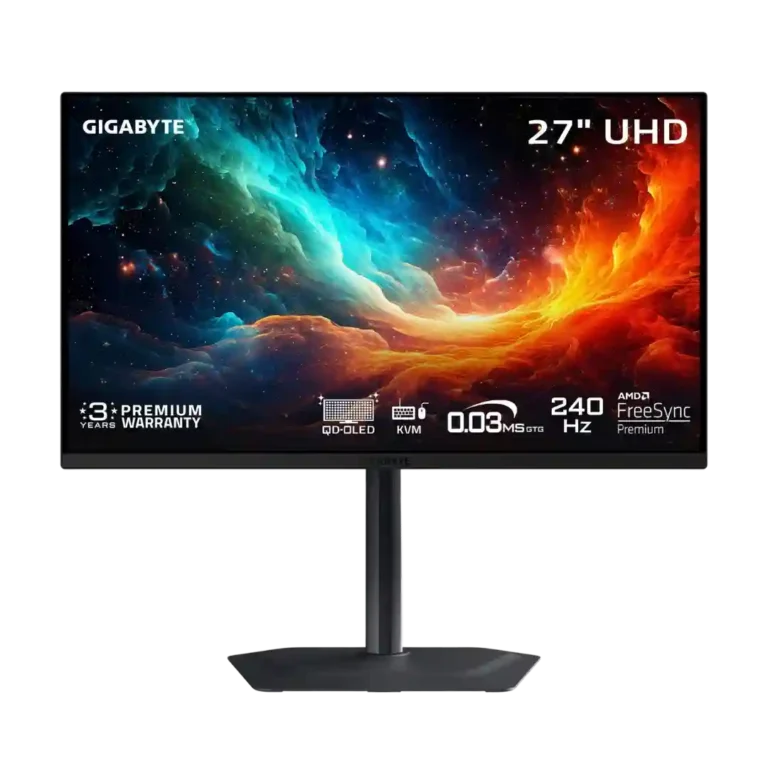
Gigabyte MO27U2 Gaming Monitor Review
Bottom Line
Choose it for razor-sharp 4K 240Hz OLED motion, excellent contrast, and a superb compact stand. Skip it at full price if you need accurate HDR, strong bright-room performance, or polished software.
Best for PC and console gamers who want a compact 27-inch 4K OLED with elite motion clarity, low latency, deep contrast, HDMI 2.1, and a highly adjustable small-footprint stand.
Skip it for bright-room use, critical color work, static desktop-heavy workloads, or full-price shopping when similarly performing rivals cost less.
The MO27U2 pairs a superb 27-inch 4K QD-OLED panel with 240Hz refresh, near-instant response, excellent contrast, and one of the best compact stands in its class. Games look exceptionally sharp and motion stays clean, while HDMI 2.1, USB-C, KVM functionality, and broad ergonomic adjustment add versatility. The weaknesses are unusually consistent: factory color accuracy is only average, HDR modes involve awkward brightness-versus-accuracy tradeoffs, bright rooms lift the black floor, and Gigabyte Control Center is unreliable. The hardware warranty is reassuring, but the $1,000 launch price is difficult to defend when cheaper rivals offer similar panel performance or better calibration. It becomes compelling mainly when discounted.
Feature Scorecards
Summary
50 reviewed features- Very positive 4.5-5.0 42% 21 features
- Positive 3.5-4.4 40% 20 features
- Neutral 2.5-3.4 18% 9 features
- Negative 1.5-2.4 0% 0 features
- Very negative below 1.5 0% 0 features
Pros
-
Because every OLED pixel controls its own light, conventional backlight bleed is effectively absent and dark scenes remain clean.
-
Processing delay is extremely low in both SDR and HDR, making controls feel immediate and competitive play highly responsive.
-
Per-pixel lighting eliminates zone transitions and sharply limits blooming around bright objects. High-contrast scenes look cleaner than on zone-lit LCDs.
-
Viewing angles are essentially perfect, with the image staying strong even from extreme off-axis positions.
-
Fast OLED response produces clean motion without the overshoot artifacts commonly seen on aggressive LCD overdrive modes.
-
OLED response needs only one overdrive behavior across the refresh range, so there is no need to retune it for different frame rates.
-
The tested panel showed excellent uniformity across white and dark-gray screens, with no noticeable dirty-screen effect.
-
Motion is one of the monitor’s strongest traits, combining 240Hz refresh with near-instant OLED response. Black-frame insertion can sharpen 120Hz play further when available.
-
The 4K 240Hz panel, G-Sync support, low latency, and DisplayPort connection make it an excellent PC gaming display.
-
The 4K resolution looks exceptionally crisp at 27 inches, with high pixel density that improves games, text, and multitasking.
-
Pixel response is essentially instantaneous, with no meaningful slowdown at lower refresh rates. Fast motion stays clean and responsive.
-
The glossy 4K panel looks exceptionally sharp, with minimal text fringing and no matte-coating grain. Fine detail and desktop text are both clear.
-
The thin screen, metal stand, and compact base feel sturdy and well made. The stand is repeatedly singled out as a major strength.
-
Extremely low latency, 240Hz refresh, clean motion, and tactical aspect-ratio modes make it excellent for competitive gaming. Only the most demanding esports players may want an even higher refresh rate.
-
Per-pixel OLED control produces excellent contrast and clean separation between bright highlights and dark backgrounds. Ambient light reduces that advantage.
-
The 240Hz refresh rate makes movement exceptionally fluid and easy to track. Its OLED clarity can resemble much faster LCD gaming monitors.
-
The compact stand offers height, tilt, swivel, and pivot adjustment while taking up little desk space. Its flat base also leaves room for accessories.
-
The understated black-and-gray design looks clean, modern, and premium without excessive RGB. Its compact metal base is especially attractive.
-
Two full-bandwidth HDMI 2.1 ports provide strong support for high-refresh 4K sources and current consoles.
-
Tactical Switch can quickly move from 16:9 to 4:3 or 5:4 and a 24-inch view, which is especially useful for competitive shooters.
-
Assembly is straightforward, with the stand clipping into the display and fastening to the base with a single thumbscrew.
-
G-Sync and VRR generally prevent tearing and preserve response consistency across refresh rates. Low, unstable frame rates can still produce OLED flicker.
-
Blacks look nearly perfect in dim rooms. Direct room light can lift them toward gray or magenta.
-
The monitor delivers sharp 4K detail, vibrant color, deep blacks, and outstanding motion. Uneven calibration, bright-room behavior, and HDR processing keep it from being class-leading.
-
The tandem QD-OLED panel delivers elite speed, contrast, color, and clarity in controlled lighting. Burn-in risk and limited bright-scene output remain familiar OLED compromises.
-
The 27-inch format is a strong match for 4K, delivering dense detail without requiring a huge desk. A selectable 24-inch mode adds flexibility for esports.
-
Variable refresh operation is generally smooth and tear-free, with stable OLED response across refresh rates. Flicker can appear when frame rates become low and inconsistent.
-
The three-year warranty includes burn-in coverage, providing useful protection for an OLED monitor. Software support is less reassuring than the hardware warranty.
-
Dual HDMI 2.1 inputs and 120Hz VRR support make the monitor well suited to modern consoles. VRR anti-flicker support may depend on firmware.
-
OLED Care tools, automatic maintenance, and burn-in warranty coverage provide solid safeguards. Static desktop use can still cause permanent wear over time.
-
The QD-OLED panel covers a wide range of DCI-P3 and Adobe RGB colors. Coverage is strong, though one test measured slightly less than expected.
-
The metal stand and refined exterior look and feel premium. Image-processing and software shortcomings keep the total experience from feeling equally polished.
-
DisplayPort 1.4 with DSC handles the monitor’s 4K 240Hz output without a meaningful real-world penalty. The lack of DisplayPort 2.1 is mostly academic.
-
The monitor covers the major gaming and productivity connections, including dual HDMI 2.1, DisplayPort, USB-C, USB hub ports, and audio. DisplayPort 2.1 is the main omission.
-
AI Black Equalizer successfully reveals enemies hidden in dark areas. It is useful for competitive play, though more specialized than essential.
-
USB-C, upstream USB-B, and downstream USB-A ports provide practical hub connectivity. USB-C power delivery is limited to 18W.
-
The joystick-driven OSD is usually fast and intuitive, but certain changes can reset the monitor or force Windows reconfiguration.
-
High pixel density, clear text, low reflections, and a compact stand make everyday work comfortable. Static desktop use and imperfect color accuracy limit professional productivity roles.
-
Deep blacks, vivid color, and precise highlights make darker cinematic games look excellent. Bright daytime HDR scenes lack the punch of stronger televisions and some LCD monitors.
-
The core 4K 240Hz QD-OLED experience is highly enjoyable, but overall enthusiasm varies. Strong picture and gaming performance are offset by software, HDR tuning, and price concerns.
-
The glossy coating preserves clarity and manages mirror-like reflections reasonably well. QD-OLED blacks still lift noticeably when ambient light reaches the screen.
Cons
-
Small HDR highlights can reach roughly 1,000 nits, but sustained bright scenes and full-screen images are much dimmer. The monitor performs best in a controlled room.
-
Anti-flicker controls may help with VRR flicker, but availability appears firmware-dependent. A small minority may still notice eye strain from OLED refresh pulsing.
-
The newer multi-layer OLED design may improve durability, and burn-in warranty coverage helps. Long periods of static content still carry permanent burn-in risk.
-
HDR is impressive in dark, high-contrast scenes but inconsistent overall. Bright-area highlights can clip, full-screen brightness is limited, and the boosted 1,000-nit mode is poorly calibrated.
-
The 5W speakers can get loud and punchy enough for casual videos, but sound quality is divisive and not a substitute for dedicated audio.
-
The monitor offers many gaming and HDR presets, but tuning them can be frustrating. Some settings introduce artifacts, reset the display, or trade accuracy for brightness.
-
Value depends heavily on price. Two sources considered the $1,000 launch price uncompetitive beside cheaper rivals, while one considered it fair for the specifications and warranty.
-
Factory accuracy is a consistent weakness, with red tinting, white-balance errors, and problematic HDR modes. Calibration can help, but it is not ideal for critical color work.
-
Software is a major weakness: Gigabyte Control Center can fail to detect or sync with the monitor, and advertised firmware features were unavailable in testing. One unit’s basic firmware behavior was otherwise stable.
Compared With Category Average
Compared with other Monitors, this product is above average in built-in speakers, eye comfort features, below average in color accuracy, HDR performance, single-player cinematic gaming suitability.
Summary
8 compared features- Above average 0.4+ pts higher 25% 2 features
- Same as average within 0.3 pts 0% 0 features
- Below average 0.4+ pts lower 75% 6 features
| Attribute | This product | Category average | Difference |
|---|---|---|---|
| color accuracy | 2.5 | 4.6 | -2.1 |
| HDR performance | 3.2 | 4.4 | -1.3 |
| single-player cinematic gaming suitability | 3.7 | 4.9 | -1.2 |
| built-in speakers | 3.0 | 1.9 | +1.1 |
| value for money | 2.8 | 3.9 | -1.0 |
| color gamut | 4.2 | 4.8 | -0.7 |
| eye comfort features | 3.3 | 2.7 | +0.6 |
| port selection | 4.0 | 4.6 | -0.6 |
FAQ
Is the Gigabyte MO27U2 good for competitive gaming?
Yes. Its 240Hz refresh rate, near-instant OLED response, very low input lag, G-Sync support, and tactical 24-inch and aspect-ratio modes make it highly competitive.
How good is HDR on the MO27U2?
HDR looks excellent in dark, high-contrast scenes, but bright scenes lack sustained punch. The accurate mode is limited to roughly 450 nits, while the brighter 1,000-nit mode can over-brighten darker content.
Does the MO27U2 work well in a bright room?
It is usable, but not ideal. Ambient light can lift QD-OLED blacks toward gray or magenta, and full-screen brightness is lower than many LCD monitors.
Is it suitable for productivity and text work?
The 4K resolution and high pixel density produce clear text and comfortable multitasking. Long static desktop sessions still carry OLED burn-in risk, and the panel is not the best choice for color-critical work.
Are the built-in speakers good?
They are serviceable for casual videos and can sound loud and punchy, but opinions are mixed and dedicated speakers or headphones will provide better sound.
Is the MO27U2 worth its full price?
At about $1,000, two sources considered it poor value beside cheaper or better-calibrated competitors. It becomes much easier to recommend when discounted near or below those alternatives.
Sample Expert Reviews We Analyzed
These are a few of the reviews included in our analysis.
Video Reviews
Article Reviews
Excellent motion clarity and vibrant color can’t fully offset its awkward image controls
- Review score
- 4.0
Compared in Reviews
Products reviewers directly compared with this model, grouped into quick takeaways.
ASUS XG27 UCDMG
- Better: calibration and feature set The ASUS alternative is considered better calibrated, better equipped, and slightly cheaper.
Dell Alienware AW2725Q
- Cheaper: price and overall value The similarly positioned Alienware model is substantially cheaper, making the Gigabyte harder to justify.
Gigabyte Aorus FO32U2P
- Better: overall performance and current value The older FO32U2P is described as better in important areas and now costs less than at launch.
Consider This Instead
If you want better color accuracy
Choose MSI MPG 322UR QD-OLED X24. It scores 4.6 vs 2.5 for color accuracy, with a 4.4 overall score.
If you want better overall satisfaction
Choose MSI MPG 322URX QD-OLED. It scores 4.9 vs 3.5 for overall satisfaction, with a 4.2 overall score.
If you want better HDR performance
Choose Alienware 27 4K Gaming Monitor AW2725Q. It scores 4.6 vs 3.2 for HDR performance, with a 4.2 overall score.
Top Monitors to Consider
Best for exceptional 4K HDR, accurate color, fast 240Hz gaming, and strong work connectivity. Skip it if you need built-in speakers, ultrawide immersion, television-level HDR brightness, or a budget-friendly upgrade.
Pros: panel type, response time
Cons: built-in speakers, curved screen immersion
Choose the AW2725Q if you want a compact 27-inch 4K QD-OLED with elite sharpness, OLED contrast, and smooth 240Hz gaming. Skip it if you need high SDR brightness, KVM/USB-C display...
Pros: response time, contrast
Cons: built-in speakers, software support
Best for breathtaking 4K OLED contrast, color, and 240Hz speed—especially with a high-end PC. Skip it at full price if bright-room use, effortless reliability, or proven DisplayPort durability matters most.
Pros: response time, motion clarity
Cons: warranty and support service, sleep and wake behavior