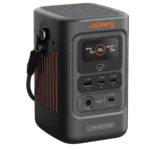
Jackery Explorer 240D Feature Scores
Explore all 96 feature scores for Jackery Explorer 240D, organized into pros and cons.
Scores by Feature
Summary
96 reviewed features-
Very positive 4.5-5.043 (45%)
-
Positive 3.5-4.420 (21%)
-
Neutral 2.5-3.49 (9%)
-
Negative 1.5-2.418 (19%)
-
Very negative below 1.56 (6%)
Pros
Sort
-
Compactness is the clearest consensus strength. The 240D fits backpacks, shelves, vehicle storage, and campsite setups far more easily than inverter-equipped stations.
-
Sub-five-pound direct 240D measurements make weight a standout advantage. It is dramatically easier to carry than most conventional power stations.
-
The detachable 140W USB-C cable doubling as the carry handle is the most consistently praised design feature. It removes one loose cable from the packing list and is hard to forget.
-
The 140W USB-C port is a standout strength, handling demanding laptops and gaming hardware at or near full charging speed. Every direct test of the high-power port was strongly positive.
-
The 240D is exceptionally easy to carry for a 256Wh device. It suits road trips, field work, camping, photography, and remote work without the bulk of a conventional power station.
-
Four ports and a 200W shared budget handle several personal devices at once. Laptops, phones, cameras, tablets, and gaming hardware can share the station effectively.
-
Value is strongest when discounted and used for USB-centric gear. Buyers needing AC output or a full accessory bundle may find a slightly larger station more economical.
-
Direct 240D coverage repeatedly praises the 6,000-cycle rating as exceptional for this size. Older Explorer 240 sources report only about 500 cycles, so model generation matters.
-
The integrated strap-handle supports easy one-handed carrying and feels secure. Its dual role as a cable makes it more useful than a conventional fixed handle.
-
Hands-on tests found stable power delivery across multiple devices and high combined loads. Direct DC output is well suited to sensitive electronics.
-
The station works well with Jackery and many third-party panels when voltage and connectors match. The dedicated solar input is more robust than relying only on USB-C.
-
With a suitable high-power charger or dual input, the 240D recharges very quickly and can reach 80% in about an hour. Slower adapters greatly extend that time.
-
A good 100W panel can refill the 240D in roughly three to four hours under strong sun. Cloud cover and older lower-input models stretch that substantially.
-
Front-facing, clearly separated ports make connections easy to understand and reduce cable clutter. Dedicated output-only and bidirectional USB-C roles are particularly useful.
-
Combining USB-C with the dedicated DC input is a major strength, pushing recharge power close to 200W and reaching about 80% in an hour.
-
The 240D's LiFePO4 cells are widely praised for safety and long service life. This chemistry is one of its strongest upgrades over older Explorer 240 versions.
-
The dedicated solar input accepts about 100W and held that limit reliably in testing. That is well matched to portable panels in this size class.
-
The dedicated solar controller tracks changing panel voltage well and makes effective use of available sunlight. Tests and comparisons consistently favor the proper MPPT input over improvised USB-C solar charging.
-
The 200W total DC output is unusually strong for the size. It supports demanding personal electronics but not AC appliances.
-
The compact upright shape, built-in cable, and low weight make it easy to keep in a car, backpack, shelf, or camping bin.
-
The LiFePO4-equipped 240D is expected to last many years, with claims around a decade. A few sources caution that electronics and the BMS may fail before the cells reach their theoretical lifespan.
-
Three USB-C ports suit modern laptops, tablets, phones, and gaming devices very well. The layout is a major improvement over older Explorer 240 models that lacked USB-C.
-
Pass-through operation works well and can keep devices running while the station recharges. Heavy simultaneous input and output may add heat or reduce available power.
-
The chassis, handle mounts, and braided cable generally feel sturdy and practical. Hands-on tests describe secure connections and typical Jackery solidity.
-
The DC-focused design wastes little energy, and measured USB efficiency is strong. Older Explorer 240 testing also produced unusually high capacity-to-output efficiency.
-
Simple buttons, straightforward ports, and minimal setup make the station approachable for first-time users. The built-in cable further reduces daily friction.
-
Skipping the AC inverter improves efficiency for USB devices by avoiding DC-to-AC-to-DC conversion. This is a central advantage of the 240D's design.
-
The 256Wh capacity is generous for phones, laptops, cameras, drones, and short outings, but modest for multi-day use. It works best as device backup rather than appliance backup.
-
Protection coverage is generally reassuring, including temperature, voltage, and battery-health safeguards. A minority of reports identify the BMS as a possible reliability weak point.
-
The exterior design and hardware are generally well liked, with sturdy cable mounts and a cleaner look than older orange-heavy Jackery styling.
-
The braided handle-cable feels durable, flexible, and capable of high-power charging. Its main compromise is its short length when a device must stay in use.
-
Low-load auto-shutdown and energy-saving behavior help prevent needless drain when connected devices stop drawing meaningful power.
-
The stated operating range is broad enough for many outdoor situations, and several sources praise all-season usefulness. Performance still degrades at temperature extremes.
-
Warranty coverage ranges from two to five years depending on source, seller, and registration. The length is competitive, though support execution is not consistently praised.
-
The DC-only design is usually silent or nearly silent. A few reports mention fan or coil noise, including unexpected fan activity at light loads.
-
The station stayed cool during extended use in the available hands-on test, with only mild warmth under heavier loads.
-
The 240D's direct-DC architecture is a strong match for USB-native gear, delivering efficient power without inverter losses. Its usefulness drops sharply for anything requiring a wall outlet.
-
Older Explorer 240 travel testing found the unit tough enough for repeated motorcycle and camping use.
-
Setup is minimal: unbox the station, attach the cable-handle, and connect a charger or device. The straightforward start-up process suits first-time users.
-
A multi-device test near a substantial load remained effectively silent, reinforcing the advantage of a DC-only station without an AC inverter.
-
A demanding multi-device test found no overheating, supporting confidence in the thermal design under ordinary use.
-
The older Explorer 240 survived accidental drops onto dirt and concrete with only minor scuffs, suggesting a resilient housing.
-
Live input and output wattage is genuinely useful for balancing solar input, device draw, and remaining energy.
-
The compact body and integrated handle make one-handed lifting easy. It is far less cumbersome than conventional power stations.
-
Front-mounted ports remain easy to reach even when the station is tucked beside a bag or other gear.
-
Electrical protection is presented as reassuring for connected devices, especially during ordinary indoor and travel use.
-
Older Explorer 240 coverage praises pure sine wave AC for sensitive electronics; the current 240D instead relies on stable direct-DC output.
-
Older Explorer 240 coverage praises pure sine wave AC for sensitive electronics. The 240D itself removes the inverter and instead supplies stable DC power.
-
The 200W total rating is considered impressive for such a small station. It is ample for several personal electronics, but not high-wattage appliances.
-
Short-circuit protection is part of a reassuring safety suite intended to protect both the battery and connected devices.
-
The older Explorer 240's smaller footprint was already a strength, and the 240D pushes the concept further with an even narrower DC-only body.
-
When paired with a suitable panel, the station can provide a practical continuous off-grid supply for small electronics. The compact solar setup is especially useful for camping and remote work.
-
As a battery station, it produces no exhaust or carbon monoxide and can be used indoors without generator-style ventilation. Normal heat clearance is still sensible.
-
The small display covers the essentials, including charge percentage and live wattage. It is functional rather than feature-rich.
-
The screen is generally easy to read head-on and in daylight, but angle washout, darkness, and cold-weather lag can reduce usability.
-
Existing Jackery owners benefit from compatible cables and charging accessories. New buyers may need to add a high-power wall charger, car cable, or solar adapter.
-
One source reports that firmware updates can improve charging behavior, though other hands-on coverage says the 240D lacks app access for installing them.
-
About 218Wh of usable energy is a realistic expectation after conversion losses, enough for a focused kit of USB devices.
-
One legacy USB-A port is considered sufficient beside the three more useful USB-C ports. The balance favors modern devices without completely abandoning older cables.
-
Cold-weather findings are mixed. Some sources expect dependable winter use, while one hands-on test found the LCD sluggish at 5°F.
-
Summer operation is generally supported, but one test measured slower charging around 95°F. High heat can trigger protective throttling.
-
Brand reputation and LiFePO4 chemistry inspire confidence, but isolated early failures keep the long-term outlook from being unequivocal.
-
Storage results conflict: one test saw only 2% loss over three months, while another report described rapid idle drain. Checking a unit periodically is prudent.
Cons
Sort
-
The defining limitation is the complete absence of an AC outlet on the 240D. Anything with a standard wall plug requires a different power station.
-
This is not an appliance-backup station. Refrigerators, kettles, pumps, CPAP machines with AC plugs, and similar loads are either impossible to connect or run for too little time.
-
At 256Wh, the battery is too large for normal commercial-airline carry-on rules. It is travel-friendly by car or on foot, not by plane.
-
Wall-charging results vary sharply by model and adapter. Direct 240D coverage is fast with high-power or dual input, while older Explorer 240 tests took five to eight hours.
-
The package is sparse: typically the station, integrated USB-C cable, and documentation. The missing wall adapter, car lead, or solar adapter can add meaningful cost.
-
The 240D omits a car-style 12V output, which is a real drawback for portable fridges and other vehicle accessories. USB-only users may not miss it.
-
Storage behavior is inconsistent. One older unit reportedly failed after being left too long, while a direct 240D report describes unusually fast idle drain.
-
The display's biggest information gap is the lack of a dependable time-remaining estimate. Users must infer runtime from wattage and capacity.
-
Vehicle charging works but is usually slower than high-power USB-C or dual input. Results range from acceptable top-ups to six- or eight-hour full charges in older-model coverage.
-
There is no built-in lantern, a notable omission beside competitors such as the Anker C300 DC. Campers may need to carry a separate light.
-
Repair economics look poor when a replacement battery can cost more than the complete unit. Long-term ownership depends heavily on avoiding an early hardware failure.
-
One owner reported replacement batteries costing more than twice the original device price, making repair economically unattractive.
-
Percentage reporting is a concern in a few sources, ranging from coarse increments to sudden 10% jumps. Buyers should not assume laboratory-level precision.
-
Most direct coverage is optimistic, but owner reports include early failures and charging problems. Reliability confidence is therefore weaker than the cell-life claims alone suggest.
-
One source describes shorter-lived lithium-ion behavior associated with older Explorer 240 coverage, contrasting with the LiFePO4 chemistry reported across direct 240D sources.
-
The 240D does not include Bluetooth, so there is no nearby app-based status checking or control.
-
Some users report the fan activating even when the unit is not under load. That behavior is unusual for a small DC-only station and can be distracting.
-
One stress test found thermal shutdown during sustained near-rated output. The unit is better suited to moderate electronics than continuous operation near its ceiling.
-
The BMS does shut the station down when combined demand exceeds safe limits, though one test triggered protection quickly near the rated ceiling.
-
Solar greatly expands usefulness, but buying panels separately can add a substantial unexpected cost. Bundle pricing deserves close comparison before purchase.
-
One report describes roughly 1% charge loss every 1.5 hours while idle, which would be poor for emergency storage. Other storage results are better, so unit-to-unit consistency is uncertain.
-
The available IP20 assessment offers no meaningful rain protection. Outdoor users should keep the station dry.
-
The enclosure is not meaningfully rainproof. Despite outdoor positioning, it should be protected from moisture and wet ground.
-
There is no Wi-Fi connection or remote cloud monitoring. That keeps the unit simple and efficient, but removes smart-home-style visibility.
-
Support experiences are inconsistent. Some owners describe quick, helpful replacements, while others report unanswered requests and prolonged warranty trouble.
-
App opinions are mixed. Some coverage mentions cycle counts and firmware access, while hands-on 240D tests report no app support and question whether a small nearby unit needs it.
-
Instruction quality is uneven. One unboxing praised the concise picture-based guide, while another source criticized grammar and misleading technical details.
-
Storage care matters. Moderate charge levels can minimize degradation, while older-model owner reports warn against leaving the unit unattended for many months.
-
The 240D is useful during short outages for phones, laptops, lights, cameras, and connectivity gear. It is not a substitute for appliance or whole-home backup.
-
The USB-focused port array is excellent for modern electronics, but the lack of AC and 12V outputs makes the overall selection highly use-case dependent.
-
Thermal protection successfully shut the unit down during a prolonged heavy load, though the interruption occurred below the nominal continuous rating.
-
Runtime is strong for phones, laptops, cameras, lights, and Starlink Mini, but short for coolers and CPAP use. Real results depend heavily on device draw and conversion path.
-
The dedicated 8020 input is sturdy, but third-party panels may require adapters. Compatibility is broad once the correct connector and voltage range are matched.