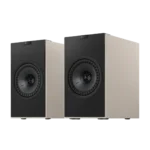
KEF Coda W Feature Scores
Explore all 52 feature scores for KEF Coda W, organized into pros and cons.
Scores by Feature
Summary
52 reviewed features-
Very positive 4.5-5.035 (67%)
-
Positive 3.5-4.411 (21%)
-
Neutral 2.5-3.46 (12%)
Pros
Sort
-
Stereo imaging is one of the Coda W’s standout strengths, with a wide, stable stage, precise placement, and a generous listening area beyond a narrow sweet spot. Reviewers repeatedly described the presentation as spacious, believable, and room-filling.
-
Setup is a major strength, with repeated praise for quick pairing, simple source connection, and the lack of separate amplification. The Coda W delivers a convincing hi-fi experience without the usual stack of components.
-
KEF’s five finish choices receive broad praise for being tasteful, sophisticated, and easy to match with real rooms. Reviewers liked that the palette feels more distinctive than the usual black, white, or wood options without becoming flashy.
-
Across the full set, the Coda W is viewed as a compelling, well-rounded active system that makes serious stereo sound unusually easy to live with. Reviewers especially liked how it balances hi-fi performance, practical inputs, and simple operation.
-
Overall sound quality is the product’s central strength: the Coda W is repeatedly described as natural, spacious, balanced, dynamic, and highly enjoyable. The main sonic caveats are weaker low-volume energy, room-sensitive bass, and a phono input that trails the digital paths.
-
The tonal balance is consistently described as neutral, natural, and well controlled, without obvious frequency bands dominating the mix. Some rooms can excite the bass, but the core midrange and treble balance remains composed.
-
Cabinet build is consistently praised as solid, sturdy, precise, and premium for the price. Reviewers repeatedly noted careful finishing and a reassuringly substantial feel.
-
Value is a recurring strength: many reviewers felt the Coda W delivers unusually mature sound, strong build, and broad connectivity for the money. The main reservation is that buyers paying around $1,000 must be comfortable giving up built-in Wi-Fi streaming.
-
Music playback is lively, engaging, and easy to enjoy across many genres, with strong rhythm, scale, and natural tone. Reviewers repeatedly described the Coda W as a system that encourages long listening sessions and makes familiar music feel fresh.
-
Bass is one of the Coda W’s biggest strengths, reaching surprisingly deep with real punch, scale, and authority for the cabinet size. Room placement matters because the rear port can become boomy, and the deepest electronic or movie bass still benefits from a subwoofer.
-
Detail retrieval is consistently strong, exposing fine textures, instrumental layers, and subtle recording cues without becoming clinical. The Coda W is not as resolving as KEF’s pricier models, but it is notably revealing for its price.
-
The Coda W’s wired connectivity is unusually versatile for an all-in-one pair, covering computers, TVs, disc players, streamers, and turntables. Several reviewers also found wired playback a little better or more capable than basic Bluetooth.
-
Dynamic headroom is a clear strength, with convincing swings from delicate passages to forceful peaks and good scale for the cabinet size. A few comparisons found finer microdynamic agility better on smaller or more expensive KEF models.
-
Voices come through naturally, clearly, and with strong placement in the stereo image. Reviewers especially liked the lack of strain, crisp articulation, and realistic vocal texture.
-
Treble is generally crisp, detailed, and smooth without the harsh metallic edge some listeners fear from an aluminum tweeter. Even reviewers who measured extra upper-treble energy did not find it fatiguing.
-
The overall design is widely praised as clean, modern, and premium without looking trendy or overstyled. Its more traditional rectangular form feels easy to place in living spaces while still carrying distinctive KEF touches.
-
High-volume composure is generally excellent: most reviewers heard little distortion, muddiness, or loss of control as levels rise. One test did report the midrange and highs starting to smear near the top of the volume range.
-
For TV use, dialogue is a strong point: commentators and movie voices remain intelligible without needing a dedicated voice mode. The stereo presentation also gives speech more natural placement than many soundbars.
-
On-device controls are convenient and responsive, especially for power, volume, and source changes without opening the app. The main annoyance is that source selection on the speaker often cycles in only one direction.
-
aptX Adaptive and aptX Lossless are welcomed as strong Bluetooth options, with several reviewers finding wireless quality close to wired convenience for normal listening. Device support remains a practical limitation, and Bluetooth still falls short of true high-resolution network streaming.
-
The Coda W works well in living rooms, offices, and some near-field setups, but its cabinets are larger than typical desktop speakers. Buyers with small desks may prefer a more compact model, while sideboards and stands suit the speakers especially well.
-
A subwoofer is optional rather than mandatory for most music, but adding one can extend the deepest bass and improve cinematic scale. Integration is useful, though one reviewer found the Coda W’s bass-management controls limited.
-
Because amplification is built in and matched to the drivers, the Coda W removes the need to choose a separate amp. Reviewers liked the simplicity while still getting strong headroom and dynamics.
-
The presentation is repeatedly described as coherent and natural, with the Uni-Q driver and DSP helping the sound hang together as a unified whole rather than feeling processed.
-
The Coda W has enough output to fill normal living rooms and offices, with reviewers praising its scale for the cabinet size. It can play loudly, though the very highest levels expose more limits than KEF’s pricier models.
-
As a TV system, the Coda W offers a convincing two-channel alternative to a soundbar, with better stereo separation and natural vocal placement. It does not replace Atmos or a true multichannel setup for buyers prioritizing cinematic surround effects.
-
The included inter-speaker cable and remote cover the essentials, and the cable is long enough for many normal layouts. Very wide setups may need KEF’s optional longer cable.
-
The built-in moving-magnet phono stage is convenient and good enough for casual or entry-level vinyl setups, but several reviewers found it less dynamic and less clear than the other inputs. A few more promotional tests were more enthusiastic, so vinyl performance is the clearest area of disagreement.
-
Packaging received direct praise for feeling premium and for protecting the speakers with generous spacing and sturdy materials.
-
Optical playback is a strong wired option, preserving detail and clarity and opening up the sound with high-resolution sources. It also makes adding a small external streamer straightforward.
-
The lack of cloud-dependent control is viewed positively by reviewers concerned about long-term software dependence. Bluetooth app control and a physical remote let the system remain useful without a cloud account.
-
The stage has convincing vertical scale as well as width, with reviewers noting strong height, layering, and realism in the image.
-
The powered USB-C output is a handy way to run a small external streamer directly from the speaker. Reviewers liked that this can add network streaming without requiring another power adapter.
-
Most reviewers considered the asking price reasonable or attractive for the performance and integrated hardware. One reviewer felt $1,000 was about the maximum they would pay and would have preferred a $600–$700 price.
-
Turntable noise control is effective when grounding is set up correctly. Reviewers noted that the grounding post or ground-lift feature can substantially reduce hum.
-
HDMI ARC makes the speakers easy to use with a TV and is repeatedly framed as a practical strength. Reviewers liked the simple direct connection and the ability to build a compact TV-audio system around it.
-
Bluetooth itself is straightforward and sounds very good for casual wireless listening, especially with the stronger aptX codecs. The tradeoff is that it is the only built-in wireless music path.
-
The wired inter-speaker link is stable and avoids dropouts or latency, but the cable itself is a tradeoff for buyers wanting a fully wireless pair. A longer optional cable helps with wider room layouts.
-
The KEF Connect app is generally easy to use and can make input switching convenient, but it is intentionally basic. One test found a repeatable subwoofer-setting bug, while others called the app clean and reliable.
-
The broad mix of analog and digital inputs makes the Coda W unusually friendly to both older audio gear and current devices, which one reviewer highlighted as a key no-fuss advantage.
-
Bluetooth pairing proved simple and seamless in the hands-on test that directly assessed connection behavior.
-
The capacitive top controls respond quickly and feel polished in use. One reviewer specifically called their responsiveness impressive.
-
Format support is strong for a Bluetooth-led system, with CD-quality aptX Lossless and high-resolution wired playback. The wireless path still does not match the highest-resolution network-streaming formats.
-
Standby behavior is flexible: the speakers can be awakened over Bluetooth, so users do not have to walk over to the primary speaker after it sleeps.
-
ECO mode lowers standby consumption while still allowing Bluetooth wake, so the energy-saving setting does not remove everyday convenience.
-
The pair feels substantial rather than lightweight, but one hands-on reviewer found the weight manageable enough to move without much trouble.
Cons
Sort
-
The biggest feature compromise is the absence of built-in Wi-Fi, Spotify Connect, multi-room streaming, and other network smarts. Reviewers often accepted that trade for stronger sound at the price, especially because an inexpensive external streamer can restore those functions.
-
The single powered primary speaker simplifies mains wiring, but a heavily connected setup can leave its rear panel crowded. Reviewers recommended planning cable routing carefully if several sources are attached.
-
Status feedback is one of the weaker usability details. Some testers disliked the audible source-change tone, and another noted the lack of a visible volume indicator can lead to unexpectedly loud playback.
-
Low-volume listening is a recurring weakness in the more critical tests: resolution, energy, and engagement can fall away when the system is turned down. One source claimed smooth behavior across listening levels, but the stronger hands-on consensus is that the Coda W prefers moderate volume.
-
The included remote is functional but not a highlight: it can feel basic, inexpensive, or slower than the app for jumping between sources. It remains useful for buyers who want to avoid app dependence.
-
The app’s EQ can make useful bass and treble adjustments and help with placement, but it is basic compared with KEF’s more advanced systems. Reviewers repeatedly wished for deeper room correction or a personalized equalizer.