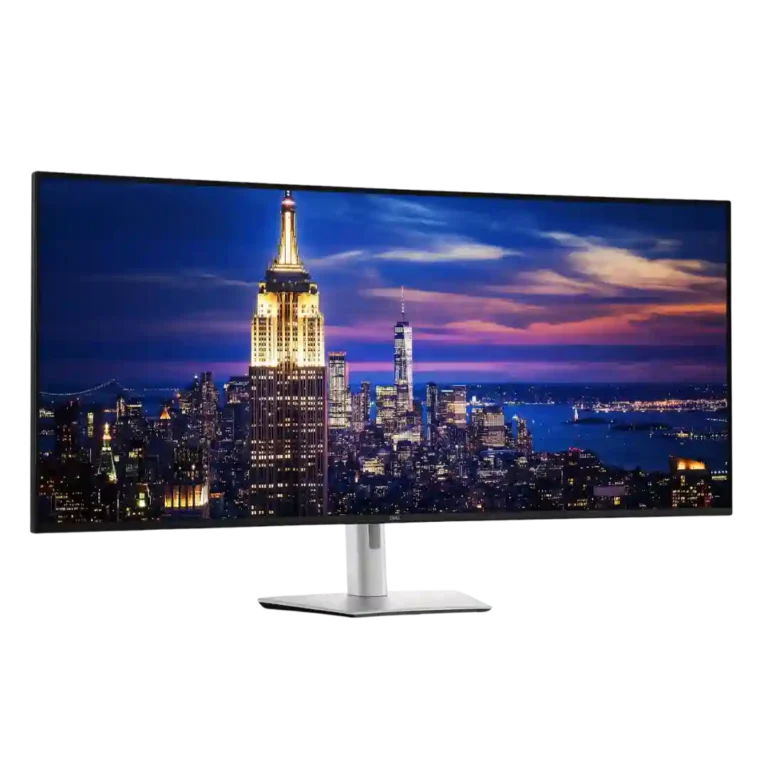
Choose it for a seamless 6K command center that replaces several displays and docks a laptop through one cable. Skip it if you lack desk space or prioritize price, HDR, fast response, or console gaming.
Best for
Traders, analysts, developers, editors, researchers, and multi-device professionals who can use one continuous 6K canvas and a full Thunderbolt dock. It is especially compelling when replacing several displays, a KVM, and a docking station.
Not for
Small desks, limited budgets, colorists who require HDR, console-first setups, or competitive gamers seeking OLED response and very high refresh rates. It is also a poor fit for users who prefer independently angled monitors.
Verdict
The U5226KW succeeds because its scale is functional rather than merely spectacular. Its sharp 6K canvas, smooth 120Hz motion, accurate wide-gamut color, strong IPS Black contrast, extensive ports, flexible partitions, and integrated hub can replace several monitors and a separate dock. That combination is transformative for traders, developers, editors, analysts, and other multi-system professionals. The tradeoff is specialization: it needs a large, deep desk, costs nearly $3,000, omits HDR, and trails gaming displays in response time, ghosting, console behavior, and dark-room contrast. KVM performance is also implementation-dependent, with network switching stronger than some USB auto-switching tests. For the right workflow it is a premium productivity centerpiece; for ordinary computing or gaming, it is expensive overkill.
Sleep mode drops power use to only a few watts, while Power Sync can start a closed-lid compatible laptop from the monitor's power button. Both behaviors were viewed as convenient and efficient.
Because it uses IPS Black rather than OLED, static professional interfaces do not carry the same burn-in risk. That makes it especially attractive for dashboards, spreadsheets, and other all-day fixed content.
The oversized packaging is extremely protective, with structured compartments and ample cushioning intended to prevent shipping damage. The box itself is enormous, but the protection was praised.
Dual DisplayPort 1.4 inputs are especially useful for desktops, Linux systems, and full-resolution 6K operation. DisplayPort proved reliable across a wide range of graphics hardware.
Measured input latency was exceptionally low at roughly a few milliseconds, making interactions feel immediate despite the monitor's productivity focus.
Connectivity is exceptionally comprehensive, with Thunderbolt 4, dual HDMI, dual DisplayPort, numerous USB-A and USB-C ports, Ethernet, and easy-access front connections. It functions as a true connectivity powerhouse.
The built-in Thunderbolt and USB hub is one of the monitor's greatest strengths, often replacing a separate dock. High-speed rear ports, front pop-out connections, charging, Ethernet, and laptop power make one-cable desks practical.
warranty and support service: 4.9, based on 4 reviews
Dell's three-year premium-panel and advanced-exchange coverage reassures buyers spending nearly $3,000. Rapid replacement promises and stronger support expectations than some competitors add meaningful peace of mind.
productivity versatility: 4.8, based on 29 reviews
Productivity is the overwhelming consensus strength: one seamless 6K canvas can replace multiple displays, reduce window switching, and keep dense workflows visible at once. It is especially effective for trading, coding, research, editing, analytics, and multi-system work.
Its sheer scale, refined construction, sharp 6K canvas, and integrated workstation features make it feel like a flagship command center. The experience is luxurious, spectacular, and distinctly unlike an ordinary monitor.
The 6144×2560 canvas fits enormous amounts of work while keeping text usable. At 129 PPI, it is less dense than smaller 4K or 5K displays and can look softer at close range.
The display covers essentially all sRGB and nearly all DCI-P3, producing vivid color suitable for editing, design, and mixed professional use. Adobe RGB coverage is broad but not class-leading for specialized print workflows.
Hardware low-blue-light filtering, flicker-free operation, and ambient sensing make long work sessions unusually comfortable without the yellow cast of software filters. Extended use caused little or no added eye strain.
The chassis feels rigid, substantial, and built like a professional tool rather than a flimsy oversized display. Long-term Dell users expect it to hold up well, though handling such a large panel always requires care.
Daily operation over weeks or months remained stable without notable bugs. The solid construction and Dell's professional-monitor track record also inspire confidence.
picture-in-picture and picture-by-picture: 4.7, based on 26 reviews
Picture-in-picture, picture-by-picture, and true screen partitioning are defining strengths, letting the panel behave like several displays or accept multiple systems at once. The many layouts are flexible, though certain Mac and console combinations have limitations.
Text, UI elements, photos, and timelines look crisp at normal working distance, including at 100% scaling. Users coming from Retina-class or smaller 5K screens can still see the lower pixel density.
The SDR picture is widely praised as sharp, colorful, accurate, and unusually strong for professional work. Weak HDR capability, IPS glow, sample uniformity variation, and lower perceived contrast than glossy or OLED screens are the main caveats.
The restrained silver-and-black design, slim bezels, and clean rear styling receive near-universal praise. It looks professional and premium without the aggressive styling common to gaming displays.
Multiple VESA patterns make heavy-duty arm or wall mounting feasible, and robust monitor arms can support it successfully. Buyers still need hardware rated for the panel's unusual size and weight.
Overall satisfaction is very high for productivity-focused users, and the screen often becomes a preferred daily work monitor. It fares worse when desk space, scaling preferences, workflow, or budget do not suit such an extreme single display.
Color accuracy is a major strength, with professional modes and factory calibration earning frequent praise. Default or wide-gamut settings may need adjustment for strict sRGB work, but calibrated modes perform very well.
The 120Hz refresh rate is one of the most celebrated upgrades over typical 60Hz office monitors, making scrolling, cursor movement, and window handling feel noticeably smoother. It also supports enjoyable casual gaming, though gaming specialists may want 240Hz.
IPS Black is widely viewed as the right panel technology for long professional sessions, combining dependable color and brightness with better contrast than ordinary IPS. It does not match OLED for deep blacks or instantaneous motion.
Desktop motion looks fluid and comfortable at 120Hz, even when several inputs run at different refresh rates. The panel handles scrolling and everyday animation far better than conventional office displays.
on-screen display usability: 4.5, based on 10 reviews
Dell's joystick-driven OSD is fast, intuitive, and packed with useful controls, shortcuts, diagnostics, and partition options. Minor complaints include physical reach around the giant panel, loud clicks, and a fixed menu position.
The two HDMI 2.1 inputs add modern multi-device flexibility and worked well in tested PC setups. They are less dependable for consoles because of the screen's uncommon resolutions and proportions.
The integrated KVM is a major advantage for multi-computer desks, especially when paired with picture-by-picture and Ethernet switching. Hardware and network switching can be excellent, but one detailed test found USB auto-KVM slow and buggy while network KVM worked flawlessly.
One-cable operation and stand routing can make a complex workstation much cleaner than a multi-monitor setup. The huge number of possible connections can still create visible clutter, and the stand does not fully conceal wiring.
Blacks look deeper and less gray than on standard IPS panels, helping dark interfaces and high-contrast work. They still lack the near-perfect depth of OLED, and matte coating can reduce perceived punch.
Dell Display and Peripheral Manager adds useful window layouts, firmware updates, profiles, KVM controls, and screen management. Mac support, daisy-chain expectations, and some KVM functions are less consistent than the strong Windows experience.
The matte anti-glare surface usually keeps overhead lights and windows under control without heavily softening the image. A lighter coating and shallow curve can still leave distracting reflections at certain angles.
ultrawide gaming experience: 4.3, based on 4 reviews
Supported ultrawide games feel expansive and can eliminate side bars, making strategy, racing, and cinematic play impressive. Not every title handles the aspect ratio properly, and the shallow curve is less enveloping than gaming-first ultrawides.
VRR helps maintain smoother motion when frame rates vary and is a welcome addition to the 120Hz panel. Certification and behavior may still depend on the connected system.
Viewing angles are generally strong, with limited color or contrast loss from the side. The mild curve can leave the far edges less comfortable, but off-axis image quality usually holds up well.
IPS Black delivers strong contrast for an IPS display, giving darker interfaces and mixed content more depth. Dark-room use still reveals IPS glow, and OLED or mini-LED alternatives remain more dramatic.
Height, tilt, swivel, and slight slant adjustments are generally smooth and useful for positioning the enormous panel. The range is limited by size, there is no pivot, and one tested stand would not keep the screen perfectly level.
The 52-inch panel can replace several monitors and feels transformative once users adapt. Its four-foot width, weight, and viewing-distance demands make a large, deep desk essential.
The tall ultrawide shape preserves more vertical room than super-ultrawides, which editors and multitaskers value. Some users still prefer standard 16:9 or wider 32:9 layouts, and the extreme width can feel awkward in certain apps.
single-player cinematic gaming suitability: 3.8, based on 3 reviews
Large-scale strategy, simulation, and cinematic games can be deeply enjoyable on the 52-inch canvas. Dark-room contrast and slower motion keep it behind OLED alternatives for movie-like gaming.
The gentle curve usually keeps the giant screen comfortable without visibly warping office content. Its subtlety suits office work, though a deeper curve would pull in the edges, reduce reflections, and improve immersion.
Connections and software setup are usually quick, but physically unboxing and positioning the 52-inch panel is inconsistent: some managed alone, while others struggled or strongly recommend two people. Arm mounting requires particular care and suitably heavy-duty hardware.
PC gaming can look spectacular at this scale, and 120Hz keeps casual play smooth. The 6K load, slower response, absent gaming extras, and platform-specific quirks make it secondary to productivity rather than a true gaming-monitor replacement.
Brightness is comfortable for most offices and home studios, generally landing in the mid-300-nit range. It can struggle in very bright rooms, and the automatic adjustment may feel too aggressive.
The dual 9W speakers are louder and fuller than many monitor speakers and work well for meetings or temporary setups. Opinions split sharply for entertainment, with some users satisfied and others recommending even basic external speakers.
Uniformity varies by sample and measurement method. Several units were reasonably consistent for such a huge panel, while one showed a pronounced brightness difference and others had weaker corners.
The roughly $2,900 price is the most repeated objection and is difficult to justify for ordinary users or gaming alone. Professionals who can replace several displays, a dock, and a high-end KVM may find the integrated package reasonable.
One test system detected variable-refresh behavior even without clear official adaptive-sync certification. Compatibility appears workable but not guaranteed across every GPU or platform.
The 5–8ms response time is adequate for work and casual games but visibly slower than OLED and fast gaming panels. Switching from a 0.03ms display makes the extra blur immediately noticeable.
console gaming compatibility: 2.3, based on 3 reviews
Console support is compromised by unusual aspect ratios and inconsistent resolution or refresh options. Some consoles may stretch the image or fail to recognize available 4K modes correctly.
The monitor does not support HDR, a consistent drawback at this price. Its strong, accurate SDR image is still preferable to the weak pseudo-HDR often found on edge-lit IPS monitors.
competitive gaming suitability: 2.1, based on 4 reviews
Competitive gamers should look elsewhere because response time, ghosting, 120Hz ceiling, and missing gaming features trail dedicated OLED and high-refresh models. The monitor is designed for work first and occasional play second.
Ghosting is a clear weakness, with motion tests showing substantially more smearing than Samsung mini-LED and LG OLED gaming displays. Fast mode does little to solve it.
The fast overdrive setting is not recommended: it harms picture clarity without delivering a worthwhile gaming improvement. Normal mode is the safer choice.
Compared With Category Average
Compared with other Monitors, this product is above average in sleep and wake behavior, eye comfort features, warranty and support service, near average in Resolution, overall satisfaction, below average in overdrive tuning, ghosting control, console gaming compatibility.
Products reviewers directly compared with this model, grouped into quick takeaways.
BenQ MA320U
Compared: physical sizeThe 52-inch Dell makes the reviewer’s already-large BenQ monitor look small by comparison.
HP E45c
Cheaper: price and practicalityThe HP is presented as a smaller and much cheaper productivity alternative for buyers who do not need the Dell’s maximum canvas.
LG 45 in Ultra Gear
Better: ghosting and motion clarityThe Dell’s ghosting is dramatically worse than the LG OLED’s much clearer motion.
FAQ
Can it replace multiple monitors?
Yes. Its 52-inch 6K canvas, screen partitions, picture-by-picture modes, and five video inputs can replace several displays without bezels, though you lose the ability to angle each screen independently.
Is it good for gaming?
It is enjoyable for casual PC gaming at 120Hz and can feel spectacular in supported ultrawide titles. Slower response, visible ghosting, no HDR, console quirks, and a 120Hz ceiling make it unsuitable as a competitive gaming-first monitor.
How much desk space does it need?
A lot: the panel is roughly four feet wide and benefits from a deep desk so the edges remain comfortable to view. Several reviewers had to change desks or use a heavy-duty arm.
Does it work well with Macs?
Many Macs reached full 6144×2560 resolution and 120Hz through Thunderbolt, but support depends on the chip and connection. Some multi-display, partition, software, and daisy-chain workflows were limited or inconsistent on macOS.
How useful are the hub and KVM?
The hub is exceptional, combining laptop charging, Ethernet, many USB ports, and front-access connections. KVM control is powerful, but one detailed test found USB auto-switching slow and buggy while network KVM switching was excellent.
Is it worth about $2,900?
It can be worth it for professionals who will replace multiple monitors, a dock, and a premium KVM while gaining a seamless workspace. For ordinary productivity or entertainment, less expensive dual-monitor and ultrawide setups deliver better value.
Sample Expert Reviews We Analyzed
These are a few of the reviews included in our analysis.

Best for exceptional 4K HDR, accurate color, fast 240Hz gaming, and strong work connectivity. Skip it if you need built-in speakers, ultrawide immersion, television-level HDR brightness, or a budget-friendly upgrade.
Best for class-leading 360Hz ultrawide motion, spectacular HDR, deep blacks, and unusually strong work-and-play connectivity. Skip it if you want 4K-like text sharpness, a matte screen, or the best value...
Choose the RD280UG for coding, trading, writing, or creative work that benefits from a tall, sharp 3:2 screen and strong eye-care features. Skip it for serious HDR, color-critical creation, esports,...
Pros: VESA mount compatibility, productivity versatility
Choose the AW2725Q if you want a compact 27-inch 4K QD-OLED with elite sharpness, OLED contrast, and smooth 240Hz gaming. Skip it if you need high SDR brightness, KVM/USB-C display...