- Review score
- 4.8
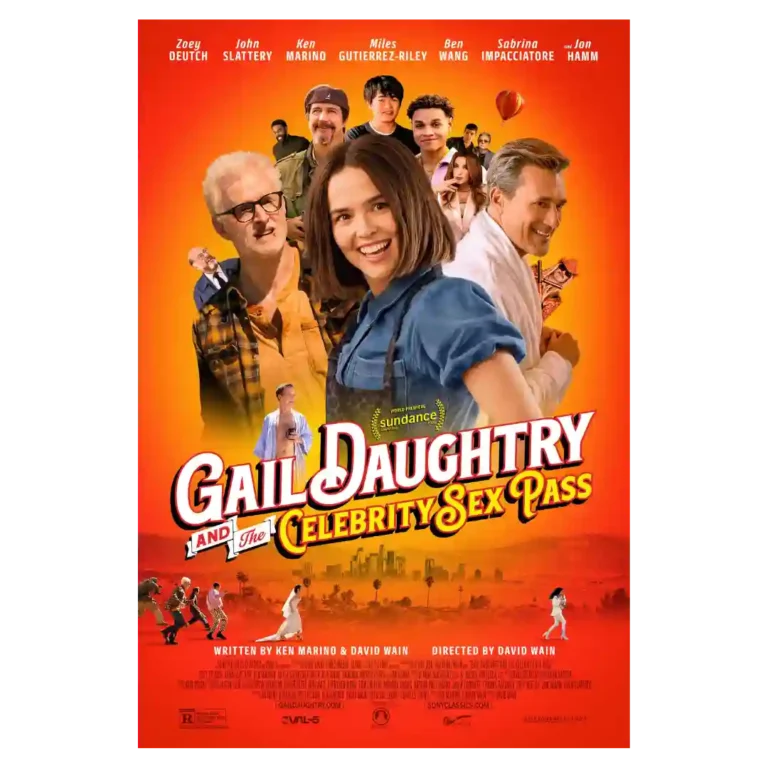
Gail Daughtry and the Celebrity Sex Pass Movie Review
Bottom Line
Choose it for fearless absurdist comedy, rapid-fire gags, and a terrific self-mocking cast. Skip it if loose plotting, niche Hollywood jokes, or cartoon violence quickly wear you down.
Best for fans of David Wain’s deliberately stupid anti-comedy, rapid-fire non sequiturs, celebrity self-parody, and Los Angeles industry jokes.
Skip it if you need a tight story, broadly accessible humor, restrained repetition, or a consistent tone without raunch and cartoon violence.
This gleefully ridiculous Wizard of Oz riff succeeds when its cast fully commits to the nonsense. Zoey Deutch gives the movie a warm, mischievous center, while John Slattery and Jon Hamm turn celebrity self-parody into its most reliable laughs. The tradeoff is a deliberately flimsy story built to carry an enormous volume of gags, and critics sharply disagree about the hit rate. Fans of David Wain’s anti-comedy may find it refreshing, fast, and highly rewatchable; others will see an overlong string of forced jokes, insider references, and tonally jarring violence.
Feature Scorecards
Summary
35 reviewed features- Very positive 4.5-5.0 20% 7 features
- Positive 3.5-4.4 34% 12 features
- Neutral 2.5-3.4 26% 9 features
- Negative 1.5-2.4 17% 6 features
- Very negative below 1.5 3% 1 feature
Pros
-
The bright wardrobe and ruby-red Oz references are a standout, with Gail’s styling helping sell the cheerful storybook tone.
-
At its best, the dialogue turns deliberate nonsense into sharp punchlines. The weakest lines can feel wooden or overworked, but the verbal hit rate impressed several critics.
-
For viewers who miss broad, fearless absurdist comedy, the movie delivers exactly that kind of experience and feels like a welcome return to an underused style.
-
Zoey Deutch is the clearest point of agreement, balancing wide-eyed sweetness, fast delivery, and controlled absurdity well enough to anchor the entire film.
-
The central premise and gleefully irrational turns feel fresh and surprising, even though the story openly borrows its basic journey from The Wizard of Oz.
-
David Wain’s commitment to absurdity, fast comic rhythm, and playful celebrity cameos is widely admired, though some felt the film shows less control than his best work.
-
Gail and Otto’s supportive friendship gives the silliness a warm center, while Jon Hamm and John Slattery’s Mad Men history adds an effective layer of self-aware chemistry.
-
The Wizard of Oz framework is familiar, yet the celebrity-sex-pass premise, aggressive anti-comedy, and self-mocking cameos make the final mix feel unusually unpredictable.
-
The cast commits fully to the movie’s heightened silliness. Some found the early overacting tiring, but most agreed the performers understand the absurd tone.
-
The supporting ensemble is energetic and game, with several performers turning tiny roles into memorable comic moments and John Slattery emerging as the most frequent standout.
-
The movie is competently shot and technically clean, even when its deliberately cheap-looking aesthetic and inserted cameos make some moments feel less polished.
-
A surprising warmth runs underneath the Hollywood satire, keeping the movie from feeling entirely cynical even when the story stays deliberately lightweight.
-
Despite its explicit premise, the movie often feels oddly wholesome and affectionate. Its sexual material, language, and cartoon violence still make it unsuitable for family viewing with younger children.
-
The sexual premise and soft-focus set pieces are raunchy but usually presented with playful innocence rather than grim explicitness, which several critics found surprisingly light.
-
The movie creates a refreshingly ridiculous version of Hollywood where celebrity logic overrides reality, and that heightened setting remains enjoyable even when individual jokes miss.
-
Supporters describe a breezy, irresistible theatrical experience; detractors found it a draining slog. Enjoyment depends heavily on whether the intentionally stupid humor clicks.
-
Some found the finale boldly unpredictable and consistent with the movie’s lunacy, while others considered the resolution bland or less satisfying than the setup.
-
The joke density is enormous, but the hit rate is the central point of disagreement. Some laughed harder than they had at a recent comedy, while others found it painfully unfunny.
-
Los Angeles is presented as bright, tacky, sleazy, and affectionately artificial. Some critics enjoyed that vulgar postcard look, while others found it cheap or visually shallow.
Cons
-
The pace is deliberately relentless and often gets funnier as it goes. Still, repeated bits, a slow first half-hour, and a sagging back half test the patience of less receptive viewers.
-
The screenplay is either tightly engineered nonsense or an underdeveloped spitballing session, depending on the viewer. Its strongest recurring bits show real craft, but weaker sections feel unfinished.
-
Some viewers were still quoting and remembering the jokes days later or immediately wanted another viewing. Others expected to forget the trip quickly and had no interest in returning.
-
At roughly 93 minutes, the movie feels fast and satisfying to fans. For viewers who reject the humor, the same runtime can feel far longer than it is.
-
This is sharply divisive comedy. Fans of David Wain’s anti-comedy and Los Angeles industry jokes are likely to enjoy it most, while mainstream viewers may find it exhausting or inaccessible.
-
The Wizard of Oz structure gives the movie a recognizable path, but the gangster subplot and constant digressions leave the narrative feeling loose, contradictory, or barely held together.
-
The cartoon and gory violence is a major tonal divider. Some viewers found the sudden brutality hilarious, while others thought it struck a sour note against the movie’s cheerful mood.
-
Gail gets a modest self-liberating arc, but most of the traveling companions remain intentionally thin comic types rather than fully developed characters.
-
The Hollywood and celebrity satire has a clear target, but the film rarely pauses long enough to explore it deeply; the emphasis stays on jokes rather than substance.
-
The late action material is one of the weaker stretches, with the Western-set climax described as laugh-light compared with the faster verbal and visual gags.
-
Critical response is highly split: enthusiastic supporters see inspired absurdism, while detractors view the same choices as sloppy, shallow, or underwritten.
-
The overall construction moves quickly, but some digitally inserted cameos and transitions feel clunky enough to break the comic flow.
-
The movie gestures toward ideas about celebrity worship and Hollywood fantasy, but the comic detours keep those ideas from reaching a strong emotional or thematic conclusion.
-
The locations and bright surfaces support the heightened Hollywood fantasy, but the inexpensive finish can look shiny, shallow, and closer to streaming than a polished theatrical comedy.
-
The story works primarily as a frame for jokes and cameos. That loose construction delights viewers who accept the format but frustrates those looking for a coherent, fully developed narrative.
-
The profanity and juvenile vulgarity fit the deliberately lowbrow style, but at least one critic found that approach puerile rather than playful.
Cast & Creators
-
Ken Marino gives the fallen paparazzo a mix of demented comic energy and surprising warmth while also helping shape the film’s absurd screenplay.
-
NarratorFred Melamed’s increasingly irritated narrator turns a small role into one of the movie’s most consistently praised running jokes.
-
TerrenceTobie Windham makes a strong impression in limited screen time, with his strange threats and officious delivery repeatedly cited as comic highlights.
-
Jon Hamm leans fully into handsome-guy self-mockery, turning his celebrity image and Mad Men history into an easy source of playful comedy.
-
Gail DaughtryZoey Deutch anchors the movie with bright sincerity, fast comic instincts, and a mischievous edge. Even many negative reviews praise her ability to sell the ridiculous premise.
-
OttoMiles Gutierrez-Riley makes Otto a charming, supportive companion whose steadiness helps balance Gail’s increasingly chaotic mission.
-
John Slattery is the broadest consensus standout, embracing a pathetic, filthy, self-roasting version of himself and often supplying the movie’s biggest laughs.
-
CalebBen Wang brings quick, eager energy to Caleb and is frequently singled out as a lively addition to the established comedy ensemble.
Compared With Category Average
Compared with other Movies, this product is above average in dialogue quality, plot originality, family friendliness, below average in message quality, production design, language level.
Summary
8 compared features- Above average 0.4+ pts higher 38% 3 features
- Same as average within 0.3 pts 0% 0 features
- Below average 0.4+ pts lower 63% 5 features
| Attribute | This product | Category average | Difference |
|---|---|---|---|
| dialogue quality | 5.0 | 2.9 | +2.1 |
| message quality | 2.0 | 3.8 | -1.8 |
| production design | 2.0 | 3.8 | -1.8 |
| language level | 1.0 | 2.8 | -1.8 |
| plot originality | 5.0 | 3.3 | +1.7 |
| critic appeal | 2.0 | 3.7 | -1.7 |
| story quality | 1.9 | 3.3 | -1.5 |
| family friendliness | 4.0 | 2.5 | +1.5 |
FAQ
Is the movie actually funny?
It depends heavily on your taste for deliberate stupidity and anti-comedy. Supporters call it one of the funniest recent theatrical comedies, while detractors found most of the jokes forced or painfully unfunny.
Who gives the best performance?
Zoey Deutch is the most consistent point of praise for anchoring the chaos with warmth and precision. John Slattery is the most frequently named comic standout, with Jon Hamm also praised for fearless self-mockery.
Does the Wizard of Oz structure work?
The familiar quest gives the movie a useful framework and several clever parallels, but the constant digressions and gangster subplot leave the story loose and unfocused for some viewers.
Is it suitable for children or family viewing?
No. Although the tone can feel oddly wholesome, the film includes sexual material, profanity, and cartoonishly bloody violence.
Who is most likely to enjoy it?
Viewers who already enjoy David Wain, Wet Hot American Summer, repeated anti-jokes, celebrity cameos, and Los Angeles industry satire are the strongest fit.
Sample Expert Reviews We Analyzed
These are a few of the reviews included in our analysis.
Video Reviews
- Review score
- 1.9
- Review score
- 4.3
- Review score
- 3.2
Article Reviews
- Review score
- 2.4
- Review score
- 4.0
- Review score
- 4.5
- Review score
- 4.8
Compared in Reviews
Products reviewers directly compared with this model, grouped into quick takeaways.
Barb and Star Go to Vista Del Mar
- Better: laugh-out-loud humor The critic enjoys the world but finds it much less laugh-out-loud funny.
- Better: absurdist comedy effectiveness The critic says this joke-delivery system is far weaker than that cult comedy.
Wet Hot American Summer
- Similar: loose string-of-gags narrative Its loose gag structure is compared favorably with Wain's comedy classic.
- Better: overall comedy quality The film is considered enjoyable but below Wain's benchmark comedy.
Evil Dead 2
- Compared: effectiveness of gory slapstick Gory slapstick is said to suit horror comedy better than this cheerful farce.
Consider This Instead
If you want better production design
Choose Enola Holmes 3. It scores 4.6 vs 2.0 for production design, with a 3.5 overall score.
If you want better critic appeal
Choose Night Nurse. It scores 5.0 vs 2.0 for critic appeal, with a 3.5 overall score.
If you want better action sequences
Choose The Isolate Thief. It scores 4.5 vs 2.0 for action sequences, with a 4.0 overall score.
If you want better message quality
Choose Minions & Monsters. It scores 4.3 vs 2.0 for message quality, with a 3.8 overall score.
Top Movies to Consider
Best for a profound, formally inventive meditation on grief, memory, and the ethics of filming family. Skip it if intensely personal addiction material, a 114-minute runtime, or occasional repetition will...
Pros: plot originality, ending satisfaction
Cons: runtime, pacing
Best for a tender, accessible portrait that lets Oliver’s poetry, friends, and archival voice carry the experience. Skip it if you want a brisk, deeply investigative biography; the calm rhythm...
Pros: romance quality, faithfulness to source material
Cons: none
Best for razor-sharp adult comedy, exceptional ensemble work, and a surprisingly moving marriage story. Skip it if talk-heavy chamber pieces, explicit relationship discussions, or an occasionally intrusive string score wear...
Pros: plot originality, lead performance
Cons: runtime, score quality
Best for luminous coastal imagery, an exceptional debut performance, and a tender search through family memory. Skip it if slow pacing, subdued conflict, or a late shift into magical realism...
Pros: ending satisfaction, acting performance
Cons: character development, score quality