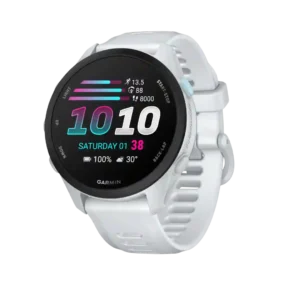
- More expensive: price and display The reviewer chose the 255 partly because it is much cheaper than the 265.
- Cheaper: display and touchscreen The reviewer says the Forerunner 265 costs more but brings a brighter AMOLED touchscreen.
Garmin Forerunner 255 Review
Bottom Line
Choose the Forerunner 255 for accurate GPS, long battery life, comfort, and serious run or triathlon training. Skip it if you want rich smartwatch apps, calls, a touchscreen AMOLED display, or full mapping.
Best for runners, triathletes, and fitness-focused users who will use GPS accuracy, coaching, recovery metrics, and long battery life. It especially fits people who prefer physical buttons and outdoor readability over a lifestyle-watch interface.
Not for shoppers who mainly want a rich smartwatch with calls, voice features, a touchscreen AMOLED display, full mapping, or a broad app experience. It may also be more watch than casual activity trackers need.
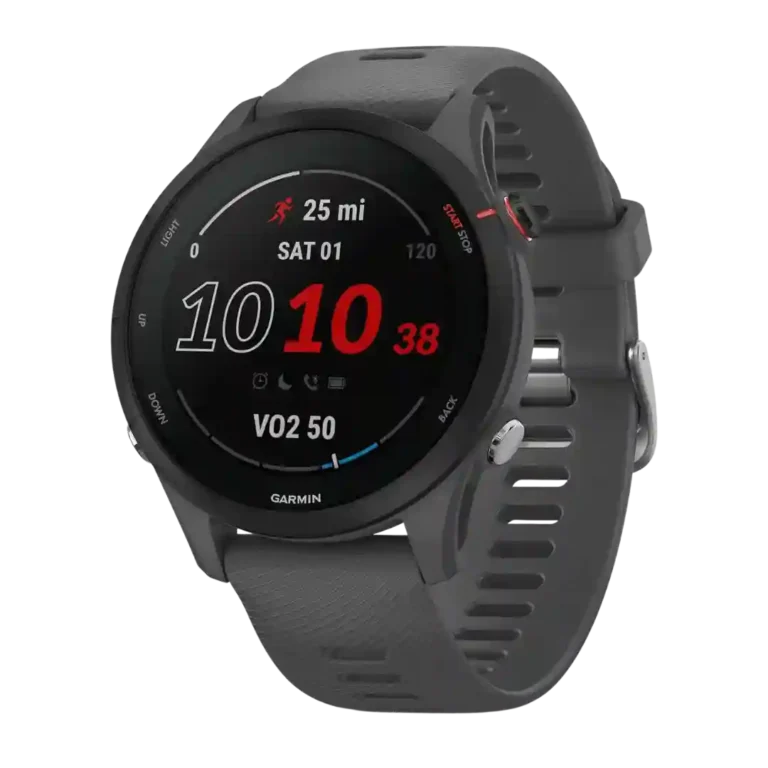
Reviewer evidence frames the Garmin Forerunner 255 as a training-first watch that pushes midrange running watches closer to premium sports models. Across reviews, GPS accuracy, heart-rate performance, battery life, comfort, size choices, multisport support, coaching, recovery metrics, and Garmin Connect depth are recurring strengths. The main tradeoff is that it behaves more like a serious fitness tool than a lifestyle smartwatch: reviewers repeatedly note no touchscreen, a less flashy MIP display, limited call handling, proprietary charging, modest smart features, and missing higher-end tools like Training Readiness or full mapping. For athletes who will wear it day and night and use the training data, the evidence is highly favorable; for casual smartwatch shoppers, its strengths may feel specialized.
Compared in Reviews
Products reviewers directly compared with this model, grouped into quick takeaways.
- Better: music storage The reviewer notes the 255 Music has far less storage than the 955.
- Better: mapping and storage The reviewer says the 955 adds mapping, more GPS endurance, and more music storage over the 255.
Garmin Forerunner 245
- Older model: battery life and features The reviewer describes the 255 as a major upgrade from the 245 with much longer battery life.
- Older model: new features The reviewer says the new features make the Forerunner 255 a worthwhile upgrade from the 235 or 245.
Feature Scorecards
Pros
-
Reliability evidence is limited but positive, with one long-term reviewer calling the watch fantastic after six months.
-
GPS accuracy is one of the strongest consensus points, with reviewers praising multi-band GNSS and reporting excellent or near spot-on tracking in varied conditions.
-
Customization is a strong point, with reviewers praising data fields, watch-face changes, activity settings, and phone-based configuration.
-
Workout variety is a major strength, with reviewers emphasizing triathlon, multisport, running, cycling, swimming, open-water swimming, and many built-in activity profiles.
-
Comfort is a consistent strength, with many reviewers describing the watch as light, comfortable for 24/7 wear, and easy to sleep in.
-
Outdoor visibility is strong, with reviewers repeatedly praising MIP visibility in direct sunlight or bright outdoor conditions.
-
Battery life is one of the clearest strengths, with reviewers repeatedly reporting week-plus use, two-week smartwatch estimates, and strong GPS endurance.
-
Fitness tracking is described as accurate and detailed across workouts, with reviewers highlighting strong sport data, reliable modes, and post-workout analysis.
-
Reviewers repeatedly report strong wrist heart-rate accuracy, often comparing it favorably with chest straps, though one notes chest straps remain preferable for maximum precision.
-
Charging speed is positive, with reviewers noting full charging in a couple of hours and 50 percent charge in under half an hour.
-
One review says the watch helps build an accurate picture of day-to-day health, based on heart rate, SpO2, sleep, stress, and related health stats.
-
Coaching features are a standout, with race widgets, Garmin Coach, adaptive suggested workouts, race-based plans, and workout guidance appearing across many reviews.
-
The companion app is a major strength, with Garmin Connect described as detailed, polished, powerful, and helpful for syncing, workouts, and long-term stats.
-
Value for money is strongly positive for sports-focused buyers, though reviewers also mention price concerns and cheaper rivals.
-
Size options are a strength, with reviewers repeatedly highlighting 41/42mm and 46mm options that serve different wrist sizes.
-
Band quality is strong, with reviewers praising the silicone quick-release band, stretch, comfort, notches, and easy swapping.
-
Durability evidence is positive but limited, with reviewers mentioning Gorilla Glass, solid daily durability, and few scratches or cracks over months.
-
Fit is positive, supported by closely spaced strap holes, multiple sizes, and reviewers reporting secure wrist adjustment.
-
Auto-detection evidence is positive but limited, with reviewers noting automatic run/walk/rest or effort detection rather than broad automatic workout recognition.
-
Pairing reliability evidence is limited, but one cycling review successfully paired power-meter pedals and used the data without complaint.
-
Software smoothness gets limited but positive evidence, with one review calling menuing smooth and lag-free.
-
Bluetooth connectivity is strong for headphones and external sensors, with reviewers noting Bluetooth audio and ANT+/Bluetooth sensor pairing.
-
Water resistance is positive, with reviewers noting 5ATM/waterproofing and suitability for swimming, pool use, showers, and open water.
-
Cross-platform compatibility is positive, with reviewers noting iOS and Android support through Garmin Connect and Bluetooth.
-
Wellness insights are well represented through Morning Report, Body Battery, Health Snapshot, and sleep/recovery context, and several reviewers call these features useful.
-
Recovery insights are a major upgrade, with HRV, Body Battery, recovery time, and training-load tools giving useful context, though Training Readiness is missing.
-
Safety features are present through emergency assistance, live tracking, and personal safety features, but evidence assumes phone-linked or outdoor use cases.
-
Operating system experience is functional and familiar, with Garmin's watch software described as consistent and usable rather than lifestyle-watch rich.
-
Button controls are broadly positive, with reviewers liking reliable physical buttons for sports, though a few mention learning curves or squishy buttons.
-
Sleep tracking is widely covered and generally positive, with several reviewers finding it useful or close to external sleep tools, while some still note overestimation or limits.
-
Onboard music storage is a clear optional strength on Music models, with Spotify/offline playlist support and roughly 500-song storage noted, though storage is limited versus higher models.
-
Wi-Fi evidence is limited to Music models and syncing/downloading use cases, but reviewers confirm Wi-Fi support for those versions.
-
Display quality is practical and readable, especially for sport use, but reviewers contrast the MIP screen with brighter AMOLED displays.
-
Watch-face quality is solid, with customizable stock faces and Connect IQ options, though one reviewer notes limits around custom Face It storage.
-
Contactless payments are consistently supported through Garmin Pay/NFC, although bank participation limits usefulness for some reviewers.
-
The app ecosystem is supported through Connect IQ and Garmin's watch-face/app store, but the evidence emphasizes fitness tools more than a broad app marketplace.
-
Build quality is generally good for a lightweight sports watch, but reviewers note the plastic/resin construction feels cheaper than metal premium models.
-
Music controls are useful, with reviewers noting phone playback control and on-watch controls such as changing, pausing, and playing tracks.
-
Calorie tracking is mentioned as part of the workout data set, but reviewers do not deeply evaluate its independent usefulness.
-
Third-party app support exists through Connect IQ and downloadable faces/apps, but reviewers describe it as useful rather than Apple Watch-level broad.
-
The user interface is practical, especially through glances and widgets, but some recovery/health metrics require interpretation.
-
Smartphone notifications are consistently available and useful for viewing messages, calls, texts, and app alerts, though controls vary by phone platform.
-
Stress tracking appears through HRV, Body Battery, and stress metrics, but evidence is mixed because at least one reviewer finds Garmin's stress data not very useful.
-
Menu navigation is mixed: Garmin's button/menu system works and can be quick, but reviewers note a learning curve and limited mapping/navigation depth.
-
Style and design are functional rather than stylish, with reviewers calling it clearly sporty, utilitarian, or not a luxury-looking watch.
-
Materials quality evidence is limited and mixed, with one review identifying the resin case and silicone band rather than premium materials.
Cons
-
Blood oxygen/Pulse Ox support is present and mentioned often, but reviewers treat it as secondary because continuous use can hurt battery life and accuracy depends on conditions.
-
Brightness is mixed: the display is readable, but multiple reviewers prefer brighter AMOLED screens or say brightness could be better.
-
Step counting evidence is limited and mixed: one reviewer reports an inaccurate stair count, while another calls the step counter very accurate.
-
Smartwatch features are adequate for Garmin Pay, music, notifications, and Connect IQ, but reviewers repeatedly say they fall short of Apple or Samsung-style smartwatches.
-
Charging convenience is mixed: the cable fits and replacement cables are available, but proprietary charging and battery drain with GPS/music are recurring caveats.
-
Touchscreen responsiveness scores low because the watch does not have a touchscreen; reviewers often frame this as acceptable for workouts.
-
Call handling is weak because one review directly says the watch cannot make calls and lacks the hardware for calling.
Compared With Category Average
Compared with other Smart Watch, this product is above average in size options, onboard music storage, contactless payments, below average in touchscreen responsiveness, call handling.
| Attribute | This product | Category average | Difference |
|---|---|---|---|
| touchscreen responsiveness | 1.7 | 3.6 | -2.0 |
| call handling | 1.5 | 3.1 | -1.6 |
| size options | 4.4 | 3.1 | +1.3 |
| onboard music storage | 4.1 | 2.8 | +1.3 |
| contactless payments | 3.9 | 2.8 | +1.1 |
| GPS accuracy | 4.7 | 4.0 | +0.7 |
| reliability | 4.8 | 3.7 | +1.1 |
| heart rate accuracy | 4.5 | 3.8 | +0.7 |
FAQ
Is the Garmin Forerunner 255 GPS accurate?
Yes. Reviewers repeatedly praise its multi-band GPS and describe tracking as excellent, extremely accurate, or close to spot on.
How good is the battery life?
Battery life is one of the strongest points. Reviews commonly mention week-plus use, up to about two weeks in smartwatch mode, and strong GPS endurance.
Is it good for triathlon training?
Yes. Reviewers repeatedly highlight triathlon and multisport support, including swim, bike, run, open-water swimming, and race-focused training tools.
Does it work well as a smartwatch?
It handles notifications, Garmin Pay, music options, and Connect IQ features, but reviewers say it is not as capable as Apple Watch or Samsung-style smartwatches.
Does the Forerunner 255 have a touchscreen?
No. Reviews consistently note that it uses physical buttons instead, which many reviewers prefer for workouts, sweat, cold, and outdoor use.
Are the recovery and coaching features useful?
Generally yes. Reviewers like Morning Report, HRV, Body Battery, Garmin Coach, race widgets, and suggested workouts, although several note that Training Readiness is missing.
Should I buy the Music version?
The Music version is useful if you want Spotify or offline music without a phone. Reviewers who carry a phone or do not use onboard music often recommend saving money.
Consider This Instead
If you want better touchscreen responsiveness
Choose Coros Pace Pro. It scores 4.8 vs 1.7 for touchscreen responsiveness, with a 3.7 overall score.
If you want better call handling
Choose Apple Watch Ultra 3. It scores 4.6 vs 1.5 for call handling, with a 4.2 overall score.
If you want better smartwatch features
Choose Apple Watch Series 10. It scores 4.7 vs 3.2 for smartwatch features, with a 4.2 overall score.
If you want better charging convenience
Choose Suunto Vertical 2. It scores 4.5 vs 3.2 for charging convenience, with a 3.8 overall score.
Overall Top Smart Watch Alternatives
Good if you want the most rugged Apple Watch, brighter outdoor screen, better battery, LTE, and top apps. Skip it if you need Garmin-like mapping, recovery analytics, smaller sizing, or...
Pros: display quality, heart rate accuracy
Cons: cross-platform compatibility, recovery insights
Choose the Galaxy Watch 6 for a polished Android smartwatch with a bright screen, strong apps, and broad health tracking. Skip it if battery life, iPhone support, or full non-Samsung...
Pros: outdoor visibility, workout tracking variety
Cons: cross-platform compatibility, battery life
Good if you need a rugged Garmin with deep outdoor, tactical, GPS, training, and battery features. Skip it if you want a cheaper lifestyle watch or do not need the...
Pros: materials quality, durability
Cons: LTE connectivity, value for money
Good if you want premium golf maps, virtual caddie tools, health metrics, music, notifications, and long battery life in one watch. Skip it if you only need basic yardages or...
Pros: pairing reliability, brightness
Cons: software smoothness, user interface