- Alternative: smartwatch-first use The reviewer frames Apple Watch Ultra 3 as the better fit for smartwatch-first buyers, not Apex 4's training-watch niche.
- Better: smartwatch features The Apex 4 trails true smartwatches because it lacks streaming, phone music control, and NFC payments.
Coros Apex 4 Review
Bottom Line
Choose the Coros Apex 4 if you want long battery life, fast maps, durable materials, and outdoor training tools. Skip it if you want AMOLED brightness, richer smartwatch apps, NFC payments, or consistently flawless wrist HR.
Best for trail runners, mountain athletes, ultrarunners, and MIP-display fans who prioritize battery life, maps, GPS, and training data over lifestyle smartwatch features.
Not for buyers who want an AMOLED display, NFC payments, streaming services, LTE calling, a built-in flashlight, or the broadest third-party app ecosystem.
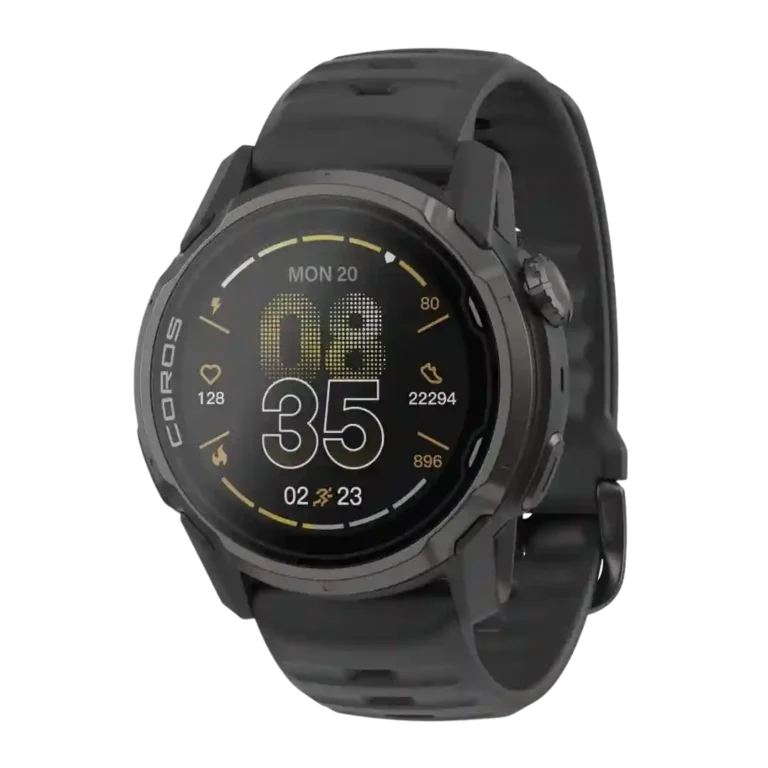
The Coros Apex 4 comes across as a focused outdoor training watch rather than a lifestyle smartwatch. Reviewers repeatedly praise its battery life, fast maps, GPS performance, titanium-and-sapphire construction, and athlete-centered training tools. The tradeoff is clear: the MIP display helps endurance and sunlight use, but several reviewers found it dull indoors, under trees, or beside AMOLED rivals. Its smart features also stay basic, with no NFC payments, no streaming music, no LTE, and limited third-party app depth. Heart-rate tracking is good enough for many runs, but the evidence includes spikes, lag, and weak non-sport readings, so serious athletes may still prefer a chest strap.
Compared in Reviews
Products reviewers directly compared with this model, grouped into quick takeaways.
- Better: display preference Run4Adventure preferred the Pace Pro because its AMOLED display felt clearer despite liking Apex 4's maps.
- Similar: GPS reliability The Run Testers found Apex 4 GPS reliable against pricier watches such as the Fenix 8 Pro.
Feature Scorecards
Pros
-
Battery life is the clearest strength: reviewers repeatedly reported multi-day or multi-week use and strong GPS runtimes.
-
Software smoothness is a standout, especially fast map rendering, responsive menus, and the newer processor.
-
Coaching features are strong for athletes, especially training calendar, load, plans, recovery time, and running fitness guidance.
-
Workout tracking variety is broad, covering running, cycling, swimming, climbing, winter sports, team/paddle sports, and multisport modes.
-
Fit is positive, especially because the watch comes in two sizes and the strap/lug design keeps it stable.
-
Fitness tracking accuracy is strong overall, driven by mostly accurate GPS and solid workout heart-rate performance, with some exceptions.
-
Style and design get positive remarks for uniqueness and a cleaner premium look, though some reviewers find it less attractive than rivals.
-
Size options are good, with 42 mm and 46 mm models that share the same core feature set.
-
Durability is a major strength, supported by titanium, sapphire, reinforced lugs, and mountain-sport positioning.
-
GPS accuracy is broadly praised, but one reviewer found serious degradation when navigation was enabled.
-
Value is strong for its niche because reviewers see premium materials, maps, battery life, and training tools at a competitive price.
-
Materials quality is strong, with repeated praise for titanium, sapphire glass, and premium-feeling construction despite some plastic/polymer.
-
Button controls are a strong point, especially the added action button and customizable shortcuts during activities.
-
Comfort is consistently positive; reviewers found the watch wearable, stable, and not overly bulky for its category.
-
Charging speed is viewed positively, with multiple reviewers citing about 90 minutes or a useful fast top-up.
-
Wi-Fi is useful for downloading maps quickly from the phone/app workflow.
-
The Coros app is generally praised for syncing, route planning, data review, colorful presentation, and training-oriented organization.
-
The watch is generally described as sturdy and rugged, with a sport-oriented case that avoids some bulk of larger adventure watches.
-
Customization is good around buttons, profiles, data screens, colors/bands, and sport-mode shortcuts.
-
Recovery insights are well represented through training load, status, recovery time, HRV, fatigue, readiness, and running fitness views.
-
Sleep tracking covers sleep timing, stages, heart-rate values, HRV, and commentary, with reviewers mostly discussing usefulness rather than lab validation.
-
Wellness insights are broad, covering HRV, sleep, stress, wellness checks, blood oxygen, and health metric snapshots.
-
The user interface is usually considered simple and athlete-focused, but not as polished or feature-rich as some rivals.
-
Stress tracking is present and integrated with HRV/wellness data, though reviews focus more on availability than precision.
-
Touchscreen responsiveness is useful for menus and helps offset crown navigation friction.
-
Call handling is useful and often surprisingly clear, but it remains phone-tethered, inbound-focused, and inconsistent for some reviewers.
-
Reviewers describe the silicone or stock band as acceptable to good, with some preferring nylon for comfort and weight.
-
Health tracking accuracy appears serviceable but less thoroughly proven than GPS, with evidence centered on updated sensors and wellness metrics.
-
The operating system experience is fitness-first and familiar to Coros users, but not a broad smartwatch platform.
-
Pairing reliability is mostly implied through easy phone/Bluetooth use, but call handoff and tethered features can be inconsistent.
-
Heart-rate accuracy is mixed: several reviewers saw strong run results, while others found spikes, lag, cycling issues, or poor non-sport readings.
-
Blood oxygen is present and updated, but evidence focuses on availability and on-demand/high-altitude use rather than deep accuracy testing.
-
Safety features exist but are basic compared with Apple and Garmin, centered on workout safety alerts or notifications.
-
The app ecosystem is training-focused and useful, but reviewers say it lacks broader social or third-party ecosystem depth.
-
Menu navigation is generally simple and usable, though one reviewer disliked the crowded rotating toolbox.
-
Bluetooth works as the required link for calls, headphones, and phone-tethered features, though several reviewers emphasize the phone must stay nearby.
Cons
-
ECG-based wellness checks are available, but reviewers note it is not a medical-grade ECG and is mainly for HRV/metrics.
-
Outdoor visibility is context-dependent: bright sunlight suits MIP, while forest, cloudy, or low-light map use can be harder.
-
Smartphone notifications are available and readable, though reviewers also recommend limiting them during runs.
-
Water resistance is adequate at 5ATM/50 m, but depth-gauge and speaker-after-water limitations keep it from feeling like a full dive tool.
-
Onboard music exists through local MP3/file storage, but reviewers note there is no streaming service support.
-
Display quality is the biggest tradeoff: MIP helps battery and sunlight readability, but many reviewers prefer AMOLED clarity and color.
-
Brightness is mixed: the newer MIP panel has better contrast, but several reviewers found it dim or non-adjustable versus AMOLED rivals.
-
Reliability is mixed: many core sports features worked well, but reviewers flagged call triggering and navigation/GPS bugs.
-
Charging convenience is mixed because the USB-C adapter is portable but small, easy to lose, and sometimes criticized as a dongle.
-
Watch face quality is limited on-watch, though one reviewer accepted the small set as battery-friendly.
-
Smartwatch features are limited; reviewers repeatedly contrast the Apex 4 with Apple, Garmin, and AMOLED lifestyle watches.
-
Third-party app support is limited, with reviewers specifically noting the absence of broad app ecosystems such as Garmin Connect IQ.
-
Voice assistant quality is effectively undeveloped; reviewers mention future offline voice commands rather than a current assistant.
-
Music controls are weak because phone playback controls are absent or limited.
-
Contactless payments are a clear absence; reviewers explicitly say NFC payments are not available.
-
LTE connectivity is not included; phone-independent calling or internet features are unavailable.
Compared With Category Average
Compared with other Smart Watch, this product is above average in size options, below average in music controls, contactless payments, brightness.
| Attribute | This product | Category average | Difference |
|---|---|---|---|
| music controls | 1.3 | 3.5 | -2.3 |
| contactless payments | 1.0 | 2.9 | -1.9 |
| brightness | 2.7 | 4.2 | -1.5 |
| smartwatch features | 2.2 | 3.5 | -1.4 |
| size options | 4.5 | 3.1 | +1.3 |
| watch face quality | 2.5 | 3.9 | -1.4 |
| display quality | 3.2 | 4.3 | -1.1 |
| voice assistant quality | 1.4 | 2.7 | -1.3 |
FAQ
Is the Coros Apex 4 good for trail running?
Yes. Reviewers repeatedly praised its GPS accuracy, fast maps, route tools, battery life, and training metrics for trail and mountain use.
How good is the battery life?
Battery life is one of the strongest themes across the reviews. Several reviewers reported multi-day or multi-week use, and long GPS sessions left plenty of charge.
Is the MIP display a drawback?
It depends on priorities. Reviewers liked the battery and sunlight benefits, but many found the display dull compared with AMOLED, especially indoors, under clouds, or on map screens.
Can the Apex 4 take phone calls?
Yes, it can receive calls through its speaker and microphone when paired to a nearby phone. Reviewers liked the audio quality, but noted it cannot work independently like LTE.
Does it have Garmin-like smartwatch features?
Not fully. Reviews note missing NFC payments, streaming music, broad app support, LTE, and phone music controls, so it is more training watch than smartwatch.
Is heart-rate accuracy reliable?
It is mixed. Several reviewers saw strong run results, but others reported spikes, lag during hard efforts, outdoor cycling issues, or moody readings outside workouts.
Consider This Instead
If you want better contactless payments
Choose Apple Watch SE 3. It scores 4.8 vs 1.0 for contactless payments, with a 4.1 overall score.
If you want better third-party app support
Choose Samsung Galaxy Watch 8. It scores 4.8 vs 2.0 for third-party app support, with a 4.0 overall score.
If you want better smartwatch features
Choose Apple Watch Series 10. It scores 4.7 vs 2.2 for smartwatch features, with a 4.2 overall score.
If you want better brightness
Choose Coros Pace Pro. It scores 5.0 vs 2.7 for brightness, with a 3.7 overall score.
Overall Top Smart Watch Alternatives
Good if you want the most rugged Apple Watch, brighter outdoor screen, better battery, LTE, and top apps. Skip it if you need Garmin-like mapping, recovery analytics, smaller sizing, or...
Pros: display quality, heart rate accuracy
Cons: cross-platform compatibility, recovery insights
Choose the Galaxy Watch 6 for a polished Android smartwatch with a bright screen, strong apps, and broad health tracking. Skip it if battery life, iPhone support, or full non-Samsung...
Pros: outdoor visibility, workout tracking variety
Cons: cross-platform compatibility, battery life
Good if you need a rugged Garmin with deep outdoor, tactical, GPS, training, and battery features. Skip it if you want a cheaper lifestyle watch or do not need the...
Pros: materials quality, durability
Cons: LTE connectivity, value for money
Good if you want premium golf maps, virtual caddie tools, health metrics, music, notifications, and long battery life in one watch. Skip it if you only need basic yardages or...
Pros: pairing reliability, brightness
Cons: software smoothness, user interface