- Worse: battery life Pocket-lint's video says MARQ battery life lasts longer than Apple Watch Ultra and Wear OS watches.
- Worse: battery life TechRadar says MARQ lasts far longer than Apple Watch Ultra.
Garmin MARQ Gen 2 Review
Bottom Line
Choose the Garmin MARQ Gen 2 if you want Garmin’s deepest sports and golf tracking in a luxury-feeling build. Skip it if Epix/Fenix-level features, smaller fit, stronger smartwatch apps, or better value matter more.
Best for buyers who want Garmin’s most complete sport, outdoor, wellness, or golf toolkit wrapped in premium materials and a dressier design. It especially suits users who value long battery life, maps, GPS accuracy, and recovery guidance more than app-store depth.
Not for value-focused buyers, smaller-wrist users, or anyone mainly seeking Apple/Google-style smartwatch features such as richer third-party apps, calls, LTE, voice assistant support, or ECG. Reviewers repeatedly point to Epix, Fenix, and Approach models as cheaper ways to get much of the same function.
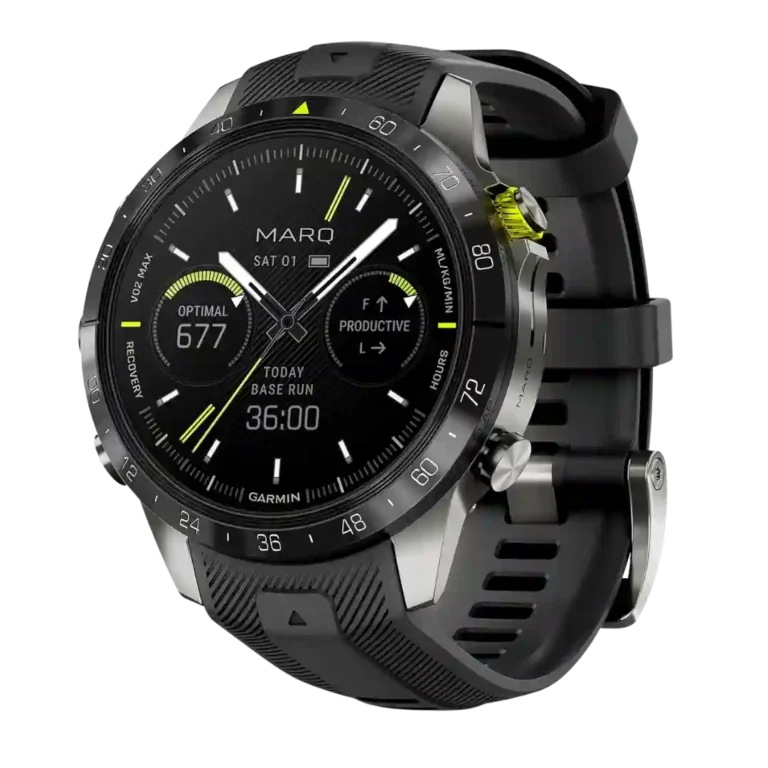
Reviewers consistently frame the Garmin MARQ Gen 2 as a luxury Garmin first: premium materials, a bright AMOLED display, strong multi-band GPS, deep sport coverage, and unusually fast charging carry the experience. The tradeoff is that much of the core software and tracking overlaps with cheaper Epix and Fenix models, while the MARQ adds weight, a large one-size case, and a very high price. Battery life and outdoor visibility earn broad praise, and recovery, wellness, maps, music, payments, and golf tools make it highly capable. Its weakest areas are value, limited third-party smartwatch depth, no LTE/calls/voice/ECG, and mixed sleep and comfort feedback.
Compared in Reviews
Products reviewers directly compared with this model, grouped into quick takeaways.
- Similar: mapping and navigation Wareable says the MARQ shares Fenix-style outdoor mapping and navigation features.
- Similar: features and value TechRadar says MARQ has luxury materials but not many extra features over cheaper Fenix models.
- Cheaper: golf functionality and price Today's Golfer notes Approach S70 can provide similar golf functionality much cheaper.
Feature Scorecards
Pros
-
Charging speed is a standout strength, with multiple reviewers citing about an hour to full charge or much faster charging than Epix/Fenix.
-
Build quality is one of the strongest themes, with reviewers repeatedly emphasizing luxury-level construction and premium execution.
-
Reliability is very strong where directly assessed, with reviewers describing flawless core functionality, quick activity loading, and strong performance.
-
Water resistance is strong, repeatedly described as 10 ATM, 100 meters, swim-capable, and suitable for rain or water-based activity.
-
Outdoor visibility is excellent, with reviewers praising direct-sunlight clarity, readability outside, and ease of checking data while moving.
-
Materials quality is excellent, centered on Grade 5 titanium, sapphire glass, ceramic or carbon details, and luxury-level finishing.
-
Workout tracking variety is excellent, with reviewers repeatedly describing huge sport coverage from running and cycling to swimming, skiing, golf, yoga, and more.
-
Pairing reliability is strong in the available evidence, including automatic external sensor connection and a no-connectivity-issues report.
-
Durability is a major strength, supported by titanium, sapphire, scratch resistance, water toughness, and reports of surviving regular use without damage.
-
The five-button layout is consistently useful, giving reliable physical control alongside touch input for workouts, menus, and golf use.
-
Style and design are a core strength, with repeated praise for the luxury watch look, premium finishing, and suitability beyond workouts.
-
GPS accuracy is one of the best-supported positives, with multi-band/SatIQ tracking described as strong, reliable, and accurate across most conditions.
-
Customization is broad, covering watch faces, widgets, notifications, activity preferences, and glances that can be reordered or personalized.
-
Brightness earns positive remarks, with AMOLED contrast and vividness making the screen easy to use and read.
-
Recovery insights are a standout Garmin feature, especially Training Readiness, Body Battery, HRV-informed guidance, and recovery-based workout suggestions.
-
Watch face quality is positive where discussed, with colorful, detailed faces and customization through Garmin’s interface and Connect IQ.
-
Coaching is strong across sports and golf, including suggested workouts, Training Readiness, recovery guidance, animated workouts, and Virtual Caddie features.
-
Menu navigation is strong once learned, helped by touch, buttons, maps, widgets, and simplified switching between smartwatch and sport modes.
-
Onboard music is a strength, with offline streaming playlists, 32GB storage, and built-in music storage repeatedly mentioned.
-
Display quality is widely praised for the AMOLED upgrade, sharpness, clarity, and vivid color, with only older MARQ evidence criticizing the screen.
-
Touchscreen responsiveness is consistently positive, with reviewers finding it reliable, responsive, and especially helpful for maps and menus.
-
Fitness tracking accuracy is generally strong across running, treadmill, and movement tracking, though some activity detection and intensity caveats remain.
-
Bluetooth support is useful for phone sync, headphones, and connected sensors, with evidence of smooth background syncing and offline music use.
-
Battery life is a clear strength, with reviewers citing multi-day always-on use and roughly two-week use when the display is not always on.
-
Wellness insights are useful and broad, including Body Battery, sleep, readiness, recovery, Health Snapshot, jet lag reminders, and clearer data presentation.
-
Charging convenience improves over many Garmin watches through magnetic or flat charging hardware, although one reviewer still dislikes the unique connector.
-
Health tracking accuracy is supported by a broad sensor suite and many tracked metrics, with reviewers generally treating Garmin’s data as credible.
-
Safety features are present but phone-dependent, with accident detection able to send location-based messages through a phone connection.
-
Software smoothness is positive, with reviewers saying the software runs well and Garmin’s recent quality has improved substantially.
-
Smartwatch features are useful but not complete, with strong payments, music, notifications, and widgets offset by missing calls, voice, LTE, and richer apps.
-
Cross-platform compatibility is good, with one review specifically saying the watch works as a good smartwatch with either iPhone or Android pairing.
-
Band feedback is mixed: the Athlete strap is criticized as plain, while nylon, rubber, and fabric straps receive praise for quality and comfort.
-
Music controls are useful and appear as part of the broader smartwatch/lifestyle toolkit, with multiple reviews calling them good or convenient.
-
Garmin Connect is treated as detailed and capable, with full metric sync and familiar settings control, though the experience can be dense.
-
Wi-Fi connectivity supports syncing and downloading content, though one reviewer notes map downloads over Wi-Fi can take a while.
-
Heart rate accuracy is mostly good, especially steady efforts, but reviewers note wrist-based limits during short intervals, cycling, and weight training.
-
Stress tracking is part of the broader Garmin wellness and readiness system, appearing in Body Battery, Health Snapshot, and Training Readiness evidence.
-
The operating system experience is Garmin’s own software: feature-rich and capable, but not positioned as a general-purpose smartwatch OS.
-
Comfort is context-dependent: some reviewers praise day-night wear or lightness, while others find the large, heavy case less natural for sleep or running.
-
Garmin Pay is useful and repeatedly mentioned, but limits such as bank support and PIN entry keep it from matching the smoothest payment systems.
-
Garmin’s Connect IQ ecosystem adds apps, widgets, watch faces, and data fields, though reviewers do not frame it as Apple- or Google-level.
-
The user interface is powerful but can feel dense or overwhelming; the best evidence says Garmin is improving usability without removing depth.
-
Free-train movement detection is supported and generally useful, but the evidence includes occasional exercise misclassification that needs app cleanup.
-
Blood oxygen tracking is available through Pulse Ox or Health Snapshot, but reviewers note battery drain and the need to sit still for best readings.
-
Notifications work for basic alerts and messaging visibility, but reviewers cite limitations such as no replies on iOS and imperfect notification threading.
Cons
-
Sleep tracking is mixed: some reviewers find sleep timing solid, while others report serious time-asleep misjudgments that affect readiness metrics.
-
Fit is mixed to negative because reviewers repeatedly point to the 46mm, chunky, heavy case and limited suitability for smaller wrists.
-
Third-party app support is limited compared with Apple or Google, even though Connect IQ provides some apps, widgets, faces, and data fields.
-
Value for money is the biggest concern, with reviewers repeatedly saying Epix, Fenix, or Approach options deliver similar features for much less.
-
Size options are a weakness because reviewers wanted a smaller case and repeatedly noted the range still has only one case size.
-
Call handling is weak because review evidence says MARQ lacks the microphone and speaker hardware found on Garmin’s call-capable models.
-
ECG is effectively absent from this MARQ evidence, with reviewers pointing to Venu 2 Plus as Garmin’s ECG-capable design instead.
-
Voice assistant quality is effectively absent, since the MARQ evidence says the needed microphone and speaker hardware is not present.
-
LTE is missing, with multiple reviews explicitly noting that MARQ does not include LTE connectivity or LTE-enabled safety features.
Compared With Category Average
Compared with other Smart Watch, this product is above average in onboard music storage, contactless payments, reliability, below average in call handling, value for money, voice assistant quality.
| Attribute | This product | Category average | Difference |
|---|---|---|---|
| call handling | 1.2 | 3.1 | -1.9 |
| onboard music storage | 4.5 | 2.8 | +1.6 |
| value for money | 2.3 | 3.8 | -1.6 |
| voice assistant quality | 1.2 | 2.7 | -1.5 |
| fit | 2.9 | 3.9 | -1.1 |
| contactless payments | 3.8 | 2.8 | +1.0 |
| reliability | 4.8 | 3.7 | +1.0 |
| ECG functionality | 1.2 | 2.3 | -1.1 |
FAQ
Is the Garmin MARQ Gen 2 worth the price?
Reviewers see it as a luxury purchase rather than a pure value buy. They praise the materials, design, display, GPS, battery, and tracking depth, but repeatedly note that cheaper Epix, Fenix, or Approach models offer much of the same functionality.
How good is the battery life?
Battery life is one of the strongest themes. Reviewers cite roughly two weeks with always-on display disabled, several days with always-on use, and meaningful drain from GPS, music, and Pulse Ox.
How accurate are GPS and heart rate tracking?
GPS accuracy is strongly praised, especially with multi-band and SatIQ. Heart rate is generally good for steady efforts, but reviewers note wrist-based limits during short intervals, cycling, and weight training.
Does it work as a full smartwatch?
It covers notifications, Garmin Pay, music, widgets, watch faces, and Connect IQ extras. It does not match Apple or Google for third-party apps, and review evidence points to no LTE, call handling, voice assistant hardware, or ECG.
Is it comfortable enough for daily wear and sleep tracking?
Comfort feedback is mixed. Some reviewers praise the straps, lightness, and day-night wear, while others find the 46mm case chunky, heavy, or not ideal for smaller wrists and sleep.
What training and wellness features stand out most?
Reviewers highlight Training Readiness, Body Battery, recovery guidance, HRV-related insights, sleep data, stress tracking, Health Snapshot, jet lag guidance, suggested workouts, and very broad sport coverage.
Consider This Instead
If you want better call handling
Choose Apple Watch Series 10. It scores 4.6 vs 1.2 for call handling, with a 4.2 overall score.
If you want better value for money
Choose Amazfit T-Rex 3. It scores 4.9 vs 2.3 for value for money, with a 3.6 overall score.
If you want better size options
Choose Garmin Approach S70. It scores 4.7 vs 2.1 for size options, with a 4.3 overall score.
If you want better third-party app support
Choose Samsung Galaxy Watch 8. It scores 4.8 vs 2.7 for third-party app support, with a 4.0 overall score.
Overall Top Smart Watch Alternatives
Good if you want the most rugged Apple Watch, brighter outdoor screen, better battery, LTE, and top apps. Skip it if you need Garmin-like mapping, recovery analytics, smaller sizing, or...
Pros: display quality, heart rate accuracy
Cons: cross-platform compatibility, recovery insights
Choose the Galaxy Watch 6 for a polished Android smartwatch with a bright screen, strong apps, and broad health tracking. Skip it if battery life, iPhone support, or full non-Samsung...
Pros: outdoor visibility, workout tracking variety
Cons: cross-platform compatibility, battery life
Good if you need a rugged Garmin with deep outdoor, tactical, GPS, training, and battery features. Skip it if you want a cheaper lifestyle watch or do not need the...
Pros: materials quality, durability
Cons: LTE connectivity, value for money
Good if you want premium golf maps, virtual caddie tools, health metrics, music, notifications, and long battery life in one watch. Skip it if you only need basic yardages or...
Pros: pairing reliability, brightness
Cons: software smoothness, user interface