Choose it for quiet, portable UPS backup, fast laptop charging, camping, and short outages. Skip it for whole-home power, heavy appliances, freezing-weather charging, or anyone unwilling to manage standby drain and occasional app quirks.
Best for
Best for campers, road-trippers, remote workers, and households that need quiet backup for routers, CPAP machines, laptops, lights, and other small essentials. It also suits buyers replacing a short-runtime lead-acid UPS.
Not for
Not for whole-home backup, sustained heaters or kitchen appliances, high-inrush tools, wet outdoor exposure, or below-freezing charging. It is also a poor fit for anyone who needs effortless app setup or guaranteed low standby drain.
Verdict
The Bluetti Elite 30 V2 is unusually capable for a 288Wh power station. Its compact body, low weight, quiet fan, rapid AC charging, strong 140W and 100W USB-C ports, and near-instant UPS transfer make it especially useful for routers, CPAP machines, computers, road trips, and camping. The 600W inverter also gives it more headroom than many similarly sized units, while Power Lifting can run simple resistive appliances in short bursts. The tradeoff is capacity: heaters, kettles, large refrigerators, and multi-day use empty the battery quickly, and high-inrush devices may fail. Standby drain can also be substantial with outputs left on, while Eco mode may shut down tiny loads. App controls are powerful but pairing, permissions, and firmware updates are inconsistent. It is an excellent small-load backup, not a miniature whole-home generator.
Its small footprint is one of the clearest strengths. It fits under desks, in tents, vehicles, sheds, and crowded camping setups without feeling like a burden.
USB-C power delivery: 5.0, 17 reviews, strong consensus
The 140W and 100W USB-C ports are a major advantage, fast-charging laptops, phones, and tablets simultaneously. This unusually strong USB-C setup is repeatedly singled out as a reason to choose the unit.
At roughly 9.5 pounds with a compact body and built-in handle, this is genuinely grab-and-go power. It is easy to move around a home, carry to a campsite, or tuck into a vehicle.
Quiet operation is one of the most consistent strengths. At light loads it is nearly silent, and even the fan under heavier use is usually unobtrusive.
UPS performance is a standout, keeping routers, servers, PCs, CPAP machines, and networking gear running through outages. The main caveat is that it supplies backup power rather than full surge-conditioning protection.
At under ten pounds, the station is notably easy to carry and far less intimidating than larger power stations. A few users still notice its dense feel, but the handle offsets it.
Basic operation is simple: turn on the station, enable AC or DC, and plug in devices. The separate output buttons can cause an initial mistake, but the learning curve is short.
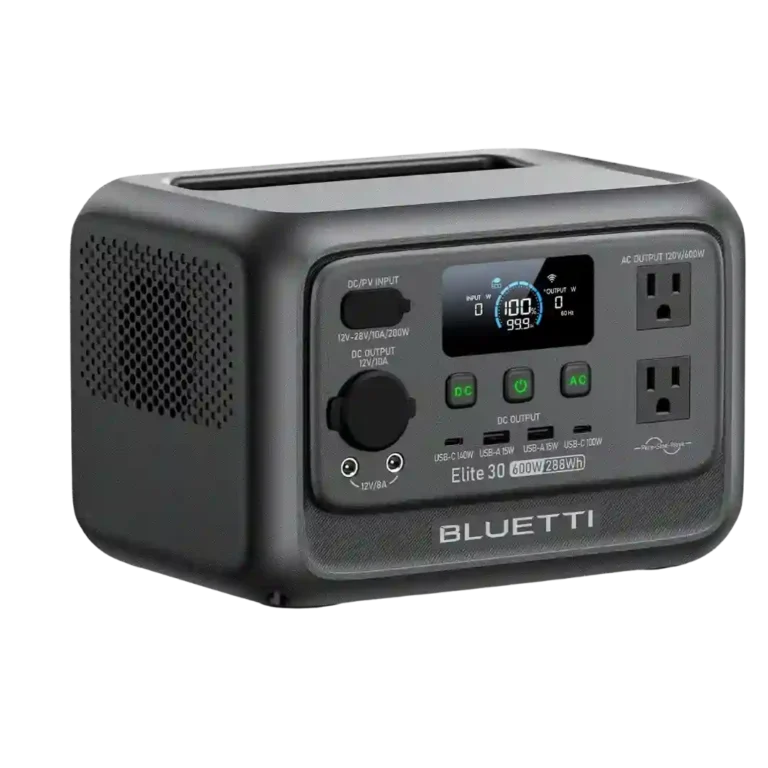
The port mix is unusually generous for the size, with AC, high-power USB-C, USB-A, a car socket, and barrel outputs. It can cover most small-device setups without adapters.
Long battery life is one of the most consistent ownership positives. Several buyers expect many years of service and specifically prefer it over UPS batteries that need replacement every two years.
AC charging speed: 4.7, 31 reviews, moderate consensus
Wall charging is usually a major strength, with Turbo mode reaching roughly 80% in about 40–50 minutes and a full charge near an hour in several tests. Standard mode is slower, and a few owners found charging less impressive.
The station handles several devices at once, including laptops, networking gear, lights, phones, and chargers. The generous port mix makes it useful for families and small work setups.
home backup capability: 4.6, 23 reviews, strong consensus
It is excellent for localized backup—routers, modems, CPAP machines, computers, lights, and phones. It is not a refrigerator-first or whole-home solution.
solar charging speed: 4.7, 15 reviews, strong consensus
With a compatible panel and decent sun, the small battery can recharge in roughly two to four hours. Performance remains respectable in imperfect weather.
Runtime is excellent on light DC loads: routers, fans, CPAP machines, laptops, and small fridges often last many hours or overnight. Heavy AC loads drain the 288Wh battery quickly.
energy efficiency: 4.8, 6 reviews, strong consensus
Measured usable energy is generally strong for the class, especially over DC. The efficiency advantage is partly offset by higher-than-expected idle consumption when outputs remain on.
The DC section is one of the strongest parts of the design, powering fridges, lights, fans, and Starlink efficiently. Users particularly like the car socket and extra barrel connectors.
Owners describe the unit as durable and dependable for travel, camping, and regular backup use. The hard-plastic body feels capable of handling ordinary bumps.
A 3,000-plus-cycle rating gives the pack an expected life measured in years rather than frequent replacement intervals. Owners replacing lead-acid UPS batteries see this as a major advantage.
Outage transfer is effectively instantaneous in real use. Routers, servers, PCs, and other connected devices generally stay online without a visible interruption.
value for money: 4.5, 64 reviews, moderate consensus
At common sale prices around the low-$200 range, the station is widely considered excellent value. Its combination of USB-C power, UPS behavior, portability, and fast charging is difficult to match, though poor support or app problems can sour the purchase.
The 600W inverter is unusually capable for a 288Wh station and comfortably runs computers, Starlink, fans, lights, and many small appliances. Heavy kitchen equipment and large motors remain outside its practical range.
The integrated handle gives a secure grip and makes one-handed carrying natural. It is especially helpful when moving the station between a vehicle, tent, or room.
The screen is bright, sharp, and polished enough to match the rest of the unit. It presents the station as a well-finished product rather than a basic battery box.
The battery chemistry is praised as safer and longer-lived than older lithium and lead-acid alternatives. It is a key reason buyers choose the unit for continuous UPS duty.
Most owners report repeated trouble-free use, including months of continuous UPS duty. A small number of defective or draining units keep the reliability picture from being flawless.
The 1,500W Power Lifting claim is useful but easy to misunderstand. It helps simple resistive appliances by lowering voltage; it does not turn the station into a true 1,500W inverter.
Most users can charge it and begin using it immediately, with little or no setup. Documentation and app access are the main exceptions when something goes wrong.
Input, output, charge level, and runtime are easy to read at a glance, including in reasonably bright conditions. Glare can appear at certain angles, but overall visibility is strong.
It handles mixed device loads confidently and can even sustain demanding resistive appliances within its limits. Multi-device tests generally finish without protection trips.
Solar tracking performs well, drawing close to a panel’s available output and continuing to charge effectively in scattered cloud. That makes modest 100W panels practical for topping up the small battery.
The 600W continuous rating is a meaningful upgrade over many similarly sized stations. It gives the unit enough headroom for real work rather than phone charging alone.
solar generator functionality: 5.0, 2 reviews, limited evidence
The station works well as a compact solar generator, keeping phones, laptops, tools, and camping gear running from renewable input. Its small battery favors daily topping-up rather than long periods without sun.
Owners can switch AC and DC outputs, change modes, and adjust settings from a phone. That is especially convenient when the station is installed under a desk or in a vehicle.
size and footprint: 4.7, 3 reviews, strong consensus
The body is small enough for desks, tents, vehicles, and storage shelves while still housing a 600W inverter. It occupies far less space than larger backup stations.
Pass-through and bypass operation are highly useful for UPS and vehicle charging setups. The important exception is that firmware updates can cut all output, including AC passthrough.
Memory Mode can restore outputs automatically after power returns, and low-load shutdown reduces wasted energy. Some recovery settings are buried behind Pro mode, making setup less intuitive than it should be.
The percentage gauge is generally trusted and tracks discharge reliably. It remains more dependable than the occasional output-wattage reading glitches.
The unusually broad color selection gives this utilitarian product more personality. Buyers appreciate being able to choose something other than standard black or gray.
The 12V outputs are especially useful for camping fridges, heated blankets, fans, and other DC gear. Extra barrel ports make it possible to run more than one 12V device.
The optional Charger 1 alternator charger meaningfully expands the system, replenishing the station far faster than a cigarette-lighter connection. It is a strong add-on for road trips and vehicle-based use.
Useful settings can be changed directly with the physical controls, reducing dependence on the phone app. The front-facing layout is straightforward once the AC and DC buttons are understood.
The small battery refills quickly, often in about an hour on the fastest setting. That rapid turnaround makes the limited capacity easier to live with.
car charging speed: 4.3, 7 reviews, moderate consensus
The included 12V cable is convenient and works well on the road, but a full recharge can take several hours. The optional alternator charger is dramatically faster.
Thermal management is well controlled, with intelligent cooling and a premium overall feel. Warm exhaust appears under stress, but the unit continues operating normally.
The 230V version has only one AC socket, while the US model has two. The single-outlet layout is considered workable with an extension lead, but it is less flexible than larger stations.
Independent tests commonly recover about 88–95% of the rated capacity, which is strong for the class. A few users and one test measured noticeably less, so results are not perfectly consistent.
Eco mode reduces idle drain by shutting down very small or inactive loads. That can also disconnect routers or trickle-charging devices, so low-load UPS users may need to disable it.
voltage regulation: 3.8, 2 reviews, limited evidence
Normal output holds stable voltage, but Power Lifting deliberately lowers voltage to keep resistive appliances running. That behavior is useful for heaters and kettles but inappropriate for sensitive electronics.
input and output monitoring: 3.5, 2 reviews, limited evidence
Real-time wattage data is genuinely useful for sizing loads and estimating runtime. One tested unit intermittently showed zero output despite continuing to power devices.
runtime at full load: 3.5, 2 reviews, limited evidence
Near the inverter’s limit, runtime is necessarily short. A hair dryer ran for about 20 minutes, while cooking loads depleted the battery faster than expected.
solar panel compatibility: 3.5, 3 reviews, low consensus
It works with Bluetti and third-party panels that stay within the supported voltage and current range. Existing high-voltage panels may be incompatible even when their wattage seems suitable.
The advertised five-year term is generous for an entry-level station. Confidence is weakened by intrusive registration and a serious complaint that coverage was refused for an open-box Amazon purchase.
Power Lifting can run simple resistive loads such as kettles, hair dryers, blankets, and small cookers by reducing voltage. Results are impressive for the size, but appliances may run slowly, high-inrush motors can fail, and sensitive electronics should not use this mode.
Support experiences vary sharply. Some owners receive quick, helpful answers, while others report difficulty reaching a person or resolving warranty claims.
The lack of an integrated light is a repeated complaint. For a product aimed at camping and emergency backup, a small area light would make it more complete.
Firmware is a weak point: updates may fail to appear, require Bluetooth, or interrupt all output during installation. Some owners also needed an update to address abnormal battery drain.
standby power loss: 2.5, 11 reviews, low consensus
Idle drain is the most repeated weakness. Leaving AC or DC outputs active can consume a surprising share of the small battery, while Eco mode may shut off loads that are too small.
Wireless setup is inconsistent: some users pair quickly and stay connected, while others struggle for hours or never connect. The connection problems are most frustrating when an update or advanced setting requires the app.
The battery will not accept a charge below freezing. That limitation can undermine outdoor emergency setups in winter, especially sheds or vehicles left in the cold.
water resistance: 2.0, 3 reviews, strong consensus
The station is not waterproof and lacks a meaningful outdoor IP rating. It should be kept inside a tent, vehicle, or protective case when rain is possible.
The 288Wh battery is well matched to phones, laptops, routers, CPAP machines, lights, and overnight camping loads. It feels small for heaters, kettles, household refrigerators, or multi-day off-grid use.
included accessories: 3.1, 6 reviews, moderate consensus
The AC cord and car-charging cable cover common charging needs, and some packages are generous. The recurring omission is a solar adapter cable, which prevents true plug-and-play PV use.
Charge retention depends heavily on power state. Fully shut down, the station can sit for months; left on with wireless or outputs active, it may lose several percent or even drain overnight.
Reliability is mixed at the margins: many units perform flawlessly, but a few owners report defects, unexpected drain, or capacity concerns. Good units are described as dependable for storms and daily UPS use.
The 200W, 30V solar ceiling is adequate for a battery this size but can reject larger existing panels. Buyers need to check voltage as well as wattage.
The printed instructions can make setup straightforward, but online documentation is thin. Owners who hit an unusual app or firmware issue may struggle to find clear guidance.
Compared With Category Average
Compared with other Generators, this product is above average in 12-volt outlet, full-load noise, weight, near average in USB-C power delivery, compactness, below average in maximum solar input, app connectivity, battery capacity.
Summary
72 compared features
Above average0.4+ pts higher
35(49%)
Same as averagewithin 0.3 pts
28(39%)
Below average0.4+ pts lower
9(13%)
Largest category differences
Attribute
This product
Category average
Difference
12-volt outlet
5.0
2.7
+2.3
maximum solar input
2.0
4.3
-2.3
full-load noise
5.0
3.2
+1.8
weight
4.8
3.5
+1.3
app connectivity
2.3
3.8
-1.5
battery capacity
3.3
4.5
-1.2
AC charging speed
4.7
3.7
+1.0
USB-A ports
2.5
3.8
-1.3
Consider This Instead
If you want better app connectivity
Choose Bluetti Elite 300. It scores 4.8 vs 2.3 for app connectivity, with a 4.3 overall score.
Worse: fan noiseThe Elite 30 V2 is quieter than the 100 V2.
FAQ
Does it work well as a UPS?
Yes. Routers, servers, PCs, networking gear, and CPAP machines generally remain running through an outage with no perceptible interruption. It does not replace a separate surge protector.
What can the 600W inverter realistically power?
It comfortably handles computers, Starlink, televisions, fans, lights, chargers, and many small appliances. Power Lifting can run simple resistive loads above 600W at reduced voltage, but it is unsuitable for sensitive electronics and some high-inrush motors.
How long does the battery last?
Runtime depends heavily on the load. Owners report overnight CPAP or fan use, many hours of router backup, and roughly a day or more for some efficient 12V refrigerators, while kettles and heaters drain it quickly.
How fast does it recharge?
Turbo AC charging commonly reaches about 80% in 40–50 minutes and can fill the battery in roughly an hour. Standard charging is closer to two hours, while compatible solar panels typically need about two to four hours in good sun.
Is the app required?
No for basic AC, DC, and USB use. The app is needed or strongly preferred for advanced UPS modes, schedules, Power Lifting, charge limits, remote monitoring, and firmware updates.
Can it be left outdoors or charged in winter?
It is not waterproof and should stay sheltered from rain. Charging is blocked below 32°F, so cold-weather emergency users need to keep the station above freezing.
Sample Expert Reviews We Analyzed
These are a few of the reviews included in our analysis.

Choose the Explorer 240D for exceptionally portable, fast USB-C power for laptops, phones, cameras, and short trips. Skip it if you need an AC outlet, overnight appliance runtime, airline carry-on...
Best for compact 3kWh backup, RV hookups, fast charging, and strong appliance runtime. Skip it if you need easy one-person carrying, expansion batteries, broad whole-home backup, or simple high-voltage solar...
Best for quiet 3,000W power, rapid wall charging, dependable UPS backup, and DJI drone integration. Skip it if you need easy one-person carrying, built-in 12V or solar connections, or freedom...