Choose it for compact 3kWh backup, RV hookups, fast charging, and strong appliance runtime. Skip it if you need easy one-person carrying, expansion batteries, broad whole-home backup, or simple high-voltage solar arrays.
Best for
Best for RV and van users, short-to-medium home outages, mobile creators, and workshops that need compact 3kWh power for selected appliances and tools.
Not for
Not ideal for frequent one-person carrying, scalable whole-home backup, common high-voltage solar arrays, or industrial loads that must run continuously near maximum output.
Verdict
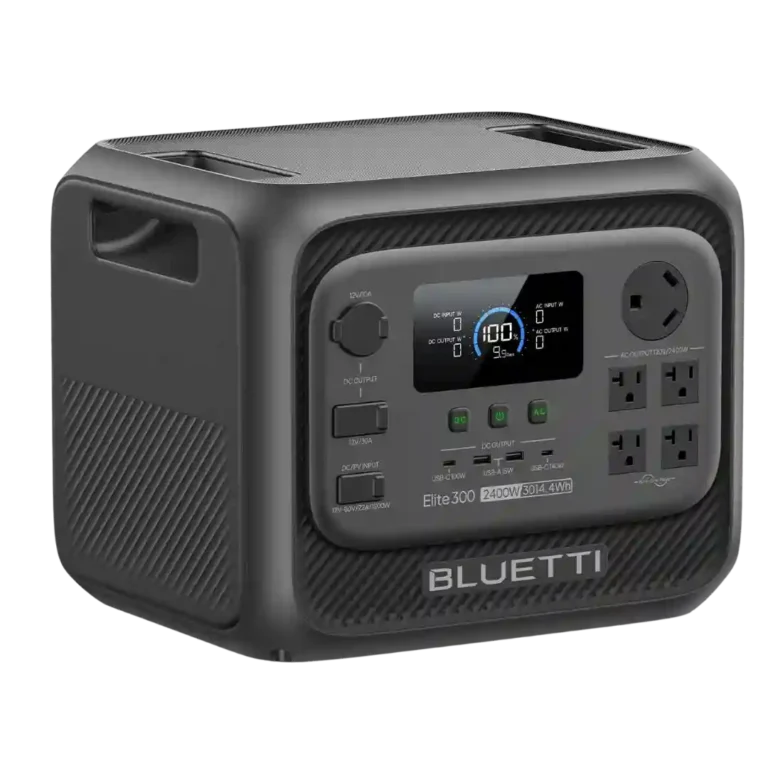
The Bluetti Elite 300 delivers an unusually strong capacity-to-size balance, pairing a 3,014Wh battery with fast AC charging, efficient output, a TT-30 RV connection, useful 12V/30A power, and dependable UPS behavior. Across home, RV, studio, and workshop testing, it handled refrigerators, cooking appliances, computers, lighting, and many tools with little drama. The tradeoffs are substantial rather than hidden: it weighs nearly 60 pounds, cannot accept expansion batteries, lacks a built-in light, and its 60V solar-input ceiling complicates large panel arrays. Most testing near the rated output was strong, but one long-duration maximum-load review reported AC and USB-C shutdowns. It is best understood as compact, high-capacity infrastructure for selected loads—not lightweight camping gear or a scalable whole-home system.
UPS performance is a standout strength: transitions were consistently fast and reliable across computers, routers, NAS devices, printers, and home-office equipment.
The built-in TT-30 is one of the most consistently praised additions. Its placement makes direct RV connection easy without blocking nearby AC outlets on the U.S. model.
For a 3kWh station, the Elite 300 is exceptionally compact and often compared in size with 2kWh models. A few testers still found it chunky rather than truly small.
The all-in-one design avoids complex inverter and battery wiring. Most setups were described as plug-and-play, with app pairing and solar connections taking only minutes.
Operation is straightforward: connect a device, select AC or DC output, and monitor the load. The simple layout and app reduce the learning curve for first-time users.
energy efficiency: 4.7, 11 reviews, strong consensus
Measured AC efficiency was consistently strong, often around 86-94%, with several testers placing it above average or among the best large stations they had measured.
Transfer to battery power is exceptionally quick, with measured or reported switching around 9-20ms. Routers, computers, printers, and networking gear generally stayed online without rebooting.
home backup capability: 4.6, 18 reviews, strong consensus
It is highly effective for selected essentials such as refrigerators, routers, lights, computers, and kitchen appliances during short or medium outages.
Kettles, toasters, microwaves, air fryers, heaters, tools, and even some welders ran successfully within the 2,400W limit. Industrial motors and simultaneous heavy loads can still trip it.
The reinforced housing, protected edges, sturdy handles, and solid feel inspire confidence for repeated transport between vans, campsites, workshops, and garages.
The high-current 12V output is repeatedly praised for RV fridges, pumps, diesel heaters, compressors, and other gear that can overwhelm a standard 10A socket.
AC charging speed: 4.5, 16 reviews, strong consensus
Wall charging is fast for a 3kWh battery, usually finishing in roughly 1.5 to 2.75 hours depending on mode and test conditions. One test found it slower than expected, but still respectable for the capacity.
The app is generally considered feature-rich, clear, and easy to use for monitoring, scheduling, UPS settings, and output control. One comparison found it slower and laggier than EcoFlow's app.
Long cycle life makes the pack feel suitable for daily use rather than occasional emergencies, with estimates extending beyond 16 years at one cycle per day.
The recessed, sturdy handles give a secure grip and make short moves manageable, even though the unit remains too heavy for casual one-handed carrying.
Most real-world loads ran smoothly, including appliances, computers, RV systems, and workshop tools. A minority of extreme sustained tests exposed shutdowns or limits near maximum output.
The 12V connections are genuinely useful for fridges, pumps, inflators, and vehicle accessories, especially when paired with the higher-current output.
Stress testing earned exceptional praise for thermal control, suggesting the compact enclosure can manage sustained high power when ventilation is clear.
Two months of testing, including near-30°C conditions, showed consistent output; extra battery drain came from connected cooling equipment working harder.
solar charging speed: 4.4, 10 reviews, strong consensus
With sufficient panels and good sun, solar charging is practical and can restore the battery in roughly three to four hours. Smaller arrays still meaningfully extend outdoor runtime.
The 2,400W inverter is strong enough for most household, RV, office, and workshop loads, though it trails some 3kWh rivals and cannot replace unlimited shore or whole-home power.
ECO mode can shut outputs down after a load finishes, reducing unnecessary drain. It should be disabled for very low-power medical devices that could be mistaken for no load.
The screen presents useful power-flow, charge, and runtime information without much learning curve. Minor complaints include visual clutter when readings sit at zero.
Multiple computers, chargers, lights, and appliances can run together, but the shared 2,400W ceiling means users must manage combinations of high-draw equipment.
Normal operation is usually quiet enough for apartments, RVs, tents, and recording work. Under heavy load or fast charging, some units became noticeably louder than competing stations.
Standby results varied sharply by mode and test, from excellent charge retention to roughly three days with the inverter left on. Output settings matter greatly when idle.
Cooling is mostly effective, including successful heat-soak testing, but one maximum-output test made the fan work harder and more erratically than expected.
Many considered the sale price compelling for 3kWh, fast charging, and RV connectivity. Others found cheaper rivals with larger batteries or expansion, making full-price value more debatable.
The small footprint travels well in vans and vehicles, but nearly 60 pounds makes it transportable rather than truly portable. It is best moved occasionally and then left in place.
solar panel compatibility: 3.6, 8 reviews, low consensus
Standard connectors and straightforward setup are positives, but the low voltage ceiling complicates series wiring and can force parallel arrays into the current limit.
At roughly 58-60 pounds, the Elite 300 is heavy despite its compact dimensions. The weight is acceptable for the capacity but remains the most consistent portability complaint.
The Elite 300 is best for selected circuits and appliances, not days of whole-home power. Buyers needing scalable household backup should look at a modular system.
Outlet count depends on region, and the two-socket European configuration drew repeated criticism. The four- or five-outlet versions are more flexible, but total inverter output still limits combined loads.
maximum solar input: 3.1, 7 reviews, low consensus
The 1,200W headline input is generous, but the 60V/22A window can make that ceiling difficult to reach with common panels. Several testers wanted a higher voltage limit.
Charging from a basic vehicle socket is painfully slow, often taking more than a day. Dedicated alternator hardware improves that dramatically to roughly three to six hours.
runtime at full load: 3.0, 3 reviews, low consensus
Results at the limit were mixed: some tests sustained near-rated output, while another shut down near empty and reviewers discouraged all-day maximum loading.
The high-current DC connections are useful, but results were not flawless. One sustained USB-C/DC test ended in an over-current shutdown, while other testers reported strong 12V performance.
Power Lifting can help with resistive appliances, but it does not turn the station into a true 4,800W continuous source. One test still capped around the normal 2,400W output.
The integrated MPPT controller measured about 81% efficiency in one test. That was better than some competitors but still left noticeable solar energy lost as heat.
Compared With Category Average
Compared with other Generators, this product is above average in Bluetooth connectivity, solar cable compatibility, 12-volt outlet, near average in compactness, ease of setup, below average in output stability, weight, materials quality.
Summary
72 compared features
Above average0.4+ pts higher
25(35%)
Same as averagewithin 0.3 pts
24(33%)
Below average0.4+ pts lower
23(32%)
Largest category differences
Attribute
This product
Category average
Difference
Bluetooth connectivity
5.0
2.0
+3.0
output stability
2.0
4.9
-2.9
solar cable compatibility
5.0
2.4
+2.6
12-volt outlet
5.0
2.7
+2.3
weight
2.6
4.2
-1.7
materials quality
2.5
4.3
-1.8
high-demand appliance support
4.6
3.1
+1.5
app connectivity
4.8
3.0
+1.7
Consider This Instead
If you want better weight
Choose Bluetti Elite 30 V2. It scores 4.8 vs 2.6 for weight, with a 4.4 overall score.
Products reviewers directly compared with this model, grouped into quick takeaways.
Elite 200 v2
Older model: RV connectivityThe added 30-amp port gives the Elite 300 a major RV-use advantage.
Older model: overall design and performanceThe Elite 300 is characterized as a dependable, well-rounded upgrade.
AC200P
Worse: compactness and maneuverabilityThe Elite 300 is substantially easier to maneuver because it is more compact.
Anker SOLIX C2000 Gen 2
Cheaper: price versus battery capacityThe Elite 300 costs only modestly more while offering substantially more storage.
FAQ
Can it run a refrigerator during an outage?
Yes. Tests ranged from more than 21 hours to several days, depending on refrigerator size, cycling, other connected loads, and whether solar was available.
Is it a good fit for an RV?
Yes. The U.S. version's TT-30 outlet and 12V/30A output are major strengths, but all AC loads still share the 2,400W inverter limit.
How quickly does it recharge?
AC charging generally took about 1.5 to 2.75 hours in testing. Strong solar arrays can refill it in roughly three to four hours under favorable conditions.
Is it genuinely portable?
It is compact for 3kWh, but at roughly 58-60 pounds it is better described as transportable. The handles help, though stairs and frequent moves can be tiring.
Can the battery capacity be expanded?
No. The 3,014Wh internal battery is fixed, so buyers who expect future expansion should consider a modular power station instead.
Does the UPS function protect computers and networking gear?
Yes. Reported and measured transfers were around 9-20ms, and computers, routers, printers, and NAS equipment generally stayed online without interruption.
Sample Expert Reviews We Analyzed
These are a few of the reviews included in our analysis.
Best for quiet, portable UPS backup, fast laptop charging, camping, and short outages. Skip it for whole-home power, heavy appliances, freezing-weather charging, or anyone unwilling to manage standby drain and...
Choose the Explorer 240D for exceptionally portable, fast USB-C power for laptops, phones, cameras, and short trips. Skip it if you need an AC outlet, overnight appliance runtime, airline carry-on...
Best for quiet 3,000W power, rapid wall charging, dependable UPS backup, and DJI drone integration. Skip it if you need easy one-person carrying, built-in 12V or solar connections, or freedom...